A Regional Ripple Effect: Mental Health in Regional Australia – Sophie Lewis
Listen to Sophie Lewis interview with Dr Alison Kennedy. Click on the link below:
https://soundcloud.com/user-235939473/a-regional-ripple-effect-mental-health-in-regional-australia
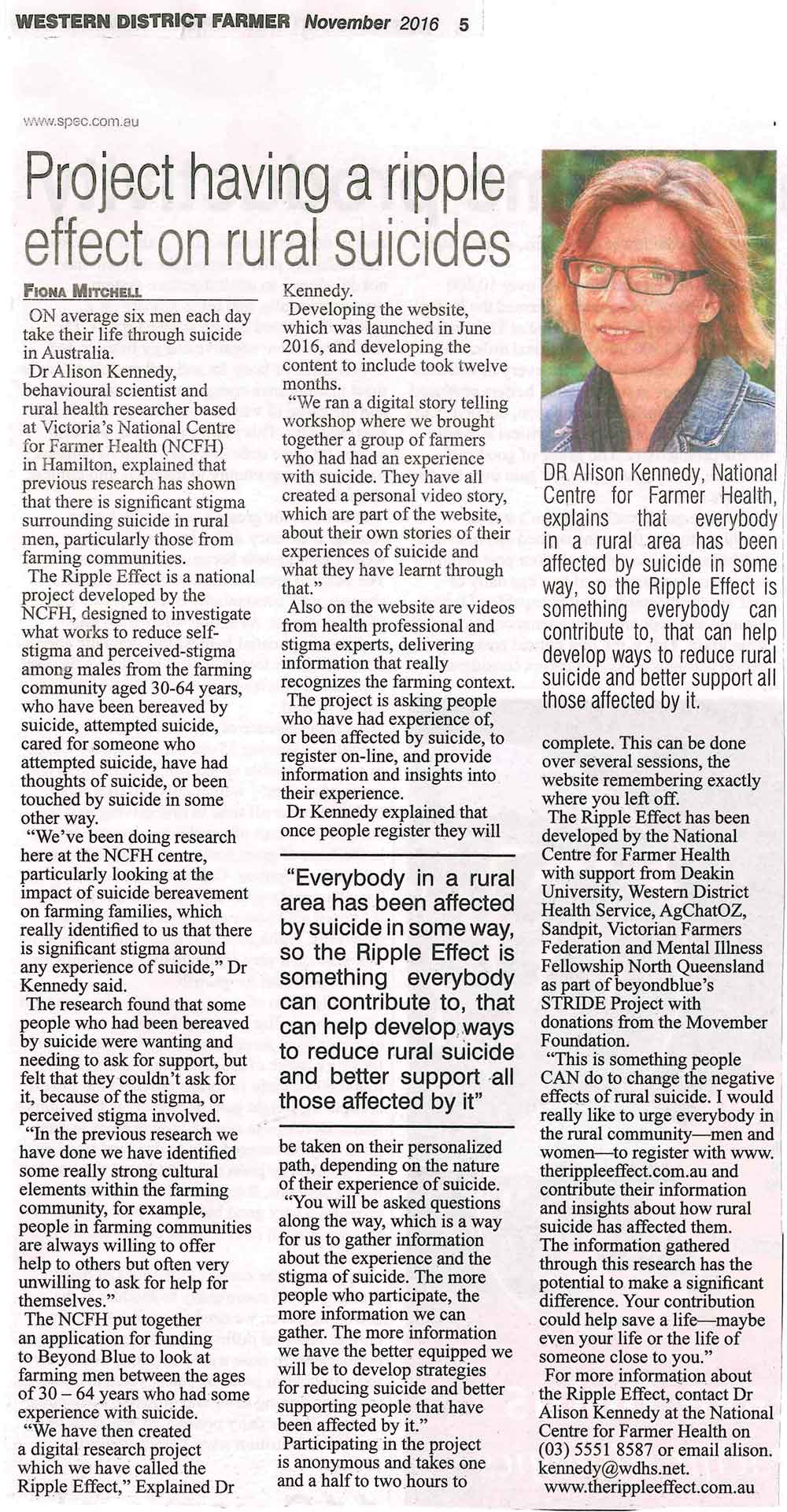
2016-11-1: Project having a ripple effect on rural suicides – Western District Farmer
2016-10-10: Rural medicine scholarships up for grabs – Farming Ahead
AUSTRALIA’S only post-graduate agricultural health and medicine course for professionals servicing farming communities is now open for scholarship opportunities, with applications closing October 31.
Entering its eighth year the scholarship program aims to create the next generation of agricultural and health leaders who understand cross-sector collaboration and can make a difference in rural communities. This year one scholarship is also earmarked for a person currently engaged in agriculture and/or a member of a farming family.
Hosted in Hamilton western Victoria from 27 February 2017, Deakin University’s intensive five day Agricultural Health and Medicine unit HMF701 is offered through the National Centre for Farmer Health (NCFH).
The course covers a broad range of agricultural health, safety and wellbeing issues ranging from mental illness and addiction through to emergency medicine, agrichemicals and agricultural trauma. The HMF701 unit has also been accredited for professional development points in areas of medicine, veterinary science, social work and nursing.
View full article: 2016-10-10: Rural medicine scholarships up for grabs – Farming Ahead
2016-10-11: Making a difference to farmers’ lives – The Star
2016-9-15: Tasmania Country Hour
Click here to listen to Tasmania Country Hour featuring Susan Brumby from National Centre for Farmer Health sharing results from Agfest Field Days in Tasmania.
Farmer Health eNews October 2016
Find out all the latest from the National Centre for Farmer Health
- 2017 HMF701 Agricultural Health & Medicine – Applications & Scholarships are OPEN!
- Run 4 Farmer Health – Sunday 16th October – We made it to 100! Lets make 110!
Sign up to receive eNews straight to your inbox! Click here
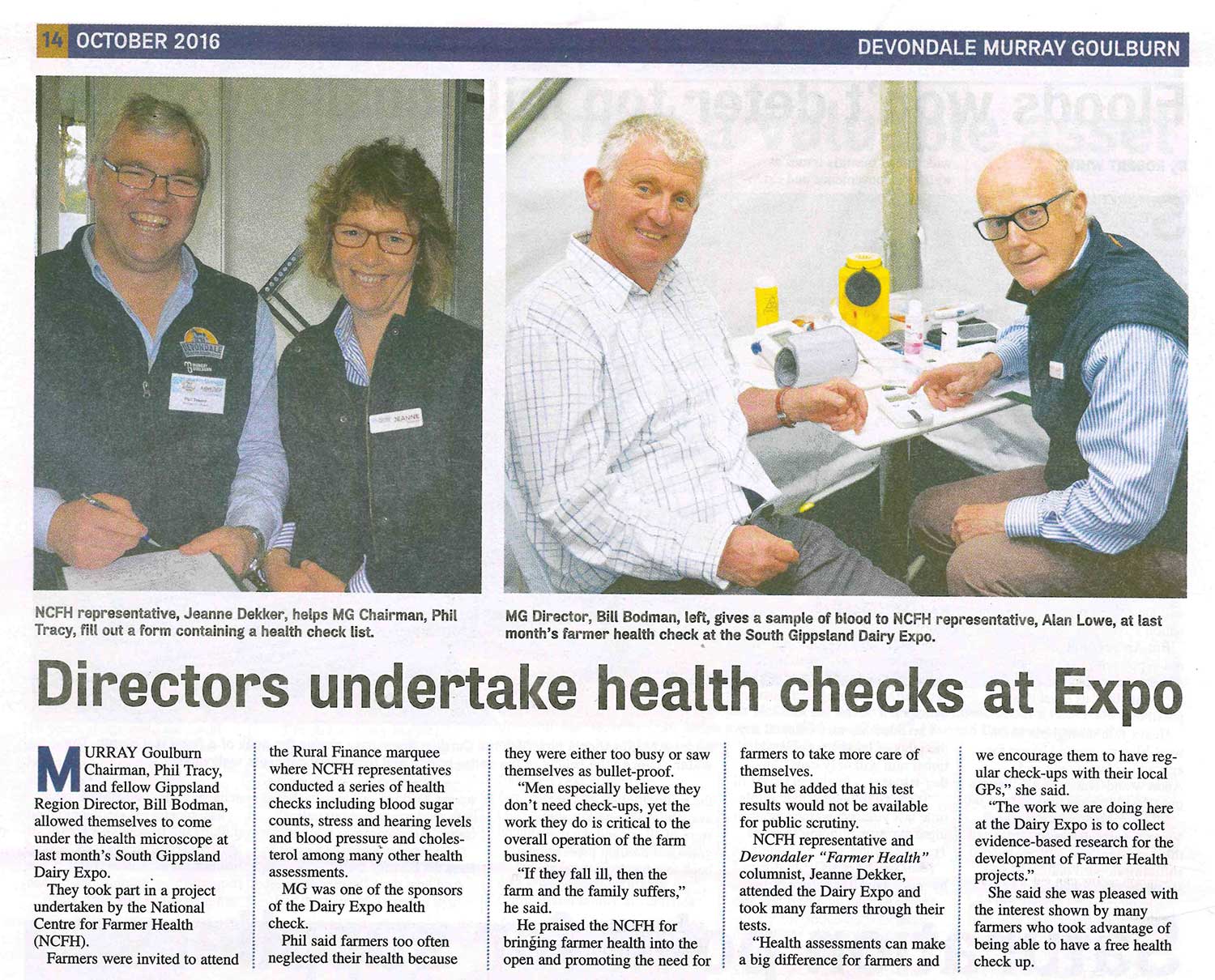
2016-10-1: Directors undertake health checks at Expo – Devondale Murray Goulburn
2016-09-22: Rural health on agenda during Henty Machinery Field Days – The Border Mail
Health has been a common topic around the Henty Machinery Field Days this year – right up there with the weather, prices and a super spring.
Iconic Australian sporting figure David Foster was happy to talk about health, especially men’s health, from his post at an oil company stand.
Foster said Australian men, especially those over 40, needed to get regular health checks – an annual grease and oil change and tune-up for the body.
“When I do my wood chop I ask people over 40 years of age if they go for a regular checkup,” Foster said.
“My dad died at 61, he never went to the doctor. It is important for us guys to look after ourselves and we should talk about it.”
Mental Health communicator Mathew Johnstone was a speaker at The Stump at the Field Days on Wednesday, and was also the guest speaker at the official lunch.
Mr Johnstone said the stigma of mental health must be broken so it was as accepted as other illnesses, or a broken leg.
“It’s all about starting the conversation because a lot of people suffer unnecessarily and I think primarily in rural communities, who are not only isolated by the land but also by the culture,” he says.
“If you’re in trouble, never be afraid to stick your hand up and ask for help because the only shame is that you’re going to miss out on life.”
This is a positive sign for rural communities as NSW prepares for Mental Health Month in October.
Dairy Australia deputy chair Simone Jolliffe said after officially opening the Field Days on Tuesday many dairy farmers were under immense pressure and said it was clear neighbours were looking out for each other emotionally.
It is where programs such as “Look Over the Farm Gate” – supported by the Victorian Farmers Federation, Royal Flying Doctors Service Victoria, Country Fire Authority, Country Women’s Association, National Centre for Farmer Health and the Victorian Government – play such an important role.
Burrumbuttock Hay Runners organiser Brendan Farrell hears stories of emotional hardship on the land every day.
He helps by delivering food hampers and stockfeed but also taking a phone call at 11pm from someone who just needs to talk.
And starting that conversation about health can be the best medicine for our wellbeing in the long term.
Read more: 2016-09-22: Rural health on agenda during Henty Machinery Field Days – The Border Mail
2016-09-19 Gippsland Jersey milk hits local shelves – Supporting the Ripple Effect
Gippslanders have been urged to act as the unofficial sales team for new local farmer-owned and operated milk brand, Gippsland Jersey.
Gippsland Jersey was officially launched at the Warragul Farmers’ Market on Saturday, with customers queuing to buy a two litre bottle of the locally produced full cream milk.
More than 1700 litres were sold on the day.
The brainchild of fourth generation Jindivick dairy farmer Steve Ronalds and Warragul public relations specialist and daughter of a dairy farmer, Sallie Jones, Gippsland Jersey aims to provide an improved farm-gate price to farmers by bypassing major milk purchasers.
But according to Mr Ronalds, the brand now needs the support of the Gippsland community to succeed.
“The response so far has been overwhelming and we have been absolutely blown away by the support we have received. Now we need that support to translate into sales so we can bring other farmers on board to supply us and further support the Gippsland dairy industry,” Mr Ronalds said.
“We are a two-person team. We don’t have a sales department and we’re competing against the major milk brands and supermarket chains. What we need is for the Gippsland community to not only buy our milk, but to ask their local cafes, restaurants, general stores, and independent supermarkets to stock Gippsland Jersey as well.”
With the slogan, ‘Good for farmers, good for you’, Ms Jones said Gippsland Jersey answered the question many people had about which milk to buy in order to best support local farmers directly.
“The dairy crisis has hit Gippsland farmers hard and we want to do what we can to support them,” Ms Jones said.
“That is why we’ve teamed up with The Ripple Effect – a program to reduce stigma about suicide – by featuring it on the back of our labels.
“The Ripple Effect is funded by beyondblue and is about farmers helping farmers beat rural suicide.”
From Monday, Gippsland Jersey milk will be sold at IGA Neerim South, Bunyip IGA, IGA Plus Liquor Trafalgar, Foster IGA, Meeniyan IGA and Heyfield IGA.
Henry Street Foodworks in Traralgon will also stock Gippsland Jersey, and many other local businesses have also committed to using and selling the milk.
Anyone who would like to stock Gippsland Jersey should email orders@cheffields.com.au or phone 1300 854 299.

Farmer Health eNews September 2016
Find out all the latest from the National Centre for Farmer Health
-
Run 4 Farmer Health – Sunday 16th October – LETS MAKE 100 RUNNERS!
-
Supporting the health and wellbeing of Dairy Farmers
- In North East Victoria
- South Gippsland Dairy Expo – 28/29 September
- Elmore Field Days – 4/5/6 October with Rural Bank
- Visit our Support Page for useful links and our free “Managing Stress on the Farm” book
-
Wellness Wednesday Topics
View the September e-News
Initial destination hospital of paediatric prehospital patients in rural Victoria
The objective of this present study was to describe the initial destination hospital of paediatric patients transported by Ambulance Victoria paramedics within the South Western area of Victoria to determine the proportion of patients that bypassed their closest hospital.
Ageing, chronic disease and injury: a study in western Victoria (Australia)
An increasing burden of chronic disease and associated health service delivery is expected due to the ageing Australian population. Injuries also affect health and wellbeing and have a long-term impact on health service utilisation. There is a lack of comprehensive data on disease and injury in rural and regional areas of Australia. The
aim of the Ageing, Chronic Disease and Injury study is to compile data from various sources to better describe the patterns of chronic disease and injury across western Victoria.
Sajjad, M.A., Holloway, K.L., Kotowicz, M.A., Livingston, P.M., Khasraw, M., Hakkenes, S., Dunning, T.L., Brumby, S., Page, R.S., Pedler, D., Sutherland, A., Venkatesh, S., Brennan-Olsen, S.L., Williams, L.J. & Pasco, J.A.2016Ageing, chronic disease and injury: a study in western Victoria (Australia)Journal of Public Health Researcg5:678Go to page

