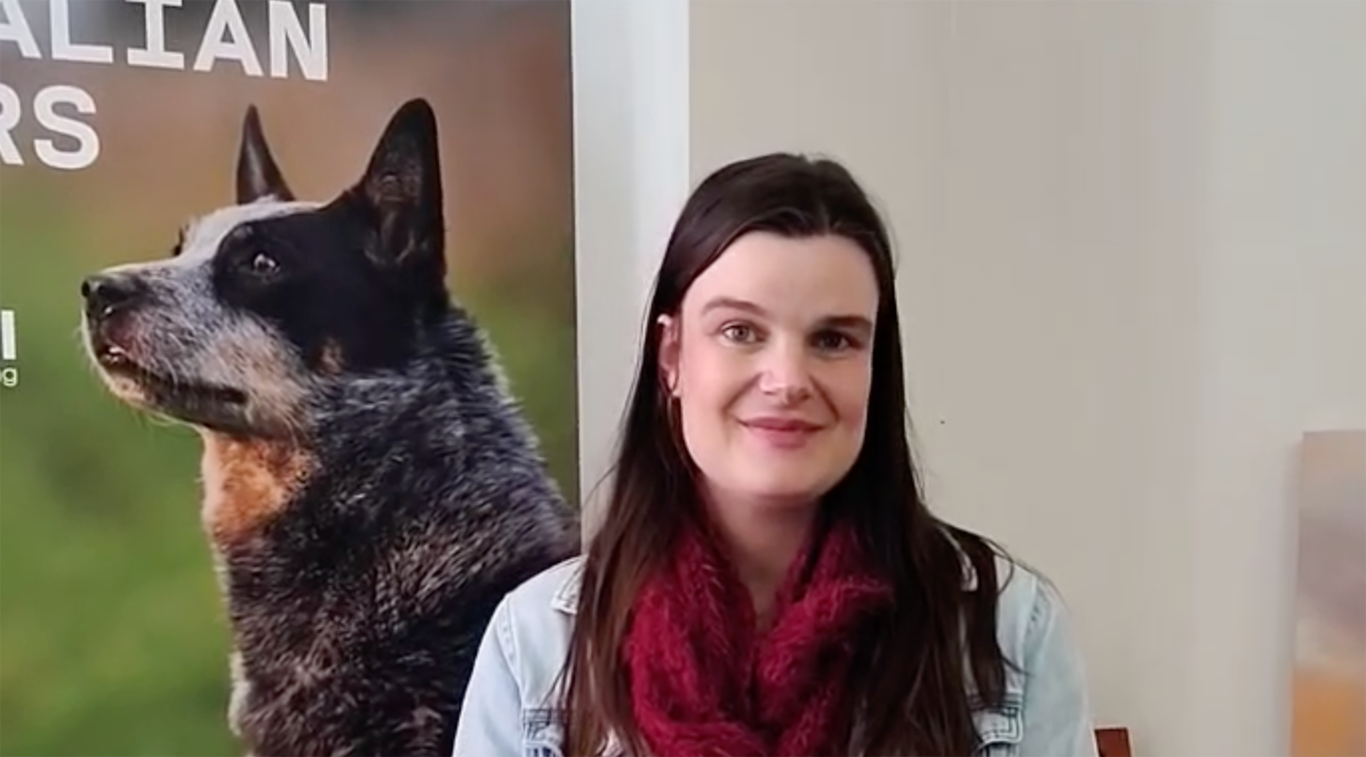
Back on Track team to host post-trial community consultations across Victorian farming regions 

The Back on Track team is inviting farming community members, local leaders, service providers, and stakeholders with an interest in rural mental health and wellbeing to attend a series of post-trial community consultations in the North East, Gippsland and South West of Victoria this March. 

Back on Track is an innovative peer-guided mental health initiative designed to support farming communities experiencing low mood and depression. The program was co-designed with farmers and delivered by trained local coaches who understand farm life and the challenges faced by agricultural communities.  

In 2024–25, a feasibility trial of Back on Track was conducted across three Victorian dairy regions to explore how a locally delivered peer-led support model could work in practice, including recruitment and training of coaches, participant engagement, and alignment with the behavioural activation model at the heart of the program.  

Now that the trial has concluded and findings are being analysed, the Back on Track team will be visiting each region to share project insights, gather community feedback and discuss next steps. Sessions are open to anyone interested in the mental health and wellbeing of farming communities, including farmers, community leaders, service providers, agricultural industry representatives, and mental health stakeholders. 

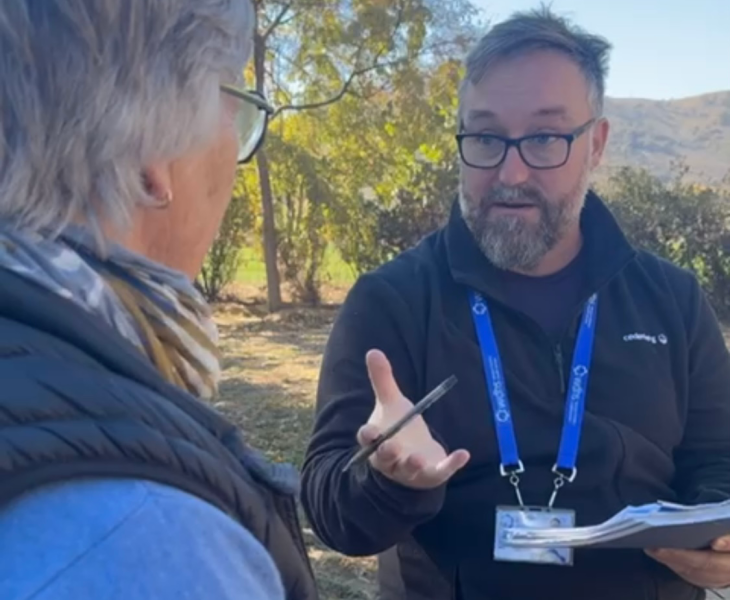
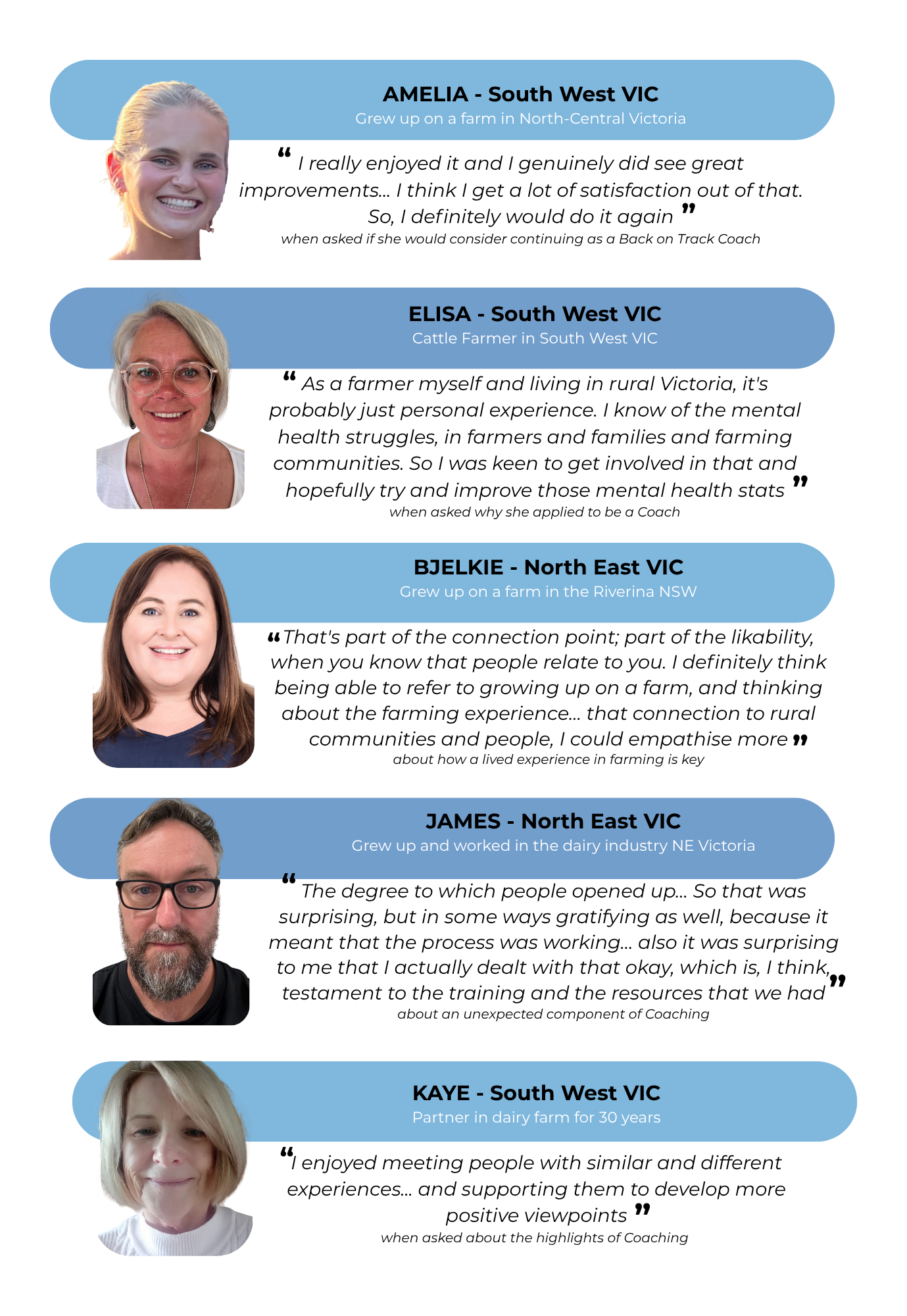
Selected Back on Track Coaches who delivered the program during the trial will attend several consultations to share reflections on their experience working with participants in their communities. 

Consultation schedule: 
North East (Tallangatta) 
• Tuesday 3 March | 11:00am–1:00pm | Tallangatta Integrated Community Centre 
• Tuesday 3 March | 6:00pm–8:00pm | Victoria Hotel, Tallangatta 

Gippsland (Maffra) 
• Wednesday 4 March | 6:00pm–8:00pm | Maffra Community Sports Club 
• Thursday 5 March | 10:00am–12:00pm | Maffra Hall 

South West (Camperdown) 
• Wednesday 11 March | 11:00am–1:00pm | Killara Centre, Camperdown 
• Wednesday 11 March | 6:00pm–8:00pm | Hampden Hotel, Camperdown 

Sessions are free to attend and catering provided. Attendees are encouraged to register in advance. 

RSVP by 28 February at the button below.

The Back on Track project was funded by the Gardiner Foundation and led by the National Centre for Farmer Health with research support from universities and health service partners.  

Media contact: 
Anna Greene 
Project Manager – Back on Track 
Phone: 03 5551 8533 
Email: BoT@wdhs.net 

Shifting Gears farm safety education program integrates hearing health for young people

The National Centre for Farmer Health and Deafness Forum Australia have launched a new hearing health module in the Shifting Gears farm safety education program for students, to celebrate World Hearing Day (3 March). The module provides young people in agricultural communities with essential knowledge about hearing health, noise exposure risks and preventative measures to reduce the impact of noise-induced hearing loss.

NCFH Senior Lecturer/Researcher Dr Jacquie Cotton said that globally, a large proportion of people under the age of 24 are exposed to high levels of noise, and hearing damage is not limited to older people.

“Young people aged between 15-24 are in a great position to learn about and adopt good hearing practices,” Dr Cotton said.

“Hearing loss isn’t something that only affects older people. Many young people living and working in agricultural communities are exposed to hazardous noise levels early in life through tractors and machinery, chainsaws, livestock, shearing sheds and working dogs.

“The new hearing health module in Shifting Gears aims to empower students to take charge of their hearing health, enabling them to prevent long term hearing damage, enjoy longer careers and reduce the risk of hearing loss in the future.” 

Shifting Gears is a teacher-led program designed to support farm safety education among students, particularly those living on farms, studying agriculture and horticulture, or considering careers in these fields. It addresses the need for age- and context-appropriate education materials, providing audiovisual resources, interactive activities, and teacher-led discussion guides to foster learning and engagement among students. 

The hearing health module is a partnership between the NCFH and Deafness Forum Australia, the national representative body for all Australians with hearing challenges, ear or balance disorders, and their families and supporters. 

Deafness Forum Australia CEO Rhonda Locke said the new content will help students understand that hearing health plays a crucial role in their overall wellbeing and physical, mental and social health and that small steps today can positively impact the rest of their lives. 

“The hearing health module in Shifting Gears makes it easier for students and educators to access evidence-based hearing health resources, and improves understanding of the risks around prolonged noise exposure on the farm. It promotes consistent use of hearing protection and safe hearing practices, and how these habits can be integrated into daily life,” Ms Locke said.  

The Shifting Gears program allows teachers to access free, easy-to-use resources that can be incorporated into their lesson plans and align with the health education curriculum. 

For more information on the program and to access the resources, visit farmerhealth.org.au/shifting-gears-2.

* END OF RELEASE*

Media contacts

National Centre for Farmer Health
Dr Jacquie Cotton – Senior Lecturer/Researcher
P: 03 5551 8533 | E: jacquie.cotton@wdhs.net

Deafness Forum Australia
Ruth Bailey – Manager, Hearing Health
E: ruth.bailey@deafnessforum.org.au

Farmer Health eNews March 2026

Find out the latest from the National Centre for Farmer Health

  • Tackling the Tough Topics: Refreshed and ready for 2026
  • New Shifting Gears hearing module
  • Industry updates for Victorian farmers:
    • RSVP to hear from Back on Track in March
    • Protect your health: Q fever vaccination clinic
    • “Safety: It does more than keep you safe” campaign
  • Help shape Pride in the Paddock
  • Upcoming events

View the March 2026 e-newsletter

Read past issues of eNews

Do you want to receive our eNews?

Community event grants extended to support Vic farmers doing it tough

Bushfire and drought affected farming regions across Victoria are set to benefit from a second round of funding from the Look Over the Farm Gate program, which supports communities to deliver events that focus on farmer mental health, wellbeing and resilience. 

The Look Over the Farm Gate program is delivered by the National Centre for Farmer Health with funding from Agriculture Victoria. It was launched in 2025 to help Victorian drought affected communities  and has so far delivered over 130 grassroots initiatives to more than 20,000 people in farming communities across the state. 

NCFH Director Dr Alison Kennedy said these events play a significant role in strengthening social connection and promoting wellbeing during tough and challenging circumstances on the farm, and the new round will play an important role in bushfire recovery as well.  

“So many of Victoria’s farming communities are facing difficult weeks and months ahead as they look to recover and rebuild. The second round of funding for Look Over the Farm Gate events will provide a welcome reprieve and the opportunity to bring community together and start important conversations around mental health,” Alison said.  

“We know that community leaders understand the dynamics and unique needs of their region better than anyone, and as a result, they can help their communities be proactive in protecting their wellbeing, building resilience, and seeking help if needed.” 

Community organisations and groups in Victoria can apply for grants up to $5000. Successful applicants receive an event resource pack from the NCFH with mental health resources tailored to farming communities, and a copy of the Tackling the Tough Topics guidelines to help deliver their event in a psychologically and emotionally safe way. 

“Many event organisers made the most of our Tackling the Tough Topics guide, which provides a step-by-step approach to plan successful mental health and wellbeing events in farming communities using templates, tips and success stories,” Alison said. 

Previous Look Over the Farm Gate events ranged from harvest dinners, performances and film screenings to twilight tennis, art workshops and information sessions such as understanding basic tractor skills. 

“Creativity is limitless in our farming communities,” Alison said. “We’ve found the key ingredients to a successful event are about creating a space for genuine connection, engaging guest speakers, organising free or low-cost activities and providing meaningful community collaboration and partnerships with local services.” 

Applications are open until 20 May 2026 or until funding has been fully allocated, with events to be completed before 30 June 2026. 

For more information on the Look Over the Farm Gate Community Grants program or to apply for funding, visit farmerhealth.org.au/look-over-the-farm-gate. Look Over the Farm Gate is funded by the Victorian Government’s 2025 Drought Support Package. 

* END OF RELEASE*

For more information, please contact:

Cecilia Fitzgerald – Project Manager, National Centre for Farmer Health 
P: 03 5551 8533 | E: cecilia.fitzgerald@wdhs.net

Article: Look Over the Farm Gate grants keeping farmers well

Thank you to the Southern Farmer publication for featuring an article on our Look Over the Farm Gate program and event success stories in the January 2026 edition.

Read the full article on pages 6-7.

Farmer Health eNews February 2026

Find out the latest from the National Centre for Farmer Health

  • Building on the success of Look Over the Farm Gate
  • Back on Track gets back to Vic communities
  • Help shape a farmer-fit suicide prevention app
  • Upcoming events

View the February 2026 e-newsletter

Read past issues of eNews

Do you want to receive our eNews?

Farmer Health eNews January 2026

Find out the latest from the National Centre for Farmer Health

  • Make a real difference in rural communities: Study ag health and medicine
  • Look Over the Farm Gate events set to continue
  • Take a break: Explore our website
  • Practical support is just a click away

View the January 2026 e-newsletter

Read past issues of eNews

Do you want to receive our eNews?

Farmer Health eNews December 2025

Find out the latest from the National Centre for Farmer Health

  • Using evidence to influence action on farmer health: Our stories
  • Calm the Farm workshops: Supporting mental health in agriculture
  • Keeping kids safe this summer: Lessons from around the world
  • Raising children in rural and regional Australia

View the December 2025 e-newsletter

Read past issues of eNews

Do you want to receive our eNews?

Transforming research into practical support for farmers: Hear from NCFH’s Dr Jacquie Cotton

Using evidence to influence action on farmer health

In this series, find out how our team at the National Centre for Farmer Health (NCFH) translates research in agriculture, health, behavioural and social sciences into practical and impactful programs and services that support farmer health, wellbeing and safety across Australia. 

At the NCFH, we use research to make a real difference to farmers’ lives. But how do we do this?

The answer is multi-faceted:

  • We use research to inform our programs and services to farmers, ensuring they remain relevant, practical and accessible
  • We reference strong data when influencing change which affects farming communities
  • We conduct our own studies on the risks and opportunities to strengthen the health, wellbeing and safety of farmers, agricultural workers and farming families 
  • We collaborate with local and international organisations to share knowledge and maximise the impact of our research.

Find out more about why an evidence-based approach is so important in this video with NCFH Senior Lecturer and Researcher Dr Jacquie Cotton, and what makes her proud of the work being delivered to Aussie farmers.

If you’ve come across our Managing Stress on the Farm booklet, you might be surprised to know that this popular resource came about from our research into mental health in farming communities.  

This is just one of many examples where our team has transformed solid evidence into something practical and valuable for Aussie farmers and regional communities.  

Hear more from NCFH Senior Lecturer and Researcher Dr Jacquie Cotton, including how our research has had a global impact and how you can get involved in the next exciting project. 

More information

Dr Jacquie Cotton
Lecturer
03 5551 8533

See the other articles in our series

Tackling the Tough Topics: Q&A with NCFH’s Sally Cunningham

A look back on Look Over the Farm Gate events

Jennifer Rowan reflects on her NCFH student placement

Back on Track: Q&A with NCFH’s Anna Greene

Meet some of our Back on Track coaches

The impact of our Health and Lifestyle Assessments

Meet some of our Back on Track coaches

Using evidence to influence action on farmer health

In this series, find out how our team at the National Centre for Farmer Health translates research in agriculture, health, behavioural and social sciences into practical and impactful programs and services that support farmer health, wellbeing and safety across Australia. 

The Back on Track mental health initiative is unique as it is a peer-guided program delivered by trusted community members – also known as coaches – who understand the unique challenges associated with farming and can provide practical and tailored support to farmers to improve their mental health.

Find out how two coaches became involved in the Back on Track feasibility trial in Victoria in 2025.

James Crooke

Growing up on a dairy farm in the Kiewa Valley in north-east Victoria, James initially planned to study landscape architecture before pivoting to his family’s ice cream business where he enjoyed a 20+ year career in the value-adding dairy production industry.

After closing the company in 2023, James was eager to continue living and contributing to his rural community. When he learnt about the Back on Track program, he thought it was a fantastic initiative, and he was keen to get involved. 

Why did you decide to get involved in the Back on Track program as a coach?

Growing up on a farm and having friends from farming backgrounds across different parts of the state, country, and world, I was aware of the challenges that farmers and their regional and rural communities face. For me personally, it was an opportunity to try something new and, in a small way, make a difference to the mental health struggles confronting our farmers and rural communities. 

From your perspective, how is the Back on Track program supporting participating farmers?

The Back on Track program provides a clear, practical, and straightforward initiative designed specifically for farmers and farming communities. The program values participants’ time and is centred around the needs and expectations of farmers, who may not have time to leave their farms to seek help for declining mental health or low mood.   

What is a personal highlight of delivering this program to farmers?  

A real highlight of my work with the Back on Track program was meeting the other coaches and collaborating during supervision, sharing the challenges and successes faced by them and their participants. It was fantastic to see that participants were gaining just as much from the program as we were. 

Kaye A’Vard

Kaye swapped her job in a large Melbourne hospital to become a partner in a dairy farming family, where she spent 30 years raising her four children.

Not yet ready to fully retire, Kaye completed a counselling course online to keep herself busy, which eventually led her to the Back on Track program.

Why did you decide to get involved in the Back on Track program as a coach?

My son informed me of the coaching position, as a perfect step into going into my own business in counselling. I will be specialising in grief and trauma, knowing over my life span, that life can throw many huge curve balls to cope with. 

From your perspective, how is the Back on Track program supporting participating farmers?

I found the Back on Track team great, but the resilience of the farmers in drought is one that I will remember as I go into my counselling. There was an opening of the mind that even when times are tough – as all farmers have experienced – there is always a time to stop and smell the roses, for that is what we are all here for. 

The first farmer I worked with did experience this in actually stopping to see and smell and feel his coffee that he missed knowing – and truly savouring every part that it brings to him – first thing in the morning.  

What is a personal highlight of delivering this program to farmers?  

Seeing a farmer, who under unbelievable stress, finally got the meaning of the coaching relating to their life. I saw the tremendous change on their face and the appreciation of the relationship to them that a coach can bring them.   

It reinforced the insight that I already knew about this specialised group of people – that the tenacity and strength that farmers hold to continue on in this field is one to be admired and treasured into the future. 

Our Back on Track coaches share their journey, insights and how they’ve supported Victorian farmers to get back on track with their mental health

More information

Anna Greene
Project manager
03 5551 8533

See the other articles in our series

Tackling the Tough Topics: Q&A with NCFH’s Sally Cunningham

A look back on Look Over the Farm Gate events

Jennifer Rowan reflects on her NCFH student placement

Back on Track: Q&A with NCFH’s Anna Greene

The impact of our Health and Lifestyle Assessments

Transforming research into practical support for farmers: Hear from NCFH’s Dr Jacquie Cotton

Back on Track: Q&A with NCFH’s Anna Greene

Using evidence to influence action on farmer health

In this series, find out how our team at the National Centre for Farmer Health (NCFH) translates research in agriculture, health, behavioural and social sciences into practical and impactful programs and services that support farmer health, wellbeing and safety across Australia. 

Back on Track is a peer-guided program where trusted community members provide practical and targeted support to farmers to support their mental health.

In 2025, a feasibility trial of the Back on Track program was conducted in three regions of Victoria to gain a clearer understanding of the benefits and areas of improvement in the delivery of the program, and potential options for expansion.

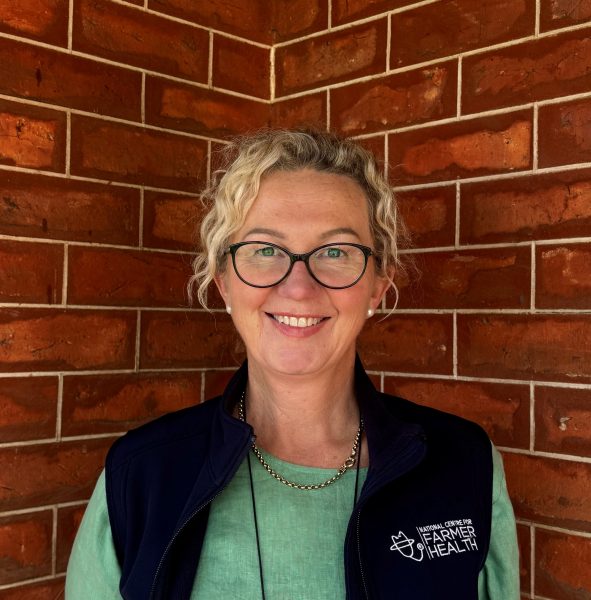
NCFH Project Officer Anna Greene (pictured right) manages the Back on Track program and is driven by a passion for improving the mental health and wellbeing of farmers and their families. Anna is a sheep farmer and accredited Mental Health First Aid instructor with over 25 years of experience in rural and agricultural health and wellbeing.

What led to the development of Back on Track?

Research shows farmers die by suicide at up to twice the rate of the general Australian population, yet do not have higher rates of diagnosed mental illness.

Farmers are geographically isolated while managing a myriad of stressors, many uncontrollable. They are less likely to seek professional mental health services, have less access and often report feeling misunderstood when they do reach out.

Integrating lived experience into mental health provision in farming communities has been identified as one way of addressing these challenges.

Following five years of co-design – drawing strongly on the lived experience of farming community members and service providers – the NCFH is leading the Back on Track feasibility research trial. Funded by the Gardiner Foundation, Back on Track is being trialled across three Victorian farming communities.

How is the Back on Track model underpinned by research and what impact does this have on the delivery of the program to farmers? 

Back on Track explores the effectiveness of a new mental health support model that includes training and mentoring trusted local farming community members as Back on Track coaches to lead delivery of a practical, farmer-focused approach to address low mood or depression. Coaches are trained in Behavioural Activation (BA); a proven safe and effective treatment for depression focused on improving mood by increasing behaviours that people enjoy and reducing avoidance behaviours.

Unlike other psychological therapies, evidence shows that non-clinicians without specialist health qualifications can learn to deliver BA with appropriate training. With shared understanding of farming life and work, the integration of trusted and trained local peers delivering the Back on Track program has the potential to overcome many well-established barriers to mental health help-seeking and support in farming communities.

This new model underpinned by a strong training, governance and support framework will be supported by an experienced team of researchers and clinicians from Deakin University, Western District Health Service, La Trobe University, the University of South Australia and Edith Cowan University. 

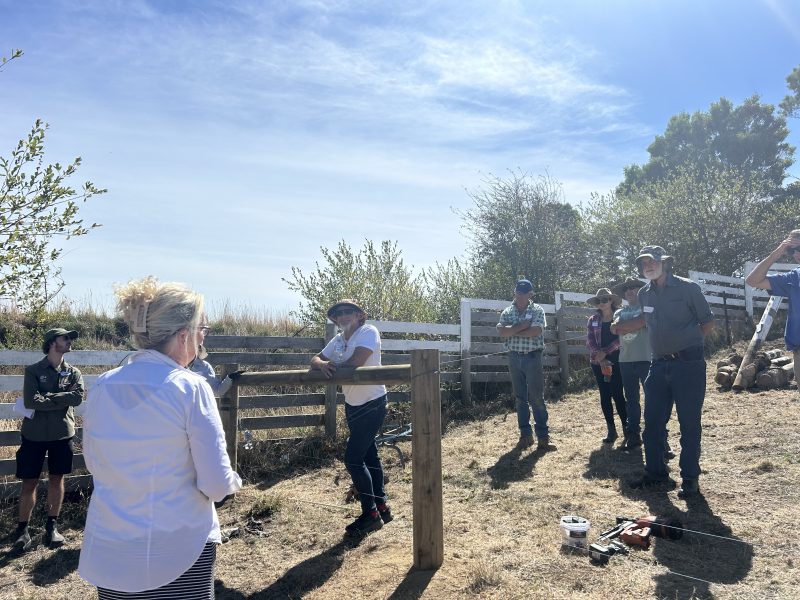
Anna talking to farmers at a fencing workshop in Gippsland, Victoria.

What feedback have you received from farmers who have participated in Back on Track?    

Feedback from farmers who participated in the NCFH  Back on Track program has been overwhelmingly positive.

Participants highlighted the program’s unique approach – delivered by coaches with both lived farming experience and mental health training – as particularly valuable. This combination made the sessions feel relevant, relatable and grounded in real-life understanding of farming challenges. 

Over the 10-week coaching period, many farmers reported:

  • Significant improvements in their mood
  • Reductions in symptoms of depression
  • Practical skills to support ongoing behavioural changes beyond the program.

Encouragingly, several participants continue to apply these learnings months after completing Back on Track, reflecting its lasting impact within farming communities. 

What do you enjoy about delivering this program to farmers?

Coordinating the Back on Track program and working alongside the coaches was an incredibly rewarding experience. It was inspiring to see how their genuine connection to farming life and their compassion for peers translated into meaningful support for participants.

Watching the coaches grow in confidence and skill throughout the program, while seeing farmers respond so positively, was a highlight of this project. 

More information

Anna Greene
Project manager
03 5551 8533

See the other articles in our series

Tackling the Tough Topics: Q&A with NCFH’s Sally Cunningham

A look back on Look Over the Farm Gate events

Jennifer Rowan reflects on her NCFH student placement

Meet some of our Back on Track coaches

The impact of our Health and Lifestyle Assessments

Transforming research into practical support for farmers: Hear from NCFH’s Dr Jacquie Cotton

Jennifer Rowan reflects on her NCFH student placement

Using evidence to influence action on farmer health

In this series, find out how our team at the National Centre for Farmer Health (NCFH) translates research in agriculture, health, behavioural and social sciences into practical and impactful programs and services that support farmer health, wellbeing and safety across Australia. 

Education is a key focus for the NCFH and we recognise the importance of putting theory into practice. 

That’s why we regularly offer students the opportunity to work with our team for a placement, research or clinical training.

Jennifer Rowan is a fourth-year social work student at Deakin University who recently completed a student placement at the NCFH, where she wrote a literature review on the Tackling the Tough Topics guide

Throughout her placement, Jen worked closely with our team in Hamilton and she shares some of the highlights from her time with us and next steps in her career in the short video below. 

Q&A: Masters of Social Work student placement

In the following testimonial, a Wimmera-based Deakin University Master of Social Work student reflects on her final Professional Practice Placement at the NCFH.

This placement was the second of two 500-hour, 65-day placements I completed as part of my degree. With a background in rural secondary school teaching, I came to social work wanting to acquire the knowledge and skills I needed to help address human rights and social justice issues in rural communities. My focus was on doing this in a rural mental health context.

Why did you choose the NCFH for your student placement?

The reason I chose the NCFH for my placement was that I wanted to learn how to become a researcher. I wanted to learn how to conduct research that can be put into action and help rural communities. The NCFH has an excellent reputation in this regard, so I knew this was the right place for me. The staff and researchers were amazing in sharing their knowledge, ideas and perspectives as I carried out my research project (a systematic review of literature) in what was a truly dynamic, welcoming working environment.

What was a highlight of your time with the NCFH?

Apart from my visits to the NCFH in Hamilton, the highlight of my placement was seeing how the NCFH’s research was put into action. The range of evidence-based programs the NCFH have developed and rolled out to help rural communities is amazing, and there is always more to do in this space.

What are the next steps for your career?

Based on my experiences at the NCFH, when I finish my placement, I am looking to further my career as a researcher. The ability to apply a social work lens to research problems is something I greatly enjoy, and I hope to be able to contribute to improving the lives of rural communities by doing this in future.

More information

Dr Jacquie Cotton
Lecturer
03 5551 8533

See the other articles in our series

Tackling the Tough Topics: Q&A with NCFH’s Sally Cunningham

A look back on Look Over the Farm Gate events

Back on Track: Q&A with NCFH’s Anna Greene

Meet some of our Back on Track coaches

The impact of our Health and Lifestyle Assessments

Transforming research into practical support for farmers: Hear from NCFH’s Dr Jacquie Cotton