

A look back on Look Over the Farm Gate events
Using evidence to influence action on farmer health
In this series, find out how our team at the National Centre for Farmer Health translates research in agriculture, health, behavioural and social sciences into practical and impactful programs and services that support farmer health, wellbeing and safety across Australia.
In 2025, the Look Over the Farm Gate program helped communities come together and support farming families under stress in drought-impacted regions of Victoria.
We share how event organisers used the Tackling the Tough Topics guidelines to plan, deliver and review the success of their event.
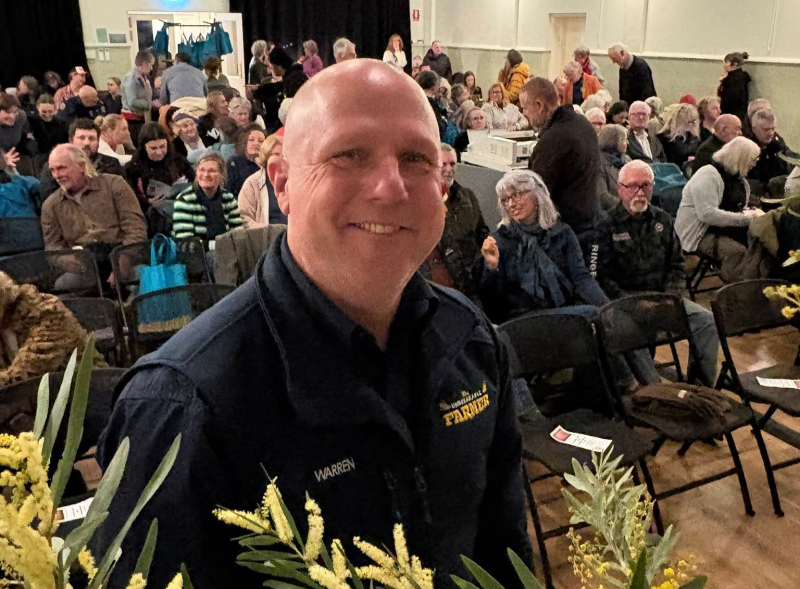
Film screening
Date of event: 29 August 2025
Location: Fish Creek, Victoria
Organiser: Marge Arnup, Fish Creek Memorial Hall
This event screened the film, Just a Farmer, with guest speaker Warren Davies (The Unbreakable Farmer, pictured above). Our aim was to bring the community together to raise awareness and start a conversation about supporting the positive mental health of our farming community.
We had 187 attendees including farmers, their families and people representing stock agents, health providers, a dairy manufacturing company, rural support services and the general public also attending. Hundreds took the opportunity to meet up and socialise before and after the film – a great chance to bolster community resilience and share experiences.
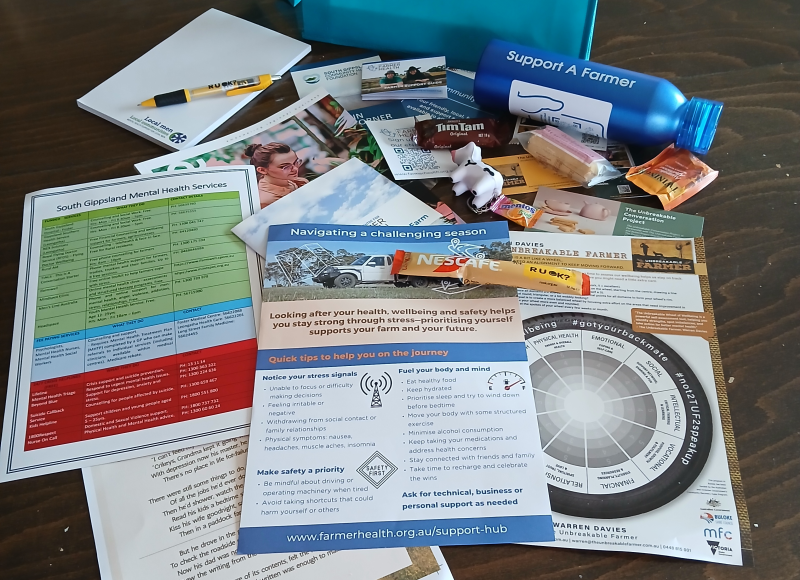
We provided one showbag per family (pictured left) which had lots of contributions in addition to the NCFH resources. This was enabled by the contributions of local sponsors. Any resources remaining went to the local medical clinic and hospital for distribution.
One lady who attended was particularly grateful for the materials because she could share them with a family member who was struggling and did not come to the event. She got lots of ideas for conversation starters and was glad to have the directory of how to access local support services which was produced for the event.
How did you use Tackling the Tough Topics to plan and develop your event?
In the planning phase for this event there was lots of community interest and funding/support from several organisations. We already had skills in running community events, but Tackling the Tough Topics gave us an ability to work together effectively and remain very focused on our objectives.
The guidelines gave us courage and confidence to talk about mental health concerns in our farming community, knowing that we had covered our bases and doing the event in a safe and respectful way. It meant we paid attention to details that might have otherwise been overlooked. The templates and checklists were great.
What feedback did you receive from attendees?
This event really brought the community together to have new conversations in a positive way. People identified strongly with the issues raised in the film and with Warren Davies as a speaker with his own lived experience as a farmer with struggles who had found a way forward.
“It was a fantastic, community focused evening, thank you to everyone who helped to pull it together! Such generosity in our community. The lovingly homemade supper food was lovely, great idea to be able to mingle, snack and chat. Warren’s presentation was a great touch and the support materials provided are fantastic. And the film Just a Farmer…is a well-made film with strong positive messages.”
We are planning to run similar events around farmer mental health and wellbeing and how we can support each other in the months ahead. We started some important conversations, and we want to build on this momentum by maybe having a panel discussion with local farmers about how they have negotiated tough seasons/issues in farming.
Night golf
Date of event: 30 August 2025
Location: Boorhaman, Victoria
Organiser: Marcus Neal, Boorhaman Golf Club
Our Look Over the Farm Gate event at Boorhaman Golf Club was designed to bring the farming community together for a night that combined fun, connection, and meaningful conversation. We know how isolating rural life can be, especially for farmers, so we wanted to create an event that felt light-hearted and welcoming – but still gave space to talk about the serious stuff.
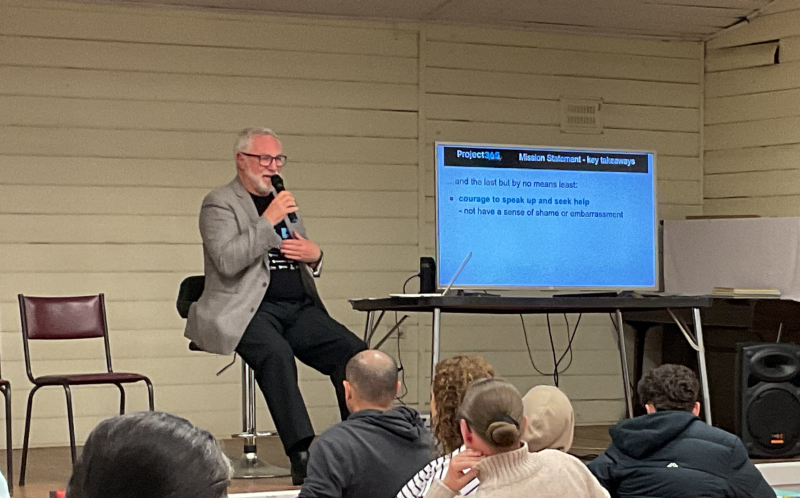
We started the evening with night golf, which was a great way to get people out of the house and onto the course in a relaxed setting. It helped break the ice and gave everyone a chance to enjoy themselves before we moved into the more formal part of the evening. After the golf, we shared a sit-down dinner and heard from Brett from Project 365 in Wangaratta (pictured above). Brett spoke openly about mental health challenges faced by farmers in Western Australia, including members of his own family. His story really resonated with the crowd and helped frame the night with honesty and purpose.
How did you use Tackling the Tough Topics to plan and develop your event?
The Tackling the Tough Topics guidelines were a great help in shaping the event. They gave us a clear framework to work from, helping us:
- Focus on the issues most relevant to our community, like financial stress, isolation and mental health.
- Make sure we had appropriate support materials and contacts available.
- Prepare our volunteers and committee members to respond appropriately if someone needed help.
We placed the handouts provided on each dinner table, and also set up an exhibition table where attendees could freely take information. We were mindful that mental health can be a difficult topic to disclose, so we wanted to make sure people could access resources privately and without pressure.
Having the guidelines available gave us confidence that we were approaching things the right way. It helped us move beyond just hosting a social night – we were able to create something that had real meaning and impact.
The guidelines also helped us be more intentional in how we framed the evening, how we supported attendees, and how we followed up afterwards.
What feedback did you receive from attendees?
The feedback was really positive. People appreciated the chance to come together in a relaxed setting and talk about things that are often kept quiet. Brett’s talk was a standout – many attendees said they saw reflections of their own experiences in his stories, and that it helped them feel seen and understood.
We also had people ask if we’d consider running more events like this, and a few offered to help out next time. It was clear that the night made a real impact.
We’re now looking at ways to build on the momentum from this event. There’s a strong appetite in our community for more opportunities to connect and support one another, and we’re exploring ideas for future events that combine sport, social connection, and mental health awareness – all with that Boorhaman spirit.
More information
The Look Over the Farm Gate community grants program was funded by Agriculture Victoria under the Victorian Government’s 2025 Drought Support Package.
See the other articles in our series
Tackling the Tough Topics: Q&A with NCFH’s Sally Cunningham
Jennifer Rowan reflects on her NCFH student placement
Back on Track: Q&A with NCFH’s Anna Greene
Meet some of our Back on Track coaches
The impact of our Health and Lifestyle Assessments
Transforming research into practical support for farmers: Hear from NCFH’s Dr Jacquie Cotton
Tackling the Tough Topics: Q&A with NCFH’s Sally Cunningham
Using evidence to influence action on farmer health
In this series, find out how our team at the National Centre for Farmer Health (NCFH) translates research in agriculture, health, behavioural and social sciences into practical and impactful programs and services that support farmer health, wellbeing and safety across Australia.
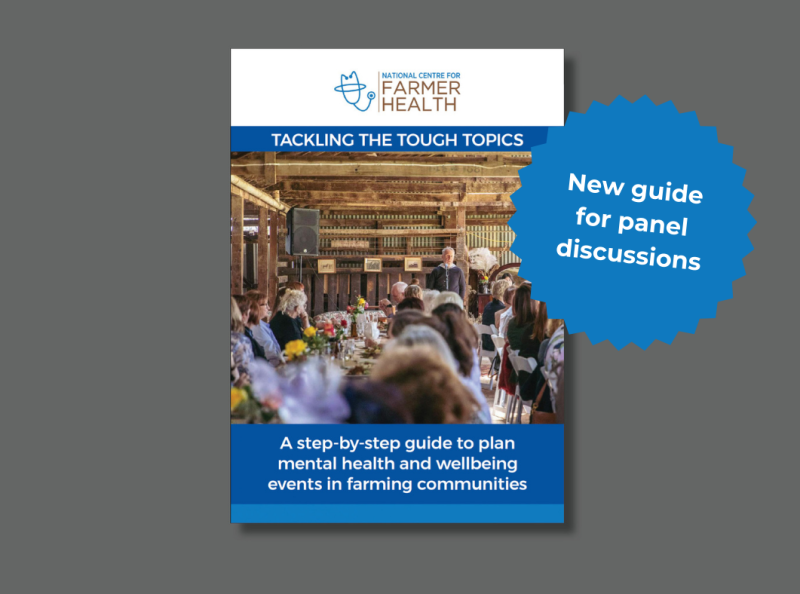
Launched in 2025, Tackling the Tough Topics outlines best practice guidelines and provides support to organise successful events that foster mental health and wellbeing while avoiding potential harm to vulnerable individuals.
The guidelines also supported event organisers for the Look Over the Farm Gate program which helped communities come together and support farming families under stress in drought-impacted regions of Victoria.
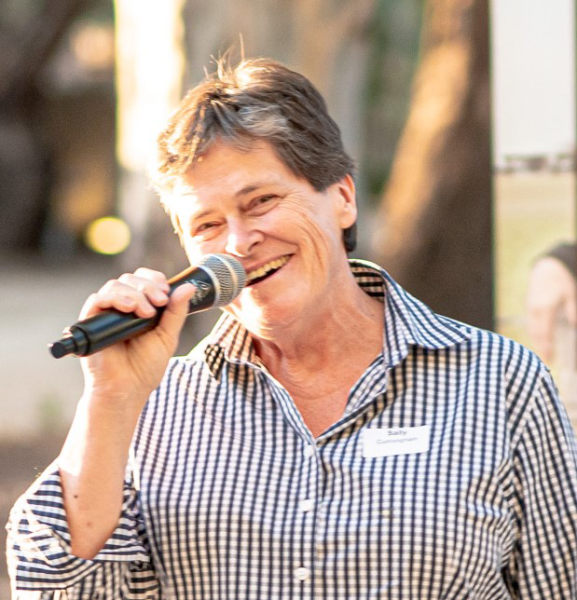
NCFH Project/Extension Officer Sally Cunningham (pictured right) led the development of the guidelines. She talks with farmers about creating mentally healthy workplaces, teaches farm safety in high schools across Victoria, and supports farmer mental health following natural disasters.
How did Tackling the Tough Topics come about?
In 2023, NCFH supported rural community group leaders to run 60 events on protecting mental health in their farming communities following floods and a very challenging season. In every case, there was strong motivation and good intention to improve mental health from within these farming communities.
Leaders really understand the dynamics of their farming community and their particular needs during recovery. However, they are often unsure how to tackle topics around mental health and wellbeing, so they were grateful for some assistance from NCFH to shape their events for maximum effectiveness.
Tackling the Tough Topics was developed in 2024 through a co-design process with rural mental health specialists, community development and shire disaster recovery staff. It aims to build awareness, knowledge and capability to ensure that when farming communities come together with the purpose of supporting and improving mental health, they are empowered to do so in a way that is well-planned, safe and effective.
How was research used to inform the content in the guidelines and what effect did this have on the final product?
NCFH and the rural mental health professionals who collaborated to produce the guidelines ensured that the language and form of the document was very accessible to Australian famers and their communities. We were not writing it for health professionals who understand jargon – it had to be readable, engaging and practical.
As a result, the guidelines include:
- A clear structure based on 14 key questions to guide event planning
- Practical templates to ensure the event runs smoothly and achieves its objectives
- Case studies from rural events and top tips that provide valuable insights
- Guidance on selecting and preparing guest speakers, ensuring they are well-briefed about the farming community’s unique needs and challenges.
What feedback have you received from those who have used the guidelines to plan and deliver an event in farming communities with a mental health focus?
Since its release in February 2025, Tackling the Tough Topics has been accessed by more than 300 event organisers. Those who have used the guidelines tell us:
- They increased their understanding, knowledge and confidence in running community events around farmer mental health
- The handbook was rated highly in terms of applicability, clarity, comprehensiveness, practicality, and achievability of recommendations
- The most useful features included case studies, guidelines for guest speakers and event planning templates.
In July 2025, the guidelines were embedded in the application process for the Look Over the Farm Gate community grants program which funds events to support farming communities impacted by drought and bushfires. Over 80% of applicants reported that Tackling the Tough Topics was very useful in their event planning.
Feedback from Look Over the Farm Gate events enabled us to review and improve the content in Tackling the Tough Topics in early 2026. This includes a greater range of case studies and top tips that will improve its appeal and usefulness to a wider demographic in the farming community. Event organisers also sought guidance on how to draw out local wisdom from their own communities about overcoming some of the challenges they have faced as farmers. This led to the inclusion of a new resource of questions to use in a panel discussion about farmer’s own wellbeing, problem solving and help seeking strategies. We hope that this approach will help to normalise these discussions in many more farming communities.
What has been your highlight of delivering Tackling the Tough Topics?
Well-run events start important conversations in farming communities where discussing personal wellbeing or mental health was once associated with stigma and shame.
It has been gratifying to see the guidelines used successfully to tackle this challenge, and see the diversity and creativity of events designed to promote social connection and protective mental health behaviours in farming communities as part of the Look Over the Farm Gate program.
After decades of technical advisory work, I enjoy working with farmers to bring about positive change for their enterprise, community and the environment.
More information
See the other articles in our series
A look back on Look Over the Farm Gate events
Jennifer Rowan reflects on her NCFH student placement
Back on Track: Q&A with NCFH’s Anna Greene
Meet some of our Back on Track coaches
The impact of our Health and Lifestyle Assessments
Transforming research into practical support for farmers: Hear from NCFH’s Dr Jacquie Cotton
Farmers’ insights crucial to guide revamped health check program
The National Centre for Farmer Health is on the lookout for farmers, rural health professionals and agriculture industry members from Victoria, New South Wales and Queensland to help drive an exciting update of the AgriSafe program which provides comprehensive health and wellbeing checkups for farmers.
Expressions of interest to join a Steering Committee are open until 31 October. The existing AgriSafe program offers 90-minute, one-on-one farmer health checkups which identify occupational hazards and exposures unique to farming and provide personalised education on ways to stay safe on the farm and improve everyday lifestyle behaviours.
The new AgriSafe 2.0 project will run for five years and is led by the National Centre for Farmer Health in collaboration with research and health service partners, with funding from the Australian Government’s Medical Research Future Fund.
“The redesign of AgriSafe will fill a crucial gap in bringing tailored support on farmer health, wellbeing and safety to rural areas where there are high rates of chronic illness and injuries among the farming population and limited access to health services,” National Centre for Farmer Health Director, Associate Professor Alison Kennedy said.
“Farmers work hard every day – but a healthy farmer can keep on farming. AgriSafe 2.0 will make it easier for farmers to get on the front foot with their health, identify and manage any issues such as diabetes and cardiovascular disease, and act on farming-specific risks such as exposure to dust and agrichemicals. Ultimately, this means a healthier farmer and a healthier farming business in the long run.”
The first stage of the project will involve a full review of the current AgriSafe model, including interviews with farmers, health professionals and members of the agricultural industry. Insights from this stage will inform the design of a revised health, wellbeing and safety program that is relevant, engaging and accessible to farmers across Australia.
The Steering Committee will meet quarterly via video conference and will play a key role in guiding the entire project from late 2025 to June 2029. A sitting fee is also available to members.
“The Steering Committee has a unique opportunity to guide the development and delivery of the new AgriSafe 2.0 program. We’re keen to hear from farmers about their lived experience, as well as rural health professionals and members of the agriculture industry. Their feedback will ensure AgriSafe 2.0 continues to make a real difference to farmers and their local communities and help us understand what’s needed to roll out and support the program in the long term,” Alison said.
The existing AgriSafe checkups are currently delivered in western Victoria, and the redesigned program will be trialled initially in Victoria, with plans to expand to New South Wales and Queensland in the third year of the program.
For more information, visit: https://farmerhealth.org.au/agrisafe-clinics
AgriSafe 2.0 is delivered in partnership with Deakin University, Western District Health Service, the Alliance of Rural and Regional Community Health (ARRCH), the NSW Agency for Clinical Innovation, Darling Downs Health Service, West Moreton Health Service and Central Queensland University.
* END OF RELEASE*
For more information, please contact:
Alison Kennedy – Director, National Centre for Farmer Health
P: 03 5551 8533 | M: 0407 549 970 | E: alison.kennedy@wdhs.net
Farmer Health eNews October 2025
Find out the latest from the National Centre for Farmer Health
- Behind the scenes at NCFH
- Scholarships open to study ag health and medicine
- Help guide the new development of AgriSafe
- Upcoming events: Farm safe and strong; Elmore Field Days
View the October 2025 e-newsletter
Do you want to receive our eNews?
Smarter livestock handling, safer farmers: Free event
A hands-on event focused on safer livestock handling and farmer health and wellbeing will be held in Hamilton, Victoria to kick off National Safe Work Month in October.
Farm safe and strong: Practical tips for improving safety when working with cattle aims to address the recent number of farmer injuries and fatalities occurring in cattle yards. The event will be delivered by the National Centre for Farmer Health (NCFH) in collaboration with WorkSafe Victoria on Friday 3 October, and is one of many events taking place online and across the state to highlight safe and healthy workplaces.
The event will feature expert-led demonstrations and practical advice on livestock handling and protecting farmer health and safety, as well as farm safety demonstrations on yard work such as loading and unloading livestock, keeping livestock calm and yourself and contractors safe.
Vet safety, including cattle crush safety and avoiding needlestick injuries will also be in focus. Needlestick injuries affect 80 per cent of livestock farmers, occurring from accidental injection with a needle intended for an animal. In extreme cases, it can cause amputation or even death.
Attendees will also find out more about Q Fever, a highly contagious flu-like infection transmitted to humans from infected livestock and wildlife. With cases among farmers increasing, Q Fever is usually transmitted from exposure to infected cattle, sheep, goats and wild pigs or from inhaling infected dust.
NCFH Director Dr Alison Kennedy said the event was an opportunity for farmers, their families and agriculture students to come together to learn, connect with others and build a culture of safety on farms.
“The most valuable asset on any farm isn’t machinery or the land – it’s the people. Protecting your safety, health and wellbeing on the farm must always be front of mind,” she said.
“Whether you need a refresher or are keen to learn something new, the ‘Farm safe and strong’ event will provide a set of practical tips to take back to the farm to support safer livestock handling and farmer health.”
WorkSafe Chief Health and Safety Officer Sam Jenkin said the event would give farmers a chance to hear expert advice while trading stories and experiences of health and safety on the land.
“Farming can be isolating work, so we encourage people to come along and make connections that will create change and a culture of safety,” he said.
“Through meaningful conversations, we can all grow our understanding of current issues in agriculture and work together to improve safety in an industry that powers our economy, supports regional communities and keeps food on our shelves.”
* END OF RELEASE*
For more information, please contact:
Alison Kennedy – Director, National Centre for Farmer Health
P: 03 5551 8533 | M: 0407 549 970 | E: alison.kennedy@wdhs.net
Farmer Health eNews September 2025
Find out the latest from the National Centre for Farmer Health
- Farm safe and strong: Practical tips for safer farming event
- Two new publications: Farmer health from Australia to Indonesia
- Hip or knee pain? NCFH is here to support you!
Do you want to receive our eNews?
New partnership to deliver hearing health education for young farmers
We’re excited to announce a new partnership with Deafness Forum Australia that will see the expansion of our existing Shifting Gears: Farm Safety Resources for Educators with the addition of a brand-new topic: Hearing Health and Protection in Farming.
Launching in January 2026, just in time for the new school year, this important topic will equip young people with the knowledge and tools to protect their hearing in noisy agricultural environments. From tractors to chainsaws, many everyday farm activities pose risks to hearing – yet awareness and prevention strategies are often overlooked.
This new module builds on our commitment to improving health and safety outcomes for the next generation of farmers. Together with Deafness Forum Australia, we’re making it easier for educators to bring practical, engaging, and evidence-based learning into the classroom.
Stay tuned for more updates as we move closer to launch!
Globalising farmer health: Australia to Indonesia
Adapting a proven Australian model to support the health and safety of Indonesian farmers
Overview
Our internationally successful health and lifestyle assessment tool has now been trialled in rural Indonesia, offering vital insights into the health, wellbeing and safety of agricultural workers.
With agriculture employing over 40 million Indonesians, this pilot study reveals generally good health and low psychological distress, but high smoking rates and unsafe agrichemical use.
Translating and adapting our tool highlights its global relevance – proving that working with our international partners strengthens efforts to improve outcomes for farming communities worldwide. Collaborative approaches like this support healthier, safer farming populations – wherever they live or work.
Key insights
- Rural and Remote HealthStudy site: Rural East Java
- 51 participants – average age: 39.5, all male
- 76% were active smokers
- 100% used agrichemicals – but personal protective equipment (PPE) use was low.
Understanding the phases and tensions of regenerative agriculture for better health outcomes for farmers
Overview
This research examines how transitioning to regenerative agriculture (RA) intersects with mental health and wellbeing among Australian farmers. Bridging sustainable agriculture and mental health – highlighting how thoughtful transition strategies can support farmer resilience during times of change.
Key insights
- Australian farmers face numerous pressures – including severe weather events, market unpredictability, technological demands, regulatory burdens and social isolation – that significantly affect their mental health.
- Regenerative agriculture is emerging as a promising approach not only for environmental and production goals, but also for supporting farmer wellbeing through more connected and adaptive farming systems.
- The study identifies distinct phases as farmers transition to RA – such as triggering, acceptance, adoption, and adaptation – and underscores that mental health vulnerabilities differ across these phases, requiring tailored supports.
Farmer Health eNews August 2025
Find out the latest from the National Centre for Farmer Health
- A Year in Review: Strengthening farmer health, wellbeing and safety
- Don’t underestimate a needlestick injury
- Seeking participants: Occupational health and safety in rural Australia
Do you want to receive our eNews?
Joining forces to make a difference
Working on the land takes a physical toll – and ongoing joint pain in your knees or hips can make everyday tasks that much harder. If you’re not sure what steps to take, you’re not alone.
That’s why the National Centre for Farmer Health has partnered with Beyond The Clinic to offer JointFit – a personalised joint health program designed to help you reduce pain, move better and avoid unnecessary surgery.
Ready to start your path to pain-free joint mobility? Whether you’re living with a joint condition or waiting for surgery, we have you covered. Most rehab plans just tell you to exercise more and hope for the best. JointFit keeps you connected – to your care team, to expert support and to your recovery goals.
The application combines expert physiotherapy care, smart technology and real-time health insights to help you protect your joints, recover faster, and stay strong for the long haul.
How does it work?
Getting started is easy – and completely free!
- Step 1: Take the assessment – Answer nine short questions to uncover your hip or knee profile.
- Step 2: Discover your Joint Health Profile – Get personalised results and advice based on your needs.
- Step 3: Get instant access to the JointFit app – You’ll receive an SMS with a link to begin your 6-week, expert-led program – at no cost to you.
- Step 4: Share your progress – Stay on top of your recovery and easily share updates with your GP or physio.
Why JointFit?
- Avoid surgery by strengthening joints and improving function.
- Get care from home – no travel, no waiting rooms.
- Access expert guidance from qualified physiotherapists.
For more information, please contact:
Beyond The Clinic
P: 1300 455 058 E: support@beyondtheclinic.io
2024-25 Year in Review
Strengthening farmer health, wellbeing and safety at the NCFH
Written by National Centre for Farmer Health Director Alison Kennedy
As I reflect on the past 12 months at the National Centre for Farmer Health (NCFH), I am filled with pride, gratitude, and renewed commitment to improving the health, wellbeing and safety of farming communities across Australia.
This year has been one of connection, innovation, and impact.
Farmer health goes to Canberra
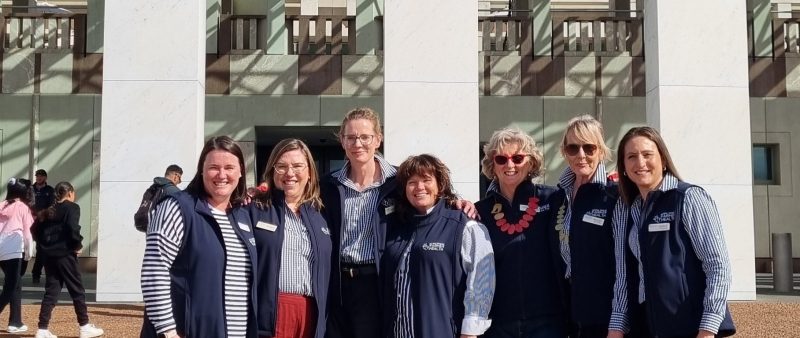
The 2024-25 year kicked off with an amazing visit to Canberra. Our team hosted an event at Parliament House, bringing together politicians, senior public servants and industry representatives to raise awareness and understanding of the importance of farmer health, wellbeing and safety.
This was followed by a Farmer Health Symposium with more than 60 attendees from across Australia – including farmers, researchers, service providers and policy makers – who came together to connect, share knowledge and build the foundations for long-term collaboration.
Not long after, our new ‘community friendly’ location in Hamilton was officially opened with great fanfare and celebration, complete with a live broadcast by the ABC Country Hour.
Scaling what works
This year we have focused on testing, refining and scaling up initiatives with the aim of reaching more farmers than ever. This includes our farmer health checks which now have new digital features to help farmers take action (including follow-up text message reminders) without compromising the face-to-face interaction with our skilled farmer health nurses. Our health checks have reached farmers from across five states in 2024-25.
We’ve also been testing a new model of mental health support this year via our Back on Track program – recruiting, training and supporting peer coaches to deliver a 10-session behavioural activation program to members of the farming community experiencing depression. We are grateful to the farming communities who have trusted us to walk alongside them in this work.
Safe Spaces model continues to build
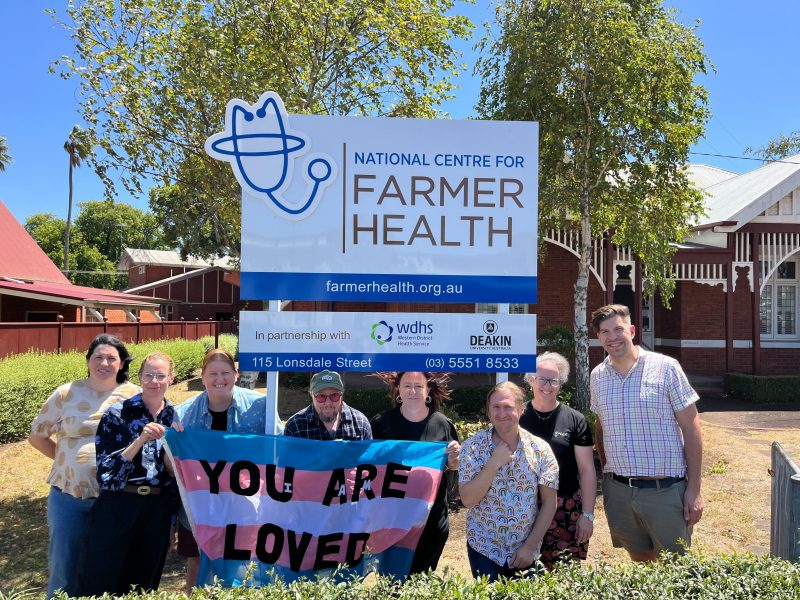
In 2025 we continued the development and deep community engagement around the Safe Spaces Model of Primary Healthcare, a five-year Medical Research Future Fund (MRFF) project aiming to transform how primary care services respond to and welcome queer rural youth.
The energy, creativity, and leadership of young people, their allies and those who support them have been inspiring, and their voices continue to shape change from the ground up.
Training, outreach and advocacy
Our education programs are reaching far and wide. They include:
- Calm the Farm workshops for farm owners/managers
- Mental health capacity building webinars for trusted advisers
- Postgraduate Agricultural Health and Medicine training for rural health professionals
- Shifting Gears teaching resources in secondary schools across five states, targeting the next farming generation.
Throughout the year, the NCFH team has also ensured that farmer voices are front and centre in national discussions around mental health, drought resilience and workforce sustainability by delivering many keynote presentations, media interviews and policy briefings.
Research that reflects reality
The NCFH research team has published and presented on a wide range of issues:
- On-farm electrical hazards
- Heat stress
- Farm safety culture
- Regenerative agriculture
- Mental health
- Climate modelling informing risk of zoonotic disease
- Innovative models of care for supporting farmer health and wellbeing.
This year, our research has increasingly focused on co-design, implementation science and systems change –ensuring that what we learn is directly translatable to community benefit.
We have also played an advisory role in shaping national and state-level rural health policy, advocating for evidence-based, community-driven and farmer-informed approaches to rural health, wellbeing and safety.
A growing and energised team
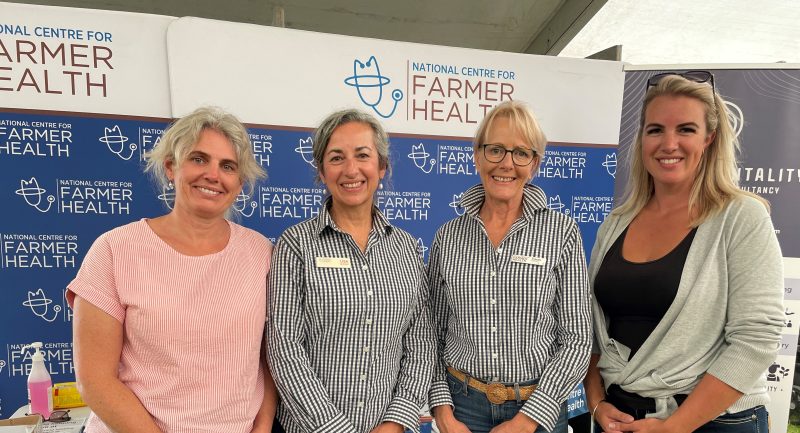
The last 12 months have seen the expansion of our team with passionate new staff members across research, peer work, project and admin support, and clinical services – bringing new skills and expertise, farming experience and fresh energy to the NCFH.
We’ve also welcomed three new junior members to our team this year (congratulations to our NCFH Mums Matilda, Jo and Tahlia).
Looking ahead
While we celebrate what has been achieved, we know the challenges facing rural communities remain complex and deeply interconnected. Climate pressures, economic uncertainty, social isolation and service shortages all continue to affect farmer wellbeing. But, with the support of our collaborators and the trust of farming communities, we are confident in our path forward.
Over the next 12 months, we will deepen our focus on systems-level change, grow our health service and training programs, and continue advocating for health equity in the bush – ensuring all of our farmers, farm workers, farming families and agriculture-dependent communities have the opportunity and resources to improve their health, wellbeing and safety.
Our partnerships – with rural organisations, farming families, universities, government and health services –continue to grow in strength and impact. Thank you to everyone who has walked alongside us this past year.
We look forward to the road ahead, with hope, humility, and a deep respect for the people who feed and care for our nation. If you would like to walk alongside us in this new financial year, please reach out to chat about how we can work together.
For more information, please contact:
Alison Kennedy – Director, National Centre for Farmer Health
P: 03 5551 8533 | M: 0407 549 970 | E: alison.kennedy@wdhs.net