

Supporting Teachers to Deliver Farm Safety Education: Introducing Shifting Gears
| Hamilton, Victoria, 13/06/2023 – The National Centre for Farmer Health introduces Shifting Gears, an innovative farm health and safety program for schools that is set to revolutionise agricultural education. Developed as a teacher-led, secondary school-based program, Shifting Gears aims to enhance farm safety culture and bridge the gap between agriculture and horticulture studies and the national skills program. Shifting Gears stands out from other initiatives by presenting the broader context of agricultural injury in rural Australia through relatable content tailored specifically for young people. This groundbreaking program promises to provide valuable insights and knowledge for middle and senior school students residing on farms, studying agriculture and horticulture, or exploring careers in the field. Alarming trends have surfaced from recent data collected by the National Centre for Farmer Health about child safety on farms. Statistics from the Gear Up for Ag program show that over half of the participants were 8 years old or younger when they began work on the farm. Disturbingly, among those currently riding a quadbike on a farm, only half reported wearing a helmet most or all the time, with 60 percent carrying passengers. Moreover, 72 percent of students expressed concerns about the safety of their family or friends on the farm. Of the students currently helping or working on farms, 47 percent state they supervise others, primarily siblings. To address these critical issues, educators are invited to participate in the Shifting Gears education pilot, beginning Term 3 this year. This program is free to participate in, available to schools nationwide, and aims to equip school teachers with the necessary tools and knowledge to integrate the intervention program into their agricultural curriculum. A webinar, led by experts from the National Centre for Farmer Health, will be held on 22nd June from 12:30 – 1:30pm. The webinar will emphasise the significance of incorporating health and safety conversations into teaching practices. Teachers and school representatives interested in the program are encouraged to register on the National Centre for Farmer Health website www.farmerhealth.org.au to explore this exciting resource and become catalysts for positive change in farm safety practices. To engage students effectively, the National Centre for Farmer Health has created unique farm safety audiovisual (AV) materials and digital animations, together with teacher resources and activities for students that capture the essence of the Australian farming experience. These documentary-style AVs connect safety concepts with human health, offering a meaningful and relatable approach for both students and teachers. In addition, digital animations have been designed to convey farm safety theories through a creative and engaging medium. Recognising the importance of classroom support, Shifting Gears offers teachers a range of resources, including health and safety statistics, discussion topics, and activities. These materials are aligned with the AVs, streamlining lesson planning and content sourcing for educators. “This is an exciting opportunity for educators to enhance their agricultural and safety expertise,” says Dr. Alison Kennedy, Director of the National Centre for Farmer Health. “By joining us in the Shifting Gears pilot program, educators can play a vital role in cultivating a culture of safety in the farming community.” Event registration link: https://utm.guru/ufLWm Shifting Gears Pilot Page: Shifting Gears | National Centre for Farmer Health ENDS. For media enquiries or interview requests, please contact: Annabelle Macgugan Marketing Coordinator amacgugan@wdhs.net 0458517699 About the National Centre for Farmer Health: The National Centre for Farmer Health is dedicated to improving the health, safety, and wellbeing of farmers, farmworkers, and their families across Australia. Through research, education, and advocacy, the centre addresses the unique health challenges faced by those working in agriculture and promotes sustainable farming practices. Note to editors: High-resolution images and additional information about Shifting Gears are available upon request. |
Improving the Understanding and Uptake of Steering Straight
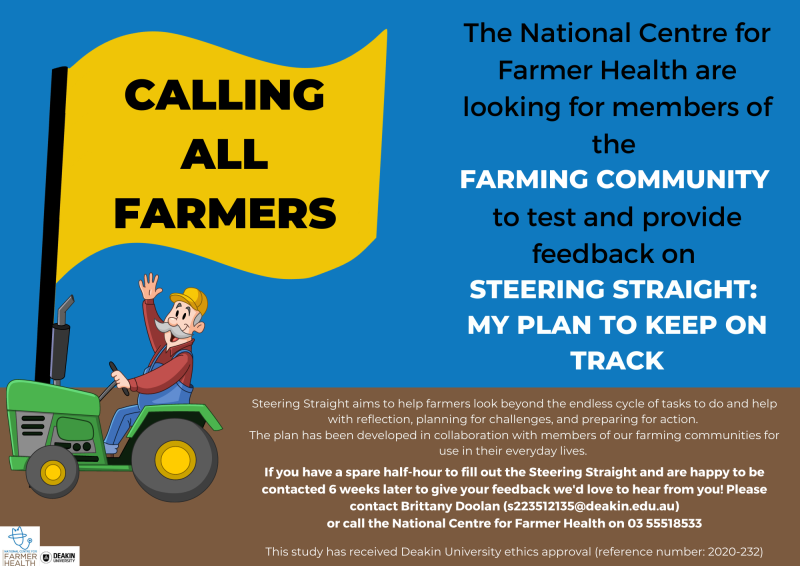
The National Centre for Farmer Health are looking for members of the NSW farming community to test and provide feedback about Steering Straight: My Plan to Keep on Track. We are looking for people who can complete the plan (it takes roughly 15 – 30 minutes) and then partake in a short phone interview about 6 weeks later.
This resource aims to help farmers look beyond the endless cycle of tasks to do, and help with reflection, planning for challenges, and preparing for action. The plan has been developed in collaboration with members of our farming communities for farmers to use in their everyday lives.
If you can help us improve the wellbeing of our farming communities, we would love to hear from you! Please contact Brittany Doolan (s223512135@deakin.edu.au) or call the National Centre for Farmer Health on 03 55518533.
This study has received Deakin University ethics approval (reference number: 2020-232)
Participant Information Form
Steering Straight: My plan to keep on track
Grampians Health FARMwell Small Community Grants
Grampians Health FARMwell Small Community Grants are available to community members of the Northern Grampians & Pyrenees Shire Councils, to support activities that increase capacity and empower farming communities faced with challenges including environmental, climatic, economic and social stressors, which can present adverse effects on personal health and wellbeing.
Applicants are invited to apply for up to $1000 for a community project, or event, provided the application meets the FARMwell program criteria, focusing on improved health outcomes and strengthening social engagement in farming communities.
FARMwell Small Grants Guidelines:
https://drive.google.com/file/d/1ZpfSlTN4VhX2nqkJG8O8PLL8Z0L5EKQI/view?usp=sharing
To find out more about the grant, please get in touch with Narelle at narelle.conroy@bhs.org.au.
Farmer Health eNews June 2023
Find out the latest from the National Centre for Farmer Health
- Presenting the Introduction Video to Shifting Gears
- Grants empower communities recovering from floods
- Scholarship closing soon for Healthy and Sustainable Agricultural Communities!
- What do you do if you get a needlestick injury?
- June Events
Do you want to receive our eNews?
Calling All LGBTQI+ Community! Improving Heart Disease Prevention, Treatment, and Rehabilitation for Everyone
We need your help to help make the prevention, treatment and rehabilitation of heart disease better for everyone.
In Australia, people in rural and remote areas have poorer outcomes in relation to heart disease – and understanding the reason for this is important.
Evidence suggests that system-wide sex biases occur in the assessment and management of coronary heart disease throughout the healthcare journey and that is to the detriment of some members of the LGBTQI+ community. Exactly when and how these biases occur is unclear, which is why we are calling for all members of the LGBTQI+ community who have experienced a coronary heart disease event to reach out and help us understand your experience.
Sharing your experience can help our work to improve the health outcomes of the LGBTQI+ community who have suffered heart disease.
To find out more or share your experience please email James via james.lucas@deakin.edu.au
Calling All Women! Improving Heart Disease Prevention, Treatment, and Rehabilitation for Everyone
We need your help to help make the prevention, treatment and rehabilitation of heart disease better for everyone.
In Australia, women suffer poorer health outcomes related to their heart disease compared with similarly affected men. Moreover, people in rural and remote areas have poorer outcomes in relation to heart disease – and understanding the reason for this is important.
Evidence suggests that system-wide sex biases occur in the assessment and management of coronary heart disease throughout the healthcare journey and that is to the detriment of women. Exactly when and how these gendered biases occur is unclear, which is why we are calling for all women who have experienced a coronary heart disease event to reach out and help us understand your experience.
Sharing your experience can help our work to improve the health outcomes of women who have suffered heart disease.
To find out more or share your experience please email James via james.lucas@deakin.edu.au
Farmer Health Shifts the Gears in Safety Resources for Young People
| The National Centre for Farmer Health has launched Shifting Gears – a suite of engaging school-based resources designed to support secondary school teachers to incorporate farm safety education into Agricultural studies. Officially launched at the recent Primary Industries Education Foundation’s Conference for agriculture educators on May 1-2, the content features stories from four diverse agricultural businesses and provides insight into ways safety plays a role in Agriculture today. Shifting Gears is designed for middle and senior school students who are living on farms, studying agriculture and horticulture, undertaking work experience, and/or interested in pursuing a career in this field. It delivers unique, unscripted farm safety audio visual (AV) material for an Australian farming context with documentary-style AVs and digital animations relatable to a young audience – shifting the learning outcomes beyond safety compliance and regulations. Rural Bank’s Head of Agribusiness Development, Andrew Smith, says “we’re proud to support a program specifically tailored to our young and emerging farmers. The skills and information provided will help keep them safe on farm. We know the importance of delivering messages in a relatable way is key to the uptake of learning, and believe that NCFH has been able to achieve this.” Teachers will be provided with classroom materials that complement agriculture and horticulture subjects and the national skills program to bring safety into the conversation and demonstrate what agricultural injury means for families and communities. Dr Alison Kennedy, Director of the National Centre for Farmer Health, says, “Shifting Gears is a unique program that fills a gap in the curriculum.” She said “This is an important step forward. Our aim is to empower young people to be part of creating a farm safety culture that encourages lifelong safe practices in farming.” “Our team are proud to support educators in delivering farm safety education – and we look forward to seeing the positive impact of the program on students, their families and their communities. Thanks to the support of Rural Bank, Shifting Gears videos will be freely accessible on our NCFH website and YouTube channel.” The National Centre for Farmer Health is now calling on schools and educators nationally to register their interest in participating in the Shifting Gears pilot program. To be a part of this exciting new program, please visit the National Centre for Farmer Health website www.farmerhealth.org.au *****ENDS***** About the National Centre for Farmer Health: The National Centre for Farmer Health is a partnership between Western District Health Service and Deakin University, with funding from the Australian Government. The Centre aims to improve the health, wellbeing, and safety of farmers, their families, and communities across Australia. For more information about National Centre for Farmer Health visit www.farmerhealth.org.au For media enquiries contact Dr Amity Latham, Associate Research Fellow (03) 5551 8533 or email: ncfh@wdhs.net Photos available. Please email ncfh@wdhs.net. |
Helping farmers out of the mud webinar now online
Do you recognise the signs exhibited by people suffering from stress and fatigue? How do you respond? Are you aware of the appropriate assistance and helpful resources available to help them through the tough times?
These were just some of points covered by the successful webinars produced and delivered by the National Centre for Farmer Health (NCFH) to help agricultural advisors and service providers working with farm families immediately after the floods and the ongoing months of flood recovery.
A recording of this informative webinar, which attracted more than 80 participants, is now available to all on the NCFH website www.farmerhealth.org.au/buildingfarmspirit.
NCFH flood recovery response project officer, Sally Cunningham, said while the floods may seem like so long ago, it is only now that the stress and fatigue of it all will start to take a hold on farmers, farm families and farm workers.
“Service providers and trusted agricultural advisors play a really important role in assisting farmers through the flood recovery journey,” Ms Cunningham said.
“This webinar helped them to recognise and respond to farmer stress, highlighted appropriate assistance and resources available and then reflect on how to protect themselves from risks to their own mental health.”
Ms Cunningham said the National Centre for Farmer Health has posted a video of the popular webinar on its website to meet the demand for this information coming from the wider community across Australia.
“While targeted to agricultural advisors, it will help people to recognise and respond to farmers exhibiting significant signs of stress, learn where to refer farmers for appropriate assistance and helpful resources, and show how to look after yourself when supporting others.”
——– ENDS ——-
Sally Cunningham is available for interview: (03) 5551 8533 or email: sally.cunningham@wdhs.net
Photo: A high res copy of the photo is available on request.
For more information about the National Centre for Farmer Health Flood Response or to access a list of support resources, visit www.farmerhealth.org.au/buildingfarmspirit or contact Project Officer, Sally Cunningham
For more information about National Centre for Farmer Health visit www.farmerhealth.org.au
For media and communications enquiries contact NCFH Marketing Communications Coordinator, Annabelle Macgugan on (03) 5551 8582 or email: amacgugan@wdhs.net
The postgraduate study that can change lives
Scholarships to study Healthy and Sustainable Agricultural Communities are now open. Apply through the link below.
More than ever, agricultural communities need people in their corner. People who understand the true impact of safety culture, changing climate, disasters like drought, flood and disease pandemic, and how changing agricultural practices influence the health and wellbeing of communities. People who are dynamic, understanding and can lead change in their communities…change makers like YOU.
Learn to support health, wellbeing and safety of your rural community – upskill and make a difference your community starting now! Part scholarships worth $1650 are now open to professionals who want to make a difference in their rural community.
“Working with rural and remote communities I believe I have a deeper understating of the mental and physical issues the farming community face thanks to the HMF702 unit. I have been able to ‘think outside the box’ when working with rural communities in supporting them to optimal health and wellbeing.”
Sarah Crosthwaite Social Worker & 2023 Nuffield Scholar, Wodonga VIC
Delivered completely online, Healthy and Sustainable Agricultural Communities (HMF702) offers the flexibility to learn remotely and connect with students from across Australia.
Apply for Healthy and Sustainable Agricultural Communities (HMF702) here
Farmer Health eNews May 2023
Find out the latest from the National Centre for Farmer Health
- Shifting Gears: farm safety resources for educators
- Dr Rob Gordon talks flood recovery
- Postgraduate study that can change lives
- This HAT fits every farmer!
- May Events
Do you want to receive our eNews?
The National Centre for Farmer Health – working together to break down barriers to mental health support
| The recent National Farmer Wellbeing report has highlighted the challenges that farmers face when it comes to managing their mental health and the need for accessible support services, such as those available through the National Centre for Farmer Health (NCFH). The National Centre for Farmer Health provides evidence-based resources and programs to support the mental and physical health of farmers. Free resources including factsheets, podcasts and assessment tools are available on the Farmer Health website along with access to the popular Managing Stress on the Farm booklet—a practical guide to identifying and dealing with common causes of stress on farms. The simple-to-use Steering Straight action plan included in the booklet helps farmers to identify personal triggers and strategies for easing stress, prepare for challenges ahead, and identify helpful resources available to them. Steering Straight was co-designed with farmers and mental health professionals. The Centre is leading the #BuildingFarmSpirit social media campaign to improve the wellbeing of farmers. The campaign is raising awareness of the challenges farmers face, while also sharing and celebrating positive examples of how they are managing ongoing seasonal challenges. The Centre has also partnered with Lysn—a leading online mental health service provider—to provide farmers easy access to farmer health trained psychologists. Dr Alison Kennedy, Director of the National Centre for Farmer Health calls for continuing collaboration in response to risks to farmer mental health: ‘The challenges noted in the National Farmer Wellbeing report remind us of the importance of raising farmers’ awareness about the support that is available to them now and into the future. While we need to continue to work with farmers, industry and stakeholders nationally to develop effective, evidence-based solutions to the ongoing challenges our farmers face, we also need to collectively encourage farmers to access supports that are already available. This is a time when working together is more important than ever—collaboration rather than confusion.’ An evaluation conducted in 2022 of some of its programs demonstrated that the NCFH plays a critical role in supporting the mental health and wellbeing of farmers across Australia. ‘The evaluation was a testament to the value of the Centre’s evidence-based resources and programs and shows that investing in mental health support for farmers not only improves the wellbeing of individuals and communities but also has the potential to save government significant costs associated with poor mental health outcomes.’ Dr Kennedy said. The National Centre for Farmer Health remains committed to working collaboratively to provide innovative and effective programs and resources to support the mental and physical health of farmers across Australia and are calling for funding commitments from federal and state governments to continue to make a positive impact on the lives of farmers and their families, and contribute to the overall wellbeing and prosperity of rural communities. ‘The Centre has been a leader in farmer mental health, wellbeing and safety for over 15 years, often in partnership with community, industry and other stakeholders. Despite uncertainty about continuing Victorian Government funding of the Centre beyond June 2023, we are committed to maximising our efforts to make a difference to farmers’ lives across Australia.’ Dr Kennedy said. If you need immediate help or are concerned about someone, reach out to Lifeline via 13 11 14 or in an emergency where there is an immediate risk of harm to a person call 000. To access the resources currently available, please visit www.farmerhealth.org.au ——- ENDS ——- For more information about National Centre for Farmer Health visit www.farmerhealth.org.au. For media and communications enquiries please contact WDHS Marketing Communications Coordinator, Annabelle Macgugan on (03) 5551 8582 or email: amacgugan@wdhs.net. For more information about National Centre for Farmer Health visit www.farmerhealth.org.au |
Keeping farmers healthy with AgriClinics – Interview for Rural Health Pro
Written by Jackelyn Villegas for Rural Health Pro. Read the original publication here.
The National Centre for Farmer Health (NCFH) developed AgriSafe AgriClinics to give farmers the opportunity to undertake a comprehensive health check with a clinician specially trained in farmer health.
According to a 10-year study by the National Rural Health Alliance, one farmer commits suicide every 10 days in Australia. Alongside poor mental health, farmers experience increased risk of injury and their workplace exposes them to potentially harmful agrichemicals. With this in mind, it is especially important that farmers in rural and remote areas have access to quality health services tailored to the specific concerns of those working in the agricultural industry.
The National Centre for Farmer Health (NCFH) developed AgriSafe AgriClinics to give farmers the opportunity to undertake a comprehensive health check with a clinician specially trained in farmer health. AgriClinics are 90 minute, free-of-charge consults available to anyone working in the Victorian agricultural sector. AgriClinics seek to assess farmers’ health with an in-depth health assessment as well as provide education on hazards around the farm and personal protective equipment use.
Consultations include a range of tests including blood glucose and lipid testing, hearing and vision testing, skin examination, urine testing and agrichemical exposure (anticholinesterase) testing. AgriSafe Clinicians also fit test farmers with a mask or respirator and complete an occupational risk assessment.
Since 2011, AgriSafe has delivered 368 clinics to farmers in rural Victoria. They currently serve the communities of Hamilton, Penshurst, Harrow, Shepparton, Dookie, Nathalia, Numurkah, Tatura, Kerang, Cohuna, Boort, Quambatook and Pyramid Hill.
AgriSafe Clinician Megan Little said AgriClinics have been very popular within the farming community.
“AgriSafe came about as there was a need for a tailored service for farmers, they are a hard-to-reach population due to geographical isolation and a lack of resources.
“The clinics have had a really good uptake in their first few years. It gets spread via word of mouth and I will often have farmers in the clinic who reach out to us and book in because their mate had a consult done and they want to find out more.
“Some farmers you have to push a little bit to get them in here, but once they’re here, they really find the service valuable,” Megan said.
Megan is a Registered Nurse who completed postgraduate studies aligning with her interest in farmer health. She studied a Graduate Certificate of Agricultural Health and Medicine through Deakin University and the NCFH. She now runs the AgriSafe clinic in Hamilton and Harrow and said AgriClinics are particularly beneficial to farmers as they are highly specific to the health and safety of farmers.
“We get patients to do a survey before they come in. That gives us an idea of the type of farming they do, their lifestyle behaviours and their safety practices on the farm. Then we can really tailor the clinics specifically to their needs.
“In the 90 minutes, we do everything from blood pressure, your basics like height and weight and body fat percentage. We do a fasting blood glucose and a cholesterol test as well. We also do a unique test called cholinesterase testing. Cholinesterase is a nerve transmitter in our body and certain agrichemicals that we use on the farm will block or inhibit cholinesterase. That leads into a really good discussion about PPE and exposure to chemicals,” Megan said.
After an AgriClinic consult, clinicians prepare a letter of recommendations to farmers covering health, safety and behaviour changes. A letter is sent to the patient’s GP and farmers are encouraged to engage with other health professionals where needed. A follow-up consult is booked in one month after the initial consultation as part of the AgriSafe process.
“We get patients to come back a month later because we like to get three cholinesterase levels. That consult a month later is a good opportunity to catch up with them and see if they followed through with anything or if they’re having any challenges and troubleshoot with them. So it’s a really personalised, tailored clinic,” Megan said.
Farmer mental health is also a focus of the consults and Kessler Psychological Distress Scale (K10) screening tests are routinely carried out and patients with high scores are referred to their GP and supported with a range of resources from the NCFH, including free, online psychology sessions.
Megan said her role as an AgriSafe Clinician is highly rewarding as she has the opportunity to make a real difference to the health of rural and remote farmers.
“For nurses out there, I just think this is one of the best jobs in nursing. Every day, I’m using my brain and I am challenged intellectually and using different skills. I love chatting to farmers in my role, it’s always fun,” she said.
If you are interested in becoming an AgriSafe Clinician, contact the NCFH to discuss the requirements. Clinicians must be Registered Nurses and enrolled in the Graduate Certificate of Agricultural Health and Medicine. AgriClinics can be set up from general practices, bush nursing centres or community health hubs and the NCFH provide all the necessary support in setting up the clinic. Currently AgriClinics operate solely in Victoria, with plans to expand nationwide in the future.