Managing Farm Stress: The Importance of Your Personal Stress Inventory
An important and essential part of any farming business is inventory management – this can include livestock numbers, chemical supplies, supplementary feed, machinery parts, the list goes on! But to be able to manage all of these moving parts you also need to see how you are tracking personally. Keeping an eye on your farm stress inventory can be a really helpful way to identify what might be causing added stress and allow you to prioritise and work through the challenges.
Regularly checking in on your farm stress score, being aware of your stressors, and knowing that many stressors in farming are outside of your control can help you accept the things that are outside of your control and allow you to direct your energy towards problem-solving and addressing the things that are within your control.
Use the stress inventory checklist as a guide and you may wish to add other areas that are relevant to you.
This stress inventory checklist is included in our free Managing Stress on the Farm booklet. Download the booklet, or order the physical copy through the button below.
Conversations and small changes drive safer farms – WorkSafe Victoria Media Release
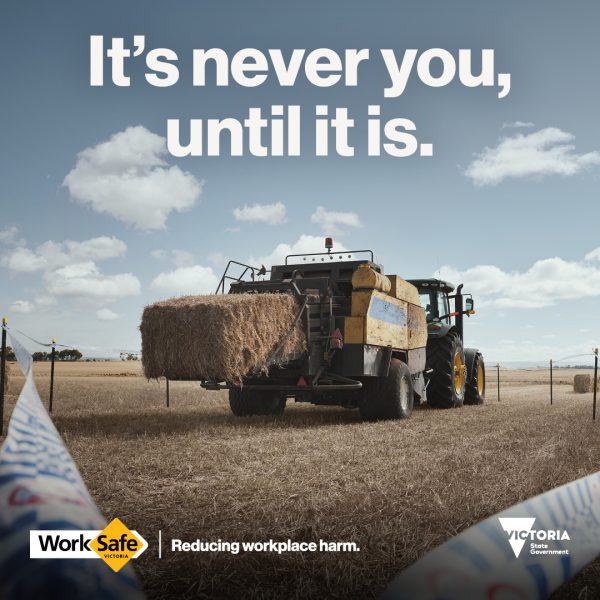
The idea that a serious incident won’t happen to experienced farmers can be common in agriculture, but after responding to dozens of farm emergencies, paramedic Jess Shepherd wants farmers to know everything can change “in the blink of an eye.”
Jess, who has been with Ambulance Victoria for 13 years, draws on her experience with farmers across Gippsland to have conversations about safer farm practices.
“We’re lucky enough to have that trust as soon as we walk in with this uniform, and I think that really helps when we give advice and when we express concern about safety,” she said.
In sharing her experiences as part of WorkSafe’s farm safety campaign, Jess reflected on one horrific incident involving an experienced farmer that has stuck with her.
“A piece of machinery came down on a farmer’s limb who had used the machinery hundreds of times before,” she said.
“When we arrived, it wasn’t bleeding profusely, but then as soon as the farmer let go of it, there was a lot of blood, and we could already tell that they would probably lose the limb.”
She later learnt the limb had in fact been amputated and they could no longer farm. This devastated her – a reminder that experience doesn’t make someone immune.
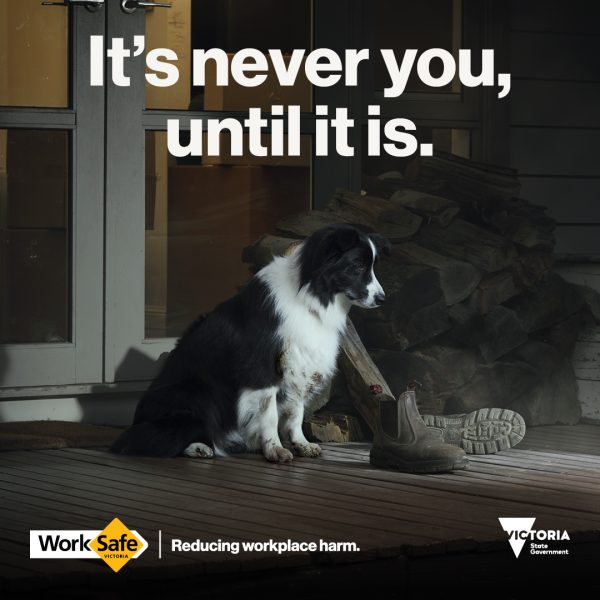
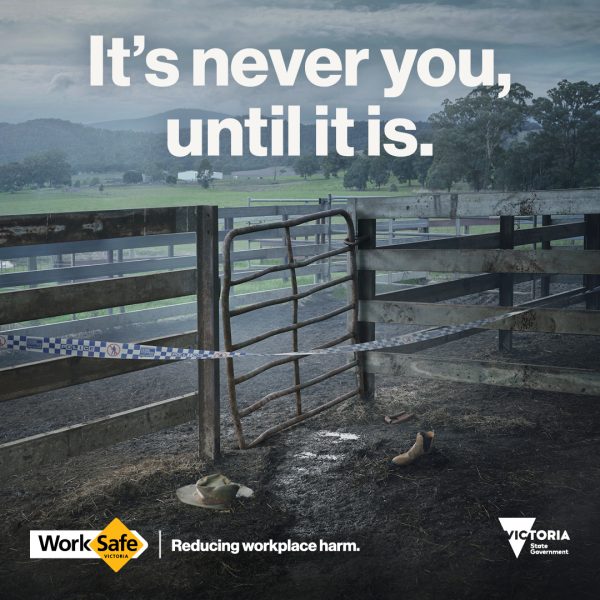
As WorkSafe’s emotive campaign, It’s never you, until it is, makes a return with new advertising across television, radio, print and digital media, it’s offering practical safety solutions for farmers and encouraging conversations around health and safety.
Tragically, three people in Victoria have been killed in the agriculture industry this year. This takes the number of agriculture deaths to 34 since 2019.
Communication and proactive safety measures can be the difference between life and death for Paul and Taylor Wallace who farm sheep at Ballangeich in the Western district.
“We take a proactive approach to safety. If something is broken, it can’t be used until it’s fixed. Things like making sure everyone knows that if they’re on the quad bike, they must wear a helmet,” Paul says.
“Common sense will only get you so far. Proper training and inductions for our staff must come into play because we can’t rely on common sense,” said Taylor.
WorkSafe Executive Director of Health and Safety Narelle Beer said every conversation about safety on farms helped shift the dial to prioritising safety.
“We’re working towards health and safety being a key part of farming operations, where raising concerns before they become larger issues and sharing beneficial safety advice are encouraged,” Dr Beer said.
“Things like good communication when working alone, checking in with yourself and others for signs of fatigue, prioritising maintenance and taking a minute to think through a job can all make a big difference for safety.”
Jess at Ambulance Victoria echoed these sentiments: “I’ve found that farmers are used to just pushing through and their bucket just fills up, drip by drip until eventually, the bucket overflows.”
“There should always be things in place to reduce the likelihood of…having that bucket overflow. Part of that is asking for help. Show the same concern for yourself as you would others.”


Farmer Health eNews September 2023
Find out the latest from the National Centre for Farmer Health
- Welcoming the next generation of students to NCFH!
- Supporting farm kids during Flood Recovery
- Getting Back On Track
- Needlestick Injuries: Your Safety, Our Priority.
Do you want to receive our eNews?
Build ‘Em Up Podcast, Episode 28: Encouraging cultural competence
“When a farm man or woman comes into an ED with chest pain, ‘how long have you had it ’, is an important question,” says Susan Brumby, Clinical Professor of the Faculty of Health, School of Medicine at Deakin University. “Often they have continued to work or do things before coming in,” she added.
Professor Brumby joins the Rural Health Alliance in Episode 28 of Build ‘Em Up to speak about the importance of health professionals’ cultural competence to deliver the best health outcomes for farm people. She speaks about the risks and challenges of farming, along with its great beauty, the autonomous nature of farm work and its impact on health and wellbeing.
Professor Brumby is the Founding Director of the National Centre for Farmer Health and an Associate Editor of the Australian Journal of Rural Health. She has made significant contributions to research and service delivery methods for engaging farm men and women in discussion about their health, wellbeing and safety.
Professor Brumby has received numerous awards recognising her contribution to rural health and has attracted over $3 million in grants and service delivery funding. In 2005, she received the Department of Human Services Award for outstanding contribution to rural health and in 2006, a Victorian Travelling Fellowship. In 2009, she was recognised with the Victorian Regional Achievement and Community Career and Trade Development Award.
eResilience
We all know that life can be unpredictable – and sometimes really tough – which is why the team at Resilience Builders have developed the online wellbeing and performance program, eResilience.
Thanks to the Victorian Government Department of Health, the self-paced online program is currently available for FREE to eligible regional Victorians.
Throughout the course, participants will learn how to incorporate strategies for building resilience into their everyday life, and will have access to a range of resources and tools to achieve their goals.
Interested? Find out more at resiliencebuilders.com.au/tour/eresilience.
Farmer Health eNews August 2023
Find out the latest from the National Centre for Farmer Health
- Championing Farmer Health: Introducing our new passionate farmer health nurse
- Farmer Perspectives on Flood Recovery
- Reflection on work placement at NCFH by Tillee Huf
- Hip hip ho-neigh!
- August Events
Do you want to receive our eNews?
Championing farmer health: Introducing our new passionate farmer health nurse Jeanne Van Der Geest Dekker!
Come and meet Jeanne, a farmer with a heart full of passion for her community and a wealth of diverse experiences. Raised on a family dairy farm, Jeanne now thrives as a partner in a share-farm agreement, overseeing a bustling 160-cow dairy operation in the picturesque South Gippsland, Victoria.
But Jeanne’s journey doesn’t end there. She’s not only a seasoned business manager but also a qualified Division 1 Registered Nurse, boasting over two decades of expertise in agricultural health and medicine. Throughout her career, she has played various integral roles, from being a caring District Nurse to a compassionate Care Manager and a diligent Practice Nurse. Her focus has always been on attending to the physical, mental, and emotional needs of her community.
Jeanne’s dedication to her field has been acknowledged through her participation in the esteemed Gippsland Community Leadership Program, proudly sponsored by the Gardiner Foundation. As a key investor in the development of the Victorian dairy industry and communities, the program has equipped Jeanne with valuable insights and knowledge to further excel in her endeavors.
Recognised for her expertise in farmer health and well-being, Jeanne regularly contributes insightful articles to the Devondaler, showcasing her deep understanding of the subject. Furthermore, she actively participates in policy development and advocacy as part of the Australian Dairy Farmers Policy Advisory Group, ensuring that the needs and concerns of farmers are heard and addressed.
Beyond her professional achievements, Jeanne’s passion for farmer health extends into the broader community. She has previously collaborated with the National Centre for Farmer Health, delivering valuable Health and Lifestyle Assessments (HLAs) at field days. Now, she eagerly embarks on a new chapter, having secured a rewarding 12-month contract as a Farmer Health Clinical Nurse. Her sights are set on the enchanting Southern Grampians region, where she aims to immerse herself in the local community and contribute her expertise as a vital member of the NCFH team.
Join Jeanne as she embraces her calling, making a lasting impact on the lives of farmers and nurturing the wellbeing of those who contribute so much to our society.
You can meet Jeanne at the upcoming Sheepvention in Hamilton, Victoria, by visiting the Producers Tent site number 7 – 9. You can also contact her via the details below.
Find out more about AgriSafe here: https://farmerhealth.org.au/agrisafe-clinics
Reflection on work placement at NCFH by Tillee Huf
The centre was lucky enough to host Psychology student Tillee Huf for the past four weeks during her work placement. Tillee is in her final year studying for a Bachelor of Psychology at Deakin University. We enjoyed having Tillee on the team and wish her all the best in the future.
Hear from Tillee…
During my four-week placement at the National Centre for Farmer Health, I have been able to give my input in nearly all the projects that the centre is involved in. This has given me an amazing overview of all the work that the centre does, and how the team members work together in different areas of farmer health to improve the wellbeing of farmers in all facets of life.
During the first week, I travelled to Maffra to observe and contribute to a resilience workshop for Agriculture Victoria employees facilitated by my new colleagues Kelly and Lauren. I learnt about how they present workshops and also had the opportunity to participate in the workshop so that I can give them feedback on how the workshop is received as a participant. This was a great experience to have and opened my eyes to some of the work that the employees at the centre do, and what my future career could look like after graduation. The conversations that I had following the workshop with my colleagues were very insightful and I loved hearing about how they presented their workshops and how they could improve for next time, both from a presenter and participant perspective. Travelling with colleagues for work in my first week also gave me the opportunity to learn more about them and network for my future.
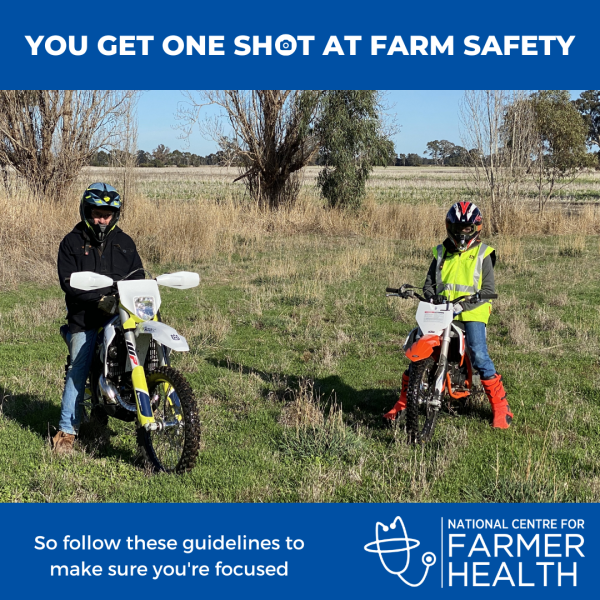
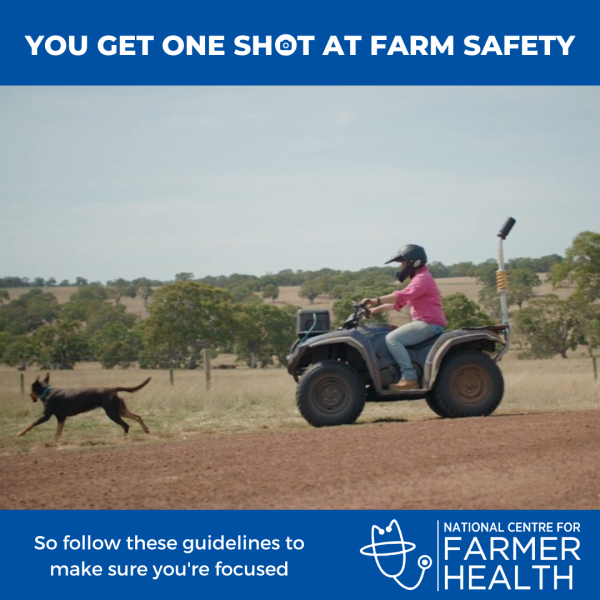
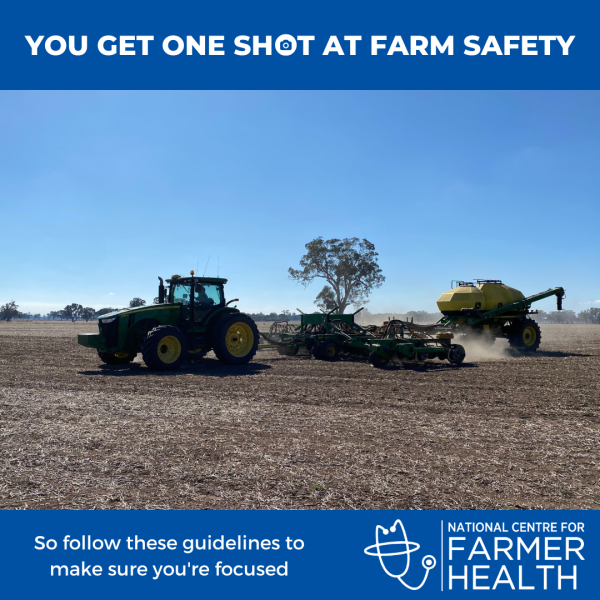
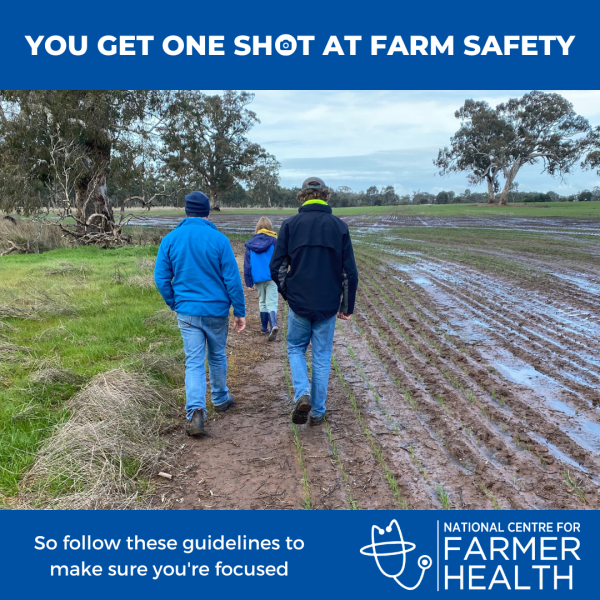
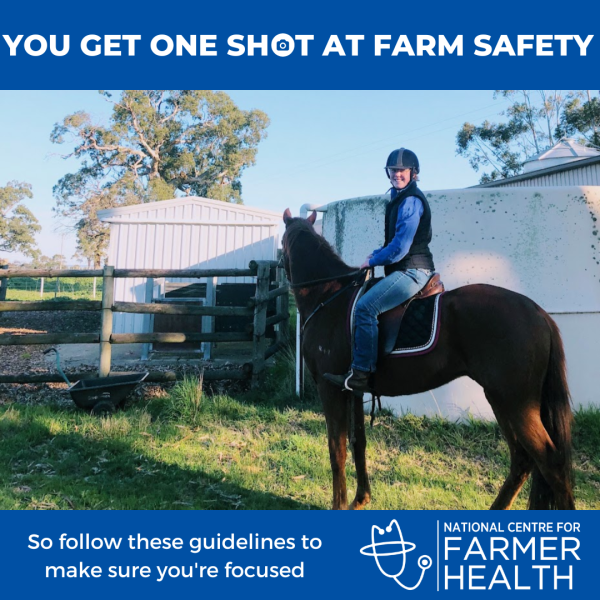
In the following weeks, I was involved in a social media campaign for Farm Safety Week, creating captions and putting together photos for the posts. This was a process that I thoroughly enjoyed, and I loved getting creative with Amity, Kylie, and Matilda to come up with our own slogan for our campaign. We focused on posting farm-safe photos which makes farmers more aware of safety on their own farm, in addition to promoting farms as safe environments for others. During this process, I learnt how to use Canva to create and edit the posts for our campaign. It was really rewarding this week to see my work on my own social media feed, and I could see the impact it was having on other farmers.
I also learnt about research and how to format an article for submission before it was published, which was my most difficult task thus far. I had never formatted an article before and was unfamiliar with the programs used to do so. I appreciated the hints from Amity and felt grateful that I could help her with her work and work through the issues independently. I also enjoyed shadowing Amity while we discussed farming policies and practises with some social work students who weren’t from farming backgrounds. This task made me feel proud to be from a farming background, and I enjoyed sharing some of my experiences on the farm with the students which would help them with their learning and understanding the challenges farmers face.
Overall, this experience has been above and beyond what I thought it would be, and I am grateful to all the staff members here at the centre for making me feel welcome and giving me an opportunity to learn a new skill and be involved in their work. My time at the centre has cemented my career path in farmer mental health, and I am grateful for the connections I made whilst on my placement. This experience has made me immensely proud to be a farmer, and I love advocating for people in the farming community both in my circle of neighbouring farmers at home and farmers all over Australia.


Win a Yeti! Complete the Farm Safety Survey to enter
We’re thrilled to announce the official launch of the S3F Agriculture Safety Learning Network! Together, we can create a safer farming environment by developing practical farm safety resources. And guess what? You have a chance to win a fantastic Yeti half-gallon flask!
We need your valuable input to make a real difference. By taking just a few moments to complete our short survey, you’ll provide us with essential insights into the current farm safety measures in place. This knowledge will guide us in focusing our time and resources on minimizing risks for you, your hardworking team, and your beloved family.
Don’t worry, we’ve made it quick and easy for you. The survey consists of only 14 simple questions that most people can complete in just 10 minutes. Your responses will remain completely anonymous, allowing you to share your thoughts and experiences with confidence.
Mark your calendars! Winners of the Yeti half-gallon flask will be notified in July. So don’t miss out on this incredible opportunity to contribute to farm safety and have a chance at winning an awesome prize. Click the link below and let’s make a positive impact together!

Farmer Health eNews July 2023
Find out the latest from the National Centre for Farmer Health
- Empower Your Students for Agricultural Success
- Enhancing Understanding and Adoption of Steering Straight
- Protecting Children on Farms: Blog Post
- Understanding Q Fever: Risks, Prevention, and Awareness
- July Events
Do you want to receive our eNews?
Supporting Teachers to Deliver Farm Safety Education: Introducing Shifting Gears
| Hamilton, Victoria, 13/06/2023 – The National Centre for Farmer Health introduces Shifting Gears, an innovative farm health and safety program for schools that is set to revolutionise agricultural education. Developed as a teacher-led, secondary school-based program, Shifting Gears aims to enhance farm safety culture and bridge the gap between agriculture and horticulture studies and the national skills program. Shifting Gears stands out from other initiatives by presenting the broader context of agricultural injury in rural Australia through relatable content tailored specifically for young people. This groundbreaking program promises to provide valuable insights and knowledge for middle and senior school students residing on farms, studying agriculture and horticulture, or exploring careers in the field. Alarming trends have surfaced from recent data collected by the National Centre for Farmer Health about child safety on farms. Statistics from the Gear Up for Ag program show that over half of the participants were 8 years old or younger when they began work on the farm. Disturbingly, among those currently riding a quadbike on a farm, only half reported wearing a helmet most or all the time, with 60 percent carrying passengers. Moreover, 72 percent of students expressed concerns about the safety of their family or friends on the farm. Of the students currently helping or working on farms, 47 percent state they supervise others, primarily siblings. To address these critical issues, educators are invited to participate in the Shifting Gears education pilot, beginning Term 3 this year. This program is free to participate in, available to schools nationwide, and aims to equip school teachers with the necessary tools and knowledge to integrate the intervention program into their agricultural curriculum. A webinar, led by experts from the National Centre for Farmer Health, will be held on 22nd June from 12:30 – 1:30pm. The webinar will emphasise the significance of incorporating health and safety conversations into teaching practices. Teachers and school representatives interested in the program are encouraged to register on the National Centre for Farmer Health website www.farmerhealth.org.au to explore this exciting resource and become catalysts for positive change in farm safety practices. To engage students effectively, the National Centre for Farmer Health has created unique farm safety audiovisual (AV) materials and digital animations, together with teacher resources and activities for students that capture the essence of the Australian farming experience. These documentary-style AVs connect safety concepts with human health, offering a meaningful and relatable approach for both students and teachers. In addition, digital animations have been designed to convey farm safety theories through a creative and engaging medium. Recognising the importance of classroom support, Shifting Gears offers teachers a range of resources, including health and safety statistics, discussion topics, and activities. These materials are aligned with the AVs, streamlining lesson planning and content sourcing for educators. “This is an exciting opportunity for educators to enhance their agricultural and safety expertise,” says Dr. Alison Kennedy, Director of the National Centre for Farmer Health. “By joining us in the Shifting Gears pilot program, educators can play a vital role in cultivating a culture of safety in the farming community.” Event registration link: https://utm.guru/ufLWm Shifting Gears Pilot Page: Shifting Gears | National Centre for Farmer Health ENDS. For media enquiries or interview requests, please contact: Annabelle Macgugan Marketing Coordinator amacgugan@wdhs.net 0458517699 About the National Centre for Farmer Health: The National Centre for Farmer Health is dedicated to improving the health, safety, and wellbeing of farmers, farmworkers, and their families across Australia. Through research, education, and advocacy, the centre addresses the unique health challenges faced by those working in agriculture and promotes sustainable farming practices. Note to editors: High-resolution images and additional information about Shifting Gears are available upon request. |
Improving the Understanding and Uptake of Steering Straight
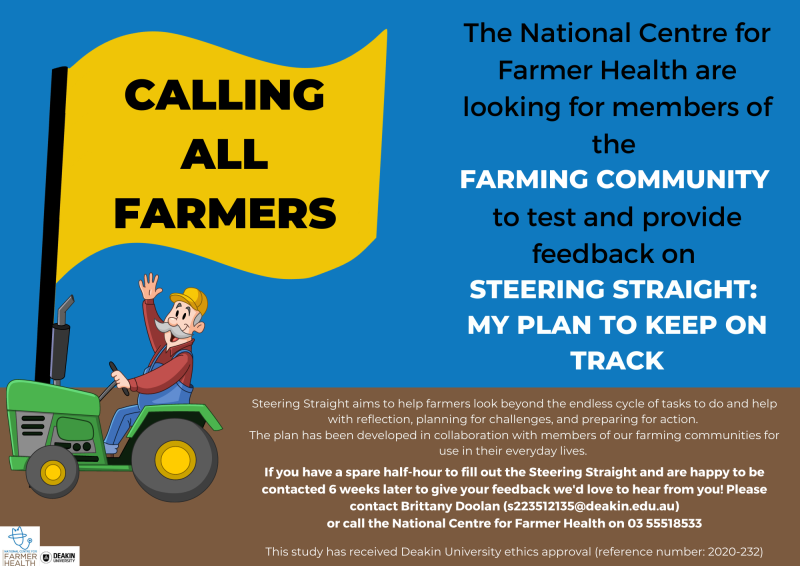
The National Centre for Farmer Health are looking for members of the NSW farming community to test and provide feedback about Steering Straight: My Plan to Keep on Track. We are looking for people who can complete the plan (it takes roughly 15 – 30 minutes) and then partake in a short phone interview about 6 weeks later.
This resource aims to help farmers look beyond the endless cycle of tasks to do, and help with reflection, planning for challenges, and preparing for action. The plan has been developed in collaboration with members of our farming communities for farmers to use in their everyday lives.
If you can help us improve the wellbeing of our farming communities, we would love to hear from you! Please contact Brittany Doolan (s223512135@deakin.edu.au) or call the National Centre for Farmer Health on 03 55518533.
This study has received Deakin University ethics approval (reference number: 2020-232)