Farmer Health eNews May 2020
Find out all the latest from the National Centre for Farmer Health
- Primary Producer Knowledge Network (PPKN) – Join our network (EOI close 11/5/20)
- Healthy and Sustainable Agricultural Communities (HMF702) unit enrollments & Scholarships now open
- Online Psychology Service
- Wellness Wednesday
Do you want to receive our eNews?
2020-05-04: Not mentally ill but distressed – Stock and Land
Royston “Doc” Nettleton had been putting it off but the chest pains and headaches had gotten so bad, the dairy farmer reluctantly presented himself to his local hospital.
They kept him in overnight for tests but sent him home with a clean bill of health.
But after two or three similar hospital stays looking for the the cause of the pain, a locum had some advice for the Orbost resident.
“Once they clear the old ticker, they think, ‘Oh, well you’re (physically) alright’,” Mr Nettleton said.
“They just put it down to stress.
“The doctor told me to go on a big holiday and all that sort of stuff.”
How realistic was the advice?
“Not realistic at all.”
Dairy farmer and president of the Orbost-Snowy Rovers, Royston “Doc” Nettleton is a busy man not known for taking holidays.
“When you’re milking all-year-round and you’re president of the local footy club, life’s busy, you can’t just run off for a holiday whenever you want,” he said.
“I just tried to stop and start again and that was it, really, try to just do the best I could.
“I was just trying not to let things affect me as much, you know?
“I’m really good now, don’t worry about that.
“Sometimes just some little things get you down but you get over it, move on, talk to my mates.
“Close mates check in on me, ask me how I’m going.”
The stress had built up slowly as Mr Nettleton dealt with a combination of off-farm and on-farm issues, including the four-year drought afflicting east Gippsland and the dairy crisis.
Mr Nettleton said he thought there might be counselling available 60 kilometres away at Lakes Entrance but in his local town, the best option was to visit a general practitioner.
It was important to push yourself to seek help before the stress got too difficult to handle, he said.
“Don’t be afraid to go to your GP.”
“The hardest thing is making the appointment, I find.”
Self-doubt got in the way.
“What initially I’d think was, ‘Is it worth going to the doctor, am I wasting everyone’s time?’, that sort of thing,” Mr Nettleton said.
“But once you make an appointment, away you go, you front up for it.”
Access inequity
Mr Nettleton’s experience of difficulty accessing specialist help in far east Gippsland is borne out by the numbers.
The more rural you live, the higher your risk of suicide, alcohol and drug use, and the more likely you are to spend a night in hospital to deal with intentional self harm or mental illness.
But none of this is because you’re more likely to be mentally ill – those rates are the same as if you lived in the city – it’s more likely linked to another key statistic: access to help.
Good help really is hard to find in the country and the statistics that appear in a new Swinburne University report bear that out.
City dwellers access Medicare-subsidised mental health services at about four times as often as their cousins in inner-regional areas.
Specialists like psychologists and psychiatrists are few and far between, and not just because the population’s more sparse.
There are four times as many psychiatrists per city-dweller than out in the bush.
Distressed, not ill
Rural mental health expert Dr Alison Kennedy said, Australians living outside the major cities have different causes of stress and different ways of coping.
Many are not mentally ill but in potentially damaging psychological distress, nonetheless.
“We can’t have that narrow focus on people who have only been diagnosed with a mental illness – we do have to look much more broadly than that,” Dr Kennedy said.
“In the past, suicide is always associated with mental illness.
“It’s really becoming apparent now that mental illness is just one factor in a whole range of complex factors.”
She says it’s time Australia looked at the situations farmers find themselves in that cause dangerously high stress levels and work on practical solutions.
Practical plan
Dr Kennedy hopes a new project called The Primary Producer Knowledge Network that was developed by the National Centre for Farmer Health (NCFH) would deliver practical plans for farmers.
“People in primary production are, on the whole, incredibly practical people,” she said.
“Mental health is an emotional topic but there are also a whole range of practical things we can do to support our mental health and to prevent ourselves from the risk of mental injury.”
The network’s shape is not fully formed, with the design being developed in conjunction with farmers, Dr Kennedy said, and would offer strategies and resources delivered through a website, interactive capacity-building program and social media platforms.
The focus would be on how workplaces could prevent distress.
“This project is quite unique,” Dr Kennedy said.
“A lot of the work at an individual level has been looking more at health promotion.
“We’re looking at it much more from a prevention kind of focus.
“This project is being funded by WorkSafe’s WorkWell Mental Health Improvement Fund and safety is very prevention focused.
“Rather than talking health promotion, we’re looking at the step before that, getting systems and procedures to prevent people from experiencing stress and for that to develop into risks to mental health.”
An example could be as simple as finding ways to manage breaks from farming.
“We think of some of these sectors as being kind of 365 days a year roles where it’s really hard to take a break,” Dr Kennedy said.
“We know that being able to take time away from a farming business is really valuable to people’s mental wellbeing and their ability to take stock and have a fresh perspective on things.
“There are practical things that we may be able to do… to help people put some sort of separation between their work in their home-life to create some space for themselves.”
The NCFH was calling for expressions of interest from primary producers and other stakeholders to engage in the design, with applications opening this week.
READ MORE: 2020-05-04: Not mentally ill but distressed – Stock and Land
Coronavirus (Covid-19) : you and the farm
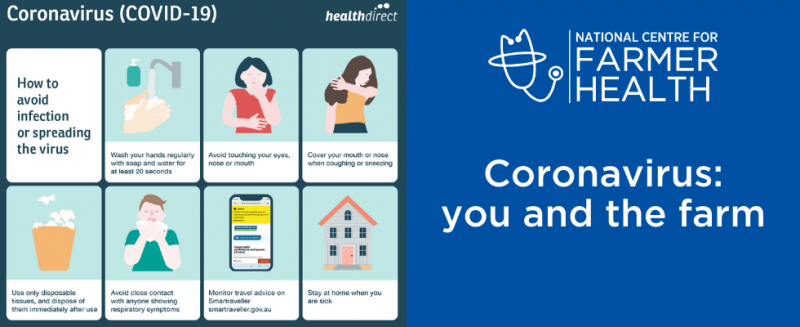
Do you have your COVID-19 farm plan? Hear how Morna and Jeff are doing theirs
Episode 2
Episode 1
This is a difficult time for us all.
Simple measures like hand washing, staying home, self isolating if you have symptoms – even with a common cold – will help stop viruses and germs spreading. And in the midst of the Coronavirus pandemic and the state of emergency, that’s critically important.

Thinking about your farm calendar:
- Plan as far ahead as possible and be prepared for increasing restrictions on travel and movements as the need to further control the spread continues
- Supplies, parts, and agrichemicals may become in short supply so consider methods to reduce usage
- Plan for being unwell and needing to rest in bed ie what are the absolute essential tasks which need to be done
- Caring for children if schools are closed or school holidays extended – particularly if your partner works in health care/ aged care
- Contract agricultural staff may be difficult to source with overseas visas and travel bans in place
- Commodity prices may be affected and the possible stresses for that
- Shortage of respiratory masks—your farm PPE may need to be used
- Using products other than toilet paper will block your septic tank—make this time an opportunity to water your citrus trees
Continue your healthy habits: exercise, drink plenty of water, eat healthy food, get plenty of sleep, make time to keep in touch and connect with family electronically.
What you can do?
- The rapid spread of the virus, and worried people, can overwhelm doctors and hospitals who are already dealing with daily health needs.
- NB rather than spread a virus into waiting rooms, patients should stay home and phone their GP or contact the Coronavirus Health Information Line on 1800 020 080.
- Make sure you have a plan for the family and kids and also work in and around the farm – with staff and contractors with cleaning, ample soap and water and hand sanitizer
- DHHS are now encouraging ‘asymptomatic’ (no symptoms) testing. READ MORE
- Looks at the next list (see below) for differences in symptoms as we head into Autumn and Spring
- Get vaccinated for all required outstanding vaccinations for yourself and your family—with flu vaccines available around mid-April
- IF you have travelled recently and or have been in contact with anyone who is ill and or is a confirmed positive Corona case see as above
- Do something kind—kindness can be contagious too! Do you have excess produce you can give to someone in need ie fruit, eggs, vegetables?
There are many commonalities between coronavirus symptoms and flu symptoms. However, with so little known about the new coronavirus, it is extremely difficult to delineate differences that would help identify which illness they have without proper testing.
SUPPORT CONTACT NUMBERS ONLINE PSYCHOLOGY SERVICECoronavirus
According to the World Health Organisation (WHO), common symptoms of coronavirus infection include:
- Fever
- Cough
- Fatigue
- Shortness of breath
- Breathing difficulties
In severe cases, symptoms become more advanced:
- Severe acute respiratory syndrome
- Kidney failure pneumonia
- Death
To highlight the difficulty of accurately describing coronavirus symptoms, around 5% of cases report a sore throat and runny nose, while a small percentage also report diarrhoea and vomiting.
Influenza
Influenza has been widely researched and most Australians are probably already familiar with its symptoms. However, according to WHO, they can include:
- Fever (often with abrupt onset)
- Chills
- Sore throat
- Cough
- Headache
- Muscle pain
Still not sure? >>Consider where you live and where you have been in the last 14 days. If you live in an area with very limited cases of known coronavirus, and you find yourself with a sore throat or a runny nose and some muscle pain, you are more likely to have the flu than coronavirus.
Read more:
Victoria
- Department of Health and Human Services
- Department of Health and Human Services – Coronavirus (COVID-19) daily update
- WorkSafe – find the latest information about coronavirus (COVID-19) and preventing exposure in the workplace
- Department of Health and Human Services – COVID-19 Workplace Symptom Checklist
National
- Australian Government – Department of Health – what do you need to know about coronavirus
- Healthdirect website – includes symptom checker
- Coronavirus Australia app
- Subscribe to the Australian Government WhatsApp Channel
- COVIDsafe app – Read more and download
International
Safe Work Practices during COVID-19
- Safe Work Australia Agriculture Industry COVID-19 factsheet
- AWI Woolgrowers & COVID-19
- Sheep Central – Shearing Operations Protocols during COVID-19

Farmer Health eNews April 2020
Find out all the latest from the National Centre for Farmer Health
- Children on Farm
- Stay fit and healthy
- New publications
- Farming and non-farming related suicides in rural Victoria – how different are they?
- Changing attitudes and behaviours towards agrichemical safety in Australian farmers.
- Chronic effects of organophosphate exposure on farmers – a narrative review.
- Wellness Wednesday
Do you want to receive our eNews?
2020-04-01: Farmers need to follow health rules during coronavirus pandemic – The Weekly Times
IN THESE extraordinary times as the coronavirus pandemic continues to spread across the world, agriculture and specifically, agricultural jobs, are essential for agricultural production.
And with governments at all levels tightening restrictions in response to COVID-19, farmers need to remember, despite being isolated, they are not immune to the virus and the flow-on effect of government lockdown restrictions.
That’s why it’s vitally important farmers ensure they embrace prevention measures like hand washing, staying home, and practising physical distancing principles to help stop the spread of the virus.
Already we have had a number of distressed calls from people on hobby farms asking how they access Centrelink, and farmers who are struggling to get their hands on personal protective equipment.
The National Centre for Farmer Health is encouraging farmers to plan ahead and follow these simple tips.
BE prepared for increasing restrictions on travel, movements, and difficulty sourcing staff.
PRACTISE physical distancing with staff and family and ensure shared surfaces and equipment such as utes, tractors and work tools are regularly cleaned. If possible nominate one vehicle per person.
MAKE sure there is a place to keep children engaged and safe on the farm during the school holidays. No matter how difficult it is to be a farm parent, think how much harder it would be if a child suffered a serious injury. With current restrictions at hospitals you may not be able to visit.
STAY physically fit, eat well, manage fatigue, and work safely.
CONSIDER methods to reduce the use of supplies, parts, agrichemicals and personal protective equipment that may already be, or become in shorter supply.
THINK about how you will continue to run the farm if you need to rest or self-isolate due to COVID-19 or other illness. And share a list of must-do tasks if you do become unwell, so essential farm work can continue.
STAY socially connected but physically distant.
The drought and the effects of bushfires continue to affect rural communities. While many farmers are used to working in isolation, it is more important than ever that they make time to stay connected to their social networks.
With the usual local and district social events no longer possible, take time to connect with family, colleagues and friends by phone or virtually.
Australian farmers are resilient, and, like everything they have dealt with before, from droughts and floods to bushfires, will get through this together. But stay home!
Keep up to date with the latest correct coronavirus information from the Victorian Department of Health and Human Services at dhhs.vic.gov.au/victorian-public-coronavirus-disease-covid-19.
Read more on farm fitness: CLICK HERE
View full article: 2020-04-01: Farmers need to follow health rules during coronavirus pandemic – The Weekly Times
Farmer Health eNews March 2020
Find out all the latest from the National Centre for Farmer Health
- Becoming AgriSafe™ Clinicians – what’s the next step?
- We’re heading to Wimmera Field Days
- Expressions of interest OPEN! Join the www.farmerhealth.org.au website committee
- Wellness Wednesday
Do you want to receive our eNews?
Farmer Health eNews – February 2020
Find out all the latest from the National Centre for Farmer Health
- Recovery after bushfire – the early days
- HMF701 2020 Enrolments now open
- Young Adult (12-25) digital storytelling workshop 2020 – that’s a wrap!
- Wellness Wednesday
Do you want to receive our eNews?
2020-1-21: Media Release – Free workshop to help rural communities navigate tough times
Staying healthy, both physically and emotionally, is important in good times and even more so in trying times.
In February, the National Centre for Farmer Health will facilitate free workshops to help farmers, agricultural workers and industry representatives gain practical skills and knowledge to better equip themselves with the stressors of life.
Five sessions of the ‘Navigating tough times’ workshop will be held across the Wide Bay and Burnett area between 3 and 7 February.
With disaster recovery firmly on the mind of many Australians, workshop facilitator Dr Alison Kennedy said it’s more important than ever to encourage those living in rural communities to recognise and respond to signs of distress.
“There’s so much happening Australia-wide at the moment and the ‘Navigating tough times’ workshops aim to help farmers and rural community members navigate what are ongoing seasonal challenges”, Dr Kennedy said.
“It’s vital we empower people to look after themselves, and look out for each other before exposure to tough times manifests as a physical or mental health condition.”
The National Centre for Farmer Health provides leadership in improving the health, wellbeing and safety of farm men and women and their families and communities across Australia.
The Centre has delivered the three-hour ‘Navigating tough times’ workshop in drought affected Victoria and other parts of Queensland.
“It is through encouraging community-based support like this that the stigma associated with seeking support can be reduced,” Dr Kennedy said.
“We wish to thank the Central Queensland, Wide Bay, Sunshine Coast PHN, Richmond Fellowship Queensland and North Burnett Community Service for recognising the clear need to support farming and rural communities through tough times and inviting us to come to the region.”
‘Navigating tough times’ will be held in Maryborough on 3 February, Monto on 4 February, at Binjour on 5 February and Biggenden on 6 February before returning to Maryborough on 7 February. For more information and to RSVP, please visit farmerhealth.org.au/events.
***ENDS***
For more information or to arrange a media interview, please contact:
Dr Alison Kennedy
Research Fellow
National Centre for Farmer Health
(03) 5551 8587
a.kennedy@deakin.edu.au
Tierra Moore
Richmond Fellowship Queensland
0451164383
Tierra.Moore@rfq.com.au
(Maryborough Workshop)
Russell Mills
North Burnett Community Service
0427 654 690
spcoordinator@nbcs.org.au
(Monto, Binjour, Biggenden workshops)
Farmer Health eNews – January 2020
Find out all the latest from the National Centre for Farmer Health
- Navigating tough times workshops in Queensland
- New online psychology Service
- HMF701 Enrolments
- Wellness Wednesday
Do you want to receive our eNews?
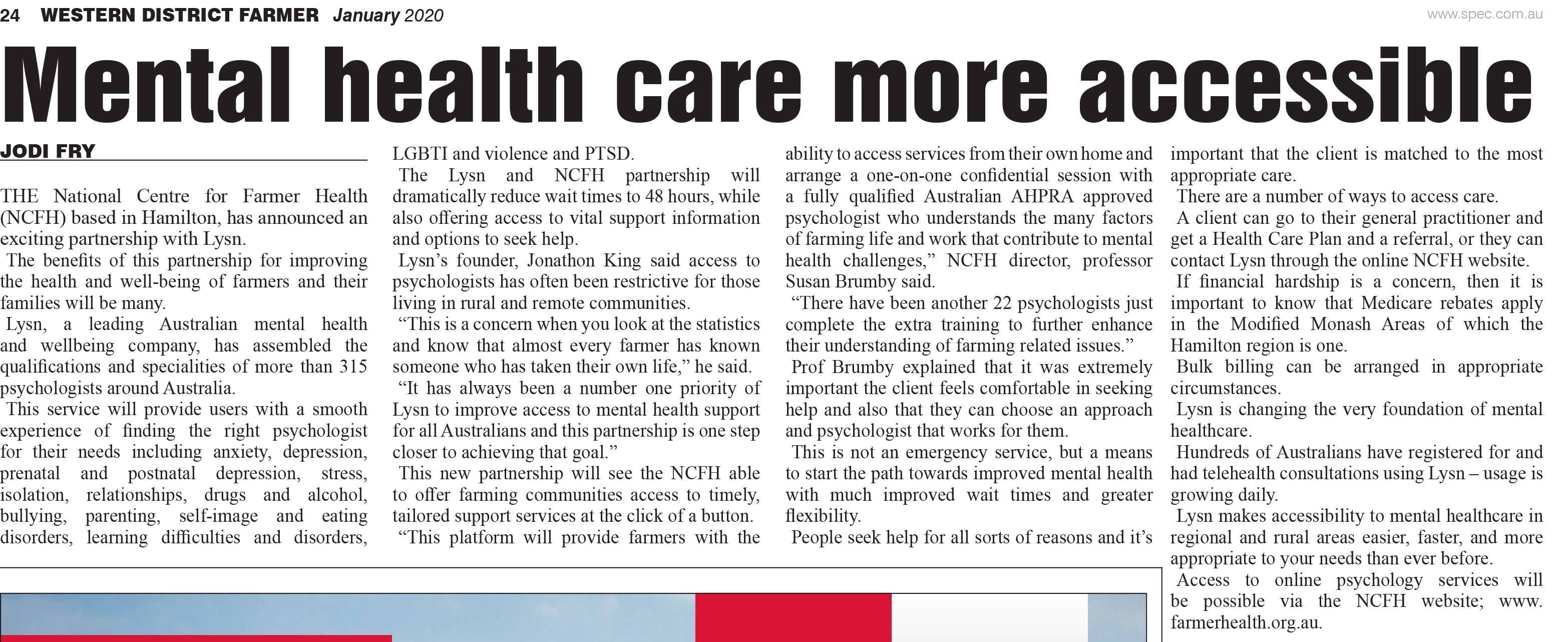
2020-1-1: Mental health care more accessible – Western District Farmer
Sustainable Fishing Families: Developing industry human capital through health, wellbeing, safety and resilience
An industry is only as healthy and sustainable as its members. In recent years, concern for the
health, safety and wellbeing of the professional wild-catch fishing industry has been growing in
Australia.
In response, this project conducted the first national survey of the health, safety and wellbeing of
the Australian professional fishing industry in 2017. The results of the survey provide a baseline
for the state of the wild-catch industry members across a range of indicators, including reported
physical and mental health, factors affecting health and safety, factors affecting levels of stress,
health and safety behaviours, and access to health services and information.
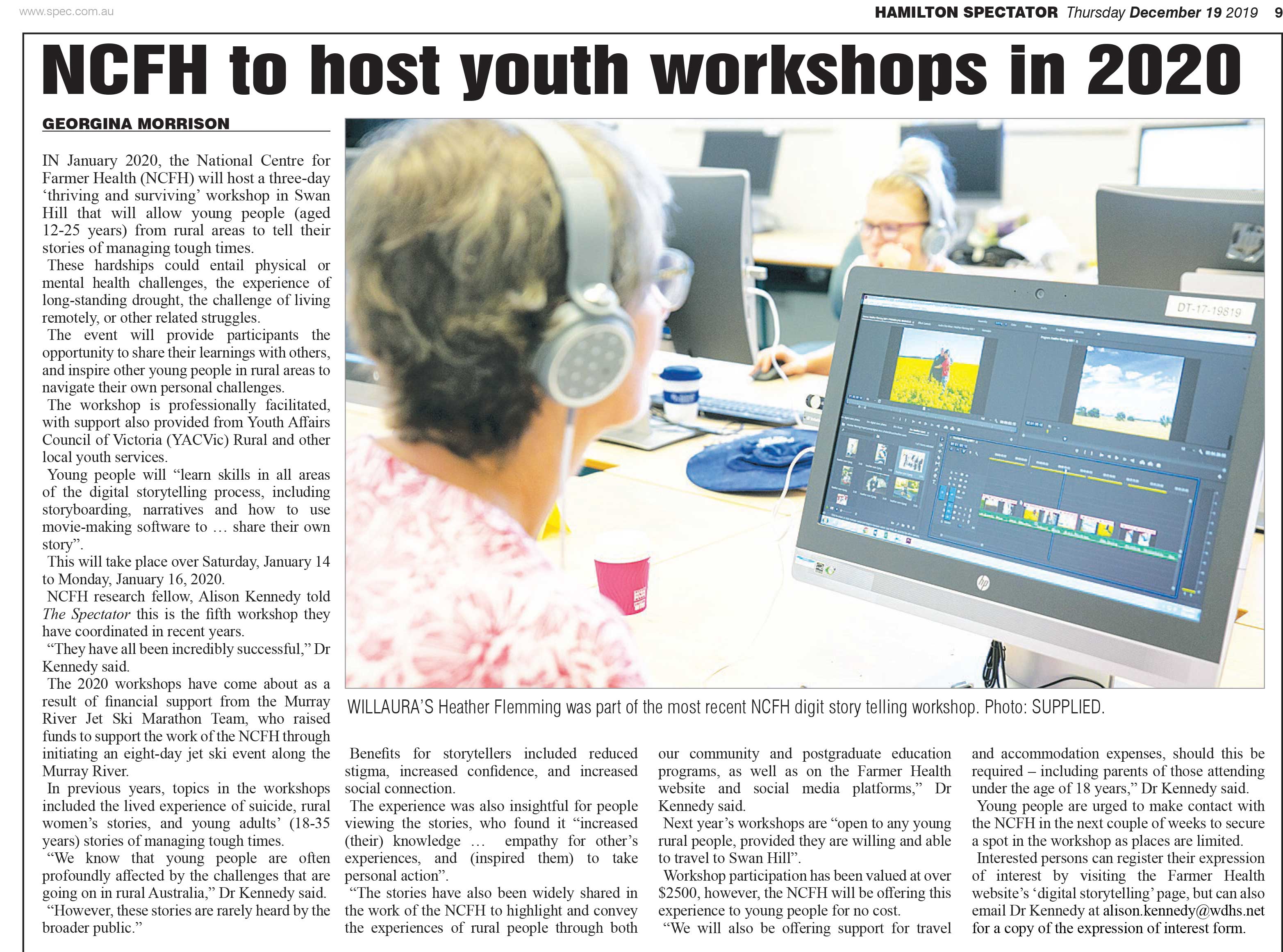
2019-12-12: NCFH to host youth workshops in 2020 – Hamilton Spectator