

Grow your career as a Research Assistant with the National Centre for Farmer Health.
Casual Research Assistant position with the National Centre for Farmer Health.
Applications close: Sunday 14 June 2026
Exciting opportunity to join our team as a Casual Research Assistant. At the NCFH, we are engaged in a wide range of research activities across the areas of physical health, mental health and farm safety.
This position would suit an Early Career Researcher (ECR) looking to build a research track record with an interest in working in (or returning to) a rural community. The position will offer exposure to a wide range of research experiences (with a strong focus on translational research) and provide a challenging and growth-oriented career opportunity.
An initial focus of the role will be on supporting the evaluation of our Health and Lifestyle Assessment program, while collaborating with internal teams, partner universities, and farming communities. Key responsibilities include attending project meetings, liaising with stakeholders, assisting with data collection, and contributing to the reporting and presentation of research findings.
Further Information
To view the position description and to apply, please be directed at the button below. For further details please contact NCFH Director, Alison Kennedy, via email: alison.kennedy@wdhs.net or phone Tel (03) 5551 8533.
To view other career opportunities at the NCFH, please visit our careers page.
Farmer Health eNews June 2026
Find out the latest from the National Centre for Farmer Health
- Farmer health scholarship applications now open
- Participants needed: Chronic pain research for farming communities
- Improving mental health and wellbeing support for parents in rural and regional areas
- Upcoming events
View the June 2026 e-newsletter
Do you want to receive our eNews?
Applications now open for HMF702 scholarships.
Grow your impact. Support farming communities. Apply for a farmer health study scholarship.
Australia’s agricultural communities face unique and evolving challenges. From climate impacts and workforce pressures to mental health and service access. HMF702: Healthy and Sustainable Agricultural Communities provides the knowledge and skills to drive meaningful, place‑based change.
With support from the National Centre for Farmer Health, a limited number of half-scholarships are available for Trimester 2, 2026 (Jul – Oct), helping to support rural professionals to undertake this 100% online Deakin University postgraduate unit.
If you work in health, agriculture, policy, education, or community services and are passionate about strengthening the wellbeing of farming communities this opportunity is for you.
Applications open 25 May and close 25 June 2026.
Invest in your professional development and help shape healthier futures for agricultural communities. Visit www.farmerhealth.org.su/scholarships or contact Dr Jacquie Cotton j.cotton@deakin.edu.au for further information.
Vic government continues investment to support farmer health with critical funding
The National Centre for Farmer Health (NCFH) has welcomed $900,000 in funding from the Victorian Government in this week’s Budget announcement.
In a time of unprecedented pressures, the investment will ensure farmers can continue to access the NCFH’s evidence-based programs, services and resources to support their health, wellbeing and safety.
“The current challenges facing our farmers are unlike anything we have seen before. The effects of rising input costs, fuel shortages, volatile markets and an ever-changing climate are compounded at the farm gate and our farmers are feeling it,” NCFH Director Alison Kennedy said.
“The Victorian Government’s commitment of $900,000 in funding shows that they see our farmers, and they are committed to investing in the health, wellbeing and safety of the people who produce our nation’s food and fibre. We are very grateful for the continuation of this decades-long support.”
The NCFH is a partnership between Western District Health Service and Deakin University. Since 2008 it has worked with primary producers, agriculture industry members, researchers, health services and all levels of government to develop and delivera range of programs and resources, including:
- Health and Lifestyle Assessments where farmers can get a free health check at industry field days and events – bringing medical professionals directly to them
- The national Shifting Gears farm safety education program for high schools, including a new module on hearing health
- Farmer-focused resources to support their mental health and wellbeing, including the online Support Hub and Managing Stress on the Farm booklet – resources which have been increasingly accessed by farmers in recent months.
“We see first-hand how our services and programs have long-lasting impacts on the lives of farmers, their families and communities,” Alison said.
“Around 20 years ago, sheep farmers Tony and Angela Kealy took part in our Sustainable Farm Families program after encouragement from a farm consultant. What started as a health check became a long-term shift in how they approach wellbeing – they not only transformed their own habits which continue today, but they inspired their children to do the same.”
The NCFH invests government funding in the operation of the Centre, to support the delivery of programs and services to Victorian farmers. Building on this, the NCFH is active in securing additional funding and grants for health projects and research from around Australia – enabling them to reach more farmers nationally and deliver innovative longer-term projects.
The NCFH also recently hosted a Partnering for Impact: Industry Showcase which brought together partners, sponsors and industry leaders to celebrate collaborative achievements that are driving long-term change, and discuss the opportunities to further strengthen farming communities across Australia.
“We are committed to long-term collaborations with partners who share our dedication to improving outcomes for farmers and their families. This ongoing support not only guarantees a continuation of our research into the health needs and priorities in rural Australia, but also ensures we can scale-up our programs to reach more farming communities,” Alison said.
“Government funding, corporate and philanthropic partnerships, in-kind support and other collaborations are all crucial to the future of the NCFH and there are many ways to partner with us to achieve on-the-ground impact.”
For more information or to find out how to support the National Centre for Farmer Health, visit farmerhealth.org.au.
* END OF RELEASE*
For more information, please contact:
Dr Alison Kennedy – Director, National Centre for Farmer Health
P: 03 5551 8533 | M: 0407 549 970 | E: alison.kennedy@wdhs.net
Farmer Health eNews May 2026
Find out the latest from the National Centre for Farmer Health
- Partnering for Impact: A time for reflection, celebration and opportunity
- Important update: Farmer needlestick injury resources
- Support through prolonged drought: Drought Hardship Loan
- Upcoming events including walk-in clinics
View the May 2026 e-newsletter
Do you want to receive our eNews?
Important Update: Farmer Needlestick Injury Resources, April 2026.
We’ve released an updated Farmer Needlestick Injuries – Risks and Recommended Treatments Table and Brochure to reflect new products and the latest safety guidance, helping you respond quickly and appropriately if an incident happens and what to take with you when getting medical attention.
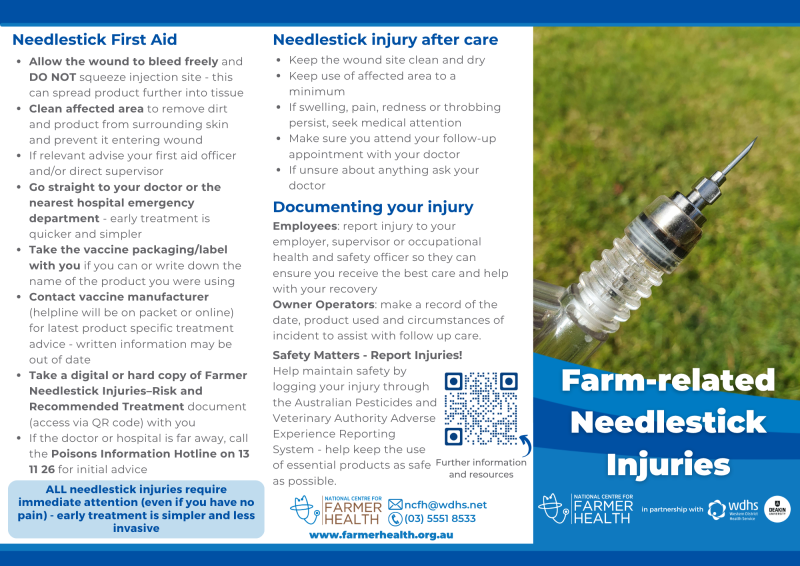
With several recent incidents, it’s vital those working with livestock and health professionals have access to the most up-to-date information to reduce risk, support correct clinical management and safe handling practices.
Working with livestock injectables, especially oil-based adjuvants, carries serious risks if a needlestick injury occurs.
These resources are particularly important for sheep and cattle producers and anyone handling vaccines or injectables on-farm.
Older versions have now been superseded. To avoid confusion, make sure you’re using the latest version dated April 2026.
To access our updated resources, Please visit our Farmer Needlestick Injuries page at the button below.
Heart Health
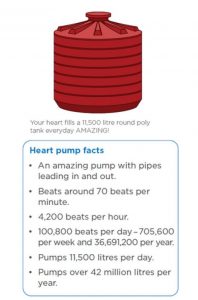
Australians living in rural and remote areas experience more cardiovascular disease (CVD) risk factors, higher rates of CVD-related hospitalisation and are more likely to die of CVD than those in metropolitan areas. The further a person lives from a metropolitan centre, the greater their risk of hospitalisation and death from cardiovascular disease. Living and working on a farm can mean that you are even further away from Emergency Departments that are suitable to treat a possible heart attack. Because of the distance, farm men and women often wait too long before seeking help. With heart attacks every minute counts and getting medical help quickly is important to save heart muscle.
Many women mistakenly believe that heart disease is only a male problem and dismiss their symptoms or don’t seek help until their condition becomes serious. This is of great concern as heart disease is currently the leading cause of death in women and men.
Contributing factors for higher rates of CVD in rural and remote communities are the result of many compounding issues:
- Including smoking, high blood cholesterol and blood pressure, diabetes, physical inactivity, overweight, depression and social isolation.
- Additionally lower incomes, lower levels of education and employment, difficulty accessing affordable healthy food, less sporting clubs, public transport and environments conducive to walking and cycling can also contribute to higher rates of cardiovascular disease,
- A lack of health professionals, reduced health infrastructure and higher costs of health care delivery can also affect patient outcomes following hear attacks.
How Cardiovascular disease develops
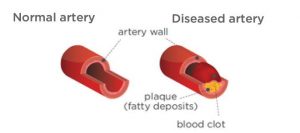
The liver is the main processing centre for cholesterol and dietary fat. When we eat too much-saturated fat, (saturated fat usually comes from animals and red meat) the liver transports the fat, together with cholesterol in the form of lipoproteins, into our bloodstream. Too many circulating low-density lipoproteins (LDLs) in our bloodstream lead to fatty deposits that develop in the arteries. This causes the vessels to narrow and eventually block, leading to heart disease, heart attack and stroke and risking the heart pump to stop at any time.
As with saturated fats, consuming too much-added sugar will impact your cholesterol. Excessive sugar intake will increase calories. If not burnt up as energy, they will travel to the liver and be converted into triglyceride fats. Triglyceride fats are then dumped back into the bloodstream contributing to more fatty deposits in the arteries.
For more information on how to find out more about your heart disease risk Click here
For more information on how to keep your heart health Click here
Fast Facts
- The further a person lives from a metropolitan centre, the greater their risk of hospitalisation and death from cardiovascular disease.
- There is no single cause for CVD, but there are risk factors that increase your chance of developing it. There are modifiable risk factors (ones that you can change) and non-modifiable risk factors (ones that you can’t change).
- You can reduce your risk of heart disease and stroke by making healthy lifestyle choices and having regular medical check-ups.
References used for this topic
More Information:
National Rural Health Alliance
Heart Disease Challenges
Deaths in Australia – Australian Institute of Health and Welfare
Leading cause of death in Australia
Heart Foundation
Know your risks
National Centre for Farmer Health
Directors Blog 2020 – Hearten up! Heart health matters
World Heart Day 2021 Resources
What is CVD? – World Heart Day (world-heart-federation.org)
Directors Blog 2020 – Hearten up! Heart health matters https://farmerhealth.org.au/directors-blog-hearten-up-heart-health-matters/
Clinical Care:
Medicare Benefits Schedule
Heart Health Check
Partnering for Impact: NCFH showcase to connect ag industry leaders to safeguard farmer health
With a dedicated vision to continue to invest in strengthening farmer health, wellbeing and safety, the National Centre for Farmer Health(NCFH) is inviting industry partners and sponsors to join agricultural leaders on 23 April in Melbourne for its inaugural Partnering for Impact: Industry Showcase – an opportunity to collaborate, invest and help drive meaningful impact across Australia’s farming communities.
The event will highlight the importance of collaboration and partnerships for the NCFH, showcasing how these investments create systemic change that leads to more resilient farming communities, which is critical during times of uncertainty.
“The challenges facing farmers are complex, interconnected and deeply human, and they can’t be solved by any one organisation working alone,” NCFH Director Alison Kennedy said.
“Climate extremes, geopolitical pressures and the multi-faceted challenges in day-to-day farming are long-term issues – and they require long-term solutions. We need to move away from relying on reactive support following an extreme event, and focus on developing sustainable, ongoing partnerships which will help us to safeguard farmer health, wellbeing and safety into the future.”
The showcase will celebrate the real-world impact of its current partnerships on farms, field days, schools and regional communities. Attendees will hear from leaders across agriculture, agribusiness, corporate and philanthropic sectors who will share how their support of the NCFH’s evidence-based programs are driving improved health outcomes for farmers.
Panel speakers include:
- Paddy Handbury – farmer and NCFH Board member, whose family provided founding philanthropic funds to establish the NCFH
- Rhonda Locke – CEO of Deafness Forum Australia, which recently partnered with the NCFH to integrate a hearing health module in the existing Shifting Gears secondary student education program
- Gerard Roney – founder of Advantage Feeders, which has donated more than $35,000 from workshop proceeds to help fund NCFH programs and resources that support farmer health, wellbeing and safety
- Rick Gladigau – a long-term dairy supplier to Udder Delights, which has donated more than $20,000 from its dedicated NCFH cheese range to help consumers support the people behind their products
- Richard Sheppy – CEO of Fat Farmers, which provided a mobile Health Hub for the NCFH to deliver farmer health checks at field days and community events
- Gardiner Foundation – which partnered with the NCFH by investing $492,000 in the Back on Track peer-guided mental health research program.
The showcase will also highlight the diverse avenues for partnership with the NCFH through corporate, philanthropic and in-kind support.
As a farmer health development partner, philanthropic and corporate organisations can support innovative new research and emerging high-impact solutions that advance the NCFH’s mission. Service delivery partners allow organisations, government bodies, industry groups and community stakeholders to bring established NCFH programs directly to their regions through event sponsorships or donations.
“Partnerships are central to our work at the NCFH. They allow us to scale what we know is working, continue to innovate, and translate research into real-world impact,” Alison said.
“There is a great opportunity for anyone interested in supporting our work to get involved. Our partnerships pathways are collaborative, flexible and tailored to reflect the individual values and interests of our partners.
“We’re excited to celebrate the impact of our current collaborations and explore how we can work together to enhance farmer health, wellbeing and safety, both now and into the future.”
To register for the NCFH’s Partnering for Impact: Industry Showcase, please contact Cecilia Fitzgerald on 03 5551 8533 or cecilia.fitzgerald@wdhs.net.
* END OF RELEASE*
For more information, please contact:
Cecilia Fitzgerald – Business Development and Industry Engagement Manager, National Centre for Farmer Health
P: 03 5551 8533 | E: cecilia.fitzgerald@wdhs.net
Supporting Farmer Mental Health Through Peer-Led Innovation
Back-on-Track: Protocol for Randomised Controlled Feasibility Trial of Behavioural Activation in Farmers
Overview
A new study outlines the Back-on-Track feasibility trial, an innovative program designed to support the mental health of people living and working in farming communities. The research describes a randomised controlled feasibility trial testing a peer-guided behavioural activation program aimed at addressing low mood and depression among farmers.
Farmers face unique stressors, including financial pressures, climate variability, geographic isolation and limited access to mental health services, yet many do not engage with traditional support services. The Back-on-Track program was co-designed with farming communities to ensure support is practical, culturally appropriate and accessible.
The program trains trusted local community members as peer coaches, who deliver a structured 10-session behavioural activation program designed to help participants build positive routines, set goals and reconnect with activities that support wellbeing. The trial evaluates whether this model is feasible, acceptable and scalable for farming communities.
Key insights
- Mental health / Farming communities
- Study design: Randomised controlled feasibility trial
- Peer-guided mental health program for farmers experiencing low mood or depression
- Uses behavioural activation, an evidence-based therapy for depression
Delivered through a 10-session structured program with trained community peer - Coaches.
- Program co-designed with farming communities to ensure relevance and accessibility
- Evaluates feasibility outcomes including recruitment, participation, retention and acceptability
- Explores the potential for scalable, peer-led mental health support in rural communities
Farmer Health eNews April 2026
Find out the latest from the National Centre for Farmer Health
- Partnering for Impact: Industry Showcase
- Fat Farmers collaboration hits Wimmera and Limestone Coast
- Planning a community event? Take a Look Over the Farm Gate
- New grant to improve powerline safety on-farm
- Upcoming events
View the April 2026 e-newsletter
Do you want to receive our eNews?
Register for Pride in the Paddock working group.
The National Centre for Farmer Health, together with Deakin University and Western District Health Service is launching Pride in the Paddock – an initiative to improve access to inclusive preventive health and mental health resources for LGBTIQA+ members of Australia’s farming communities.
We’re looking for LGBTIQA+ farmers, agricultural workers, rural community members and health professionals to join the project, where you will:
 Share your insights Review and update existing resources and program content Advise on future content priorities
As part of the working group, you’ll be invited to attend 3 – 5 online workshops, 60–90 minutes in length.
Your voice will help shape practical, relevant and inclusive resources that support the health and wellbeing of LGBTIQA+ people in agriculture. Participants will also be offered a small reimbursement ($50 per meeting) for participating in the working group outside of their paid work role e.g. self-employed farmers.
Project starts April 2026 and will continue throughout 2026.
The Pride in the Paddock working group is now at full capacity. If you’d like to be updated with PIP project outcomes, please follow our social media accounts, or contact our office on (03) 5551 8533 to be put in touch with project coordinators.
Shifting Gears farm safety education program integrates hearing health for young people
The National Centre for Farmer Health and Deafness Forum Australia have launched a new hearing health module in the Shifting Gears farm safety education program for students, to celebrate World Hearing Day (3 March). The module provides young people in agricultural communities with essential knowledge about hearing health, noise exposure risks and preventative measures to reduce the impact of noise-induced hearing loss.
NCFH Senior Lecturer/Researcher Dr Jacquie Cotton said that globally, a large proportion of people under the age of 24 are exposed to high levels of noise, and hearing damage is not limited to older people.
“Young people aged between 15-24 are in a great position to learn about and adopt good hearing practices,” Dr Cotton said.
“Hearing loss isn’t something that only affects older people. Many young people living and working in agricultural communities are exposed to hazardous noise levels early in life through tractors and machinery, chainsaws, livestock, shearing sheds and working dogs.
“The new hearing health module in Shifting Gears aims to empower students to take charge of their hearing health, enabling them to prevent long term hearing damage, enjoy longer careers and reduce the risk of hearing loss in the future.”
Shifting Gears is a teacher-led program designed to support farm safety education among students, particularly those living on farms, studying agriculture and horticulture, or considering careers in these fields. It addresses the need for age- and context-appropriate education materials, providing audiovisual resources, interactive activities, and teacher-led discussion guides to foster learning and engagement among students.
The hearing health module is a partnership between the NCFH and Deafness Forum Australia, the national representative body for all Australians with hearing challenges, ear or balance disorders, and their families and supporters.
Deafness Forum Australia CEO Rhonda Locke said the new content will help students understand that hearing health plays a crucial role in their overall wellbeing and physical, mental and social health and that small steps today can positively impact the rest of their lives.
“The hearing health module in Shifting Gears makes it easier for students and educators to access evidence-based hearing health resources, and improves understanding of the risks around prolonged noise exposure on the farm. It promotes consistent use of hearing protection and safe hearing practices, and how these habits can be integrated into daily life,” Ms Locke said.
The Shifting Gears program allows teachers to access free, easy-to-use resources that can be incorporated into their lesson plans and align with the health education curriculum.
For more information on the program and to access the resources, visit farmerhealth.org.au/shifting-gears-2.
* END OF RELEASE*
Media contacts
National Centre for Farmer Health
Dr Jacquie Cotton – Senior Lecturer/Researcher
P: 03 5551 8533 | E: jacquie.cotton@wdhs.net
Deafness Forum Australia
Ruth Bailey – Manager, Hearing Health
E: ruth.bailey@deafnessforum.org.au