

NCFH – Making a difference to farmers’ lives in 2022
The National Centre for Farmer Health (NCFH) continues to empower Australian farmers and their families to take charge of their health, wellbeing and safety, delivering 293 health assessments in 2022.
The Centre’s position as a national leader in the health, wellbeing and safety of Australian farmers and farming communities was reaffirmed upon the recent release of its Year in Review.
The document showed the positive impact NCFH has made to building evidence in its field, conducting 13 research projects which led to the release of 17 publications across 2022.
“We are excited to share what we have achieved in the last 12 months. We’ve continued to innovate and find ways to engage with and support our farming communities—through direct services, education programs and research.” (NCFH Director, Alison Kennedy)
The culmination of the Primary Producer Knowledge Network (PPKN) in 2022, was a highlight for the Centre’s research achievements.
In partnership with Western District Health Service (WDHS), Deakin University, University of SA, Griffith University, and Cath Cosgrove Consulting, PPKN worked with farmers, fishers and industry partners to develop practical strategies to reduce work-related risks to mental health. The project—supported by WorkSafe Victoria’s WorkWell Mental Health Improvement Fund—brought together industry leaders and over 120 partners to produce ‘Campfire’—including 20 podcasts (11 new episodes produced in 2022), 24 interactive Q&A sessions, 27 blogs and 22 roadshow events across Victoria. Topics released in 2022 included flood recovery, child safety on farm, biosecurity, responding to climate change, succession planning and farm crime, among others.
“…I would highly recommend Campfire to my farming peers as a great way to source information.” (Farmer participating in Campfire)
In 2022, with a profound media reach of 1,838,800, and a growing social media following of over 7000, the Centre also helped to spread key messaging via 24 conference and 20 community presentations.
To further expand its reach and build strong relationships with like-minded organisations who share the NCFH vision of making a difference to farmers’ lives, the Centre worked in collaboration with 15 health partners and 90 research and industry partners.
These collaborations resulted in a wide range of outcomes including the expanded reach of NCFH health programs, the development of a Community of Practice to support resilience in farming communities, and the delivery of 17 professional development workshops to 234 rural and health professionals.
In September, the Farming a Brighter Future symposium enabled its 103 attendees to connect, network and learn with the industry’s best in a face-to-face environment.
Through a combination of workshops, panel discussions and presentations, the event provided a forum to foster learning, promote discussion and extend collaborative networks to make a difference to farmers’ lives, both now and into the future.
Attendees heard from engaging and award-winning speakers covering a wide range of topics including the portrayal of safe farm practices in media and social media, working dogs and mental health, and telehealth strategies for supporting farmers returning to work after stroke.
“Farming a Brighter Future provided an extraordinary opportunity to bring farmers, researchers, policy makers and industry into one room to learn from each other and work together to shape the future of farmer health, wellbeing and safety” (NCFH Director, Alison Kennedy)
The Centre’s Gear Up for Ag™ program reached 109 secondary students across eight programs delivered in 2022, building on the 13 programs delivered the previous year.
Recognising young people as central to an innovative and sustainable agriculture future, Gear Up for Ag engages students in a practical, fun and interactive way while providing evidence-based education.
The program builds student knowledge of farm hazards and understanding of the importance of safe practices to positively influence farm safety behaviours.
“2023 is building up to be another big year for farmer health, wellbeing and safety. We’re excited to once again be able to deliver research programs, services and education programs face-to-face in farming communities across Australia. We’re also continuing to find effective new ways to engage farmers and share information, including online webinars and education programs, community events and podcasts.” (NCFH Director, Alison Kennedy)
——- ENDS ——-
For more information about National Centre for Farmer Health visit www.farmerhealth.org.au. For media and communications enquiries please contact WDHS Marketing Communications Coordinator, Annabelle Macgugan on (03) 5551 8582 or email: amacgugan@wdhs.net.
For more information about National Centre for Farmer Health visit www.farmerhealth.org.au
Protected: Webinar: Helping your clients out of the mud
Steering Straight: Adapting suicide risk safety planning as a prevention-focused self-management resource for the Australian farming community
Abstract
Objective
This paper draws on the principles of suicide risk safety planning to co-design a farming community resource for preventing and managing risks to mental health.
Setting
This project was undertaken in the Great South Coast Region of Victoria, Australia.
Participants
A working group (n = 6–8) from the Victorian farming community contributed to the iterative co-design and co-production of Steering Straight: My plan to keep on track. Twenty-four members of the farming community pilot tested Steering Straight.
Design
Co-design to develop, pilot and refine the resource with working group and target farming community.
Results
Steering Straight was viewed positively by the farming community as a tool that prompts prioritising well-being; encourages reflection, planning and concrete steps towards taking action; helps set and meet personal goals; is simple and practical; and identifies pathways to support. Most participants (94%) completed Steering Straight on their own, taking approximately 15–30 min to create their personalised plan. Questions most likely to be filled in related to recognising personal signs of deteriorating well-being and listing and planning enjoyable activities. A majority of participants (67%) kept a hard copy of their Steering Straight plan on hand to refer back to, while 78% expressed a preference for a digital version.
Conclusion
The co-design and co-production process resulted in a tailored prevention-focused resource that was accepted and valued by the farming community.
Media Release: Grants available to build farm spirit
Are you planning a community event to help the health and wellbeing of farmers and farm families impacted by the floods and flood recovery?
The National Centre for Farmer Health (NCFH) #BuildingFarmSpirit program is partnering with Victoria’s community groups, local agriculture industry, not-for-profit organisations, sporting clubs and individuals with grants of $500 to $1,500 for activities that provide social connection and mental health promotion for farmers and farming communities.
Social connection is an important part of supporting farmer mental health. You may like to host a barbeque lunch or dinner and get a local speaker who has lived experience to share their story, follow your AGM or regular meeting with a guest speaker, start a walking group, book-club or podcast community or tie an activity to a local festival.
If you have an idea for a community event or program that promotes social connection and wellbeing for farmers and farm families, go to www.farmerhealth.org.au/buildingfarmspirit and register your interest.
In addition, the social media campaign, #BuildingFarmSpirit, enables Victorian farmers and farming families affected by flood, to share stories, ideas and tips with others, without the need to leave the farm during the increased workload of flood recovery.
NCFH flood recovery response project officer, Sally Cunningham, said the social media campaign was a ‘welcoming space’ for farmers to share stories about navigating challenging times.
“Short videos, written stories and poems on how they are maintaining their wellbeing during this challenging time, helps to build a shared understanding and online social connection,” Ms Cunningham said.
“While our farming communities often have limited formal resources to effectively manage challenges, there are many human stories to be told that express emotion, raise awareness, reduce stigma, start conversations, develop empathy and provide inspiration to take positive action.”
——– ENDS ——-
Sally Cunningham is available for interview: (03) 5551 8533 or email: sally.cunningham@wdhs.net
For a higher resolution copy of the photo, email lgrey@wdhs.net
For more information about the National Centre for Farmer Health Flood Response or to access a list of support resources, visit www.farmerhealth.org.au/buildingfarmspirit or contact Project Officer, Sally Cunningham
For more information about National Centre for Farmer Health visit www.farmerhealth.org.au
For media and communications enquiries contact the National Centre for Farmer Health Marketing Communications Coordinator, Annabelle Macgugan on (03) 5551 8582 or email: amacgugan@wdhs.net
Taking a look back at 2022…
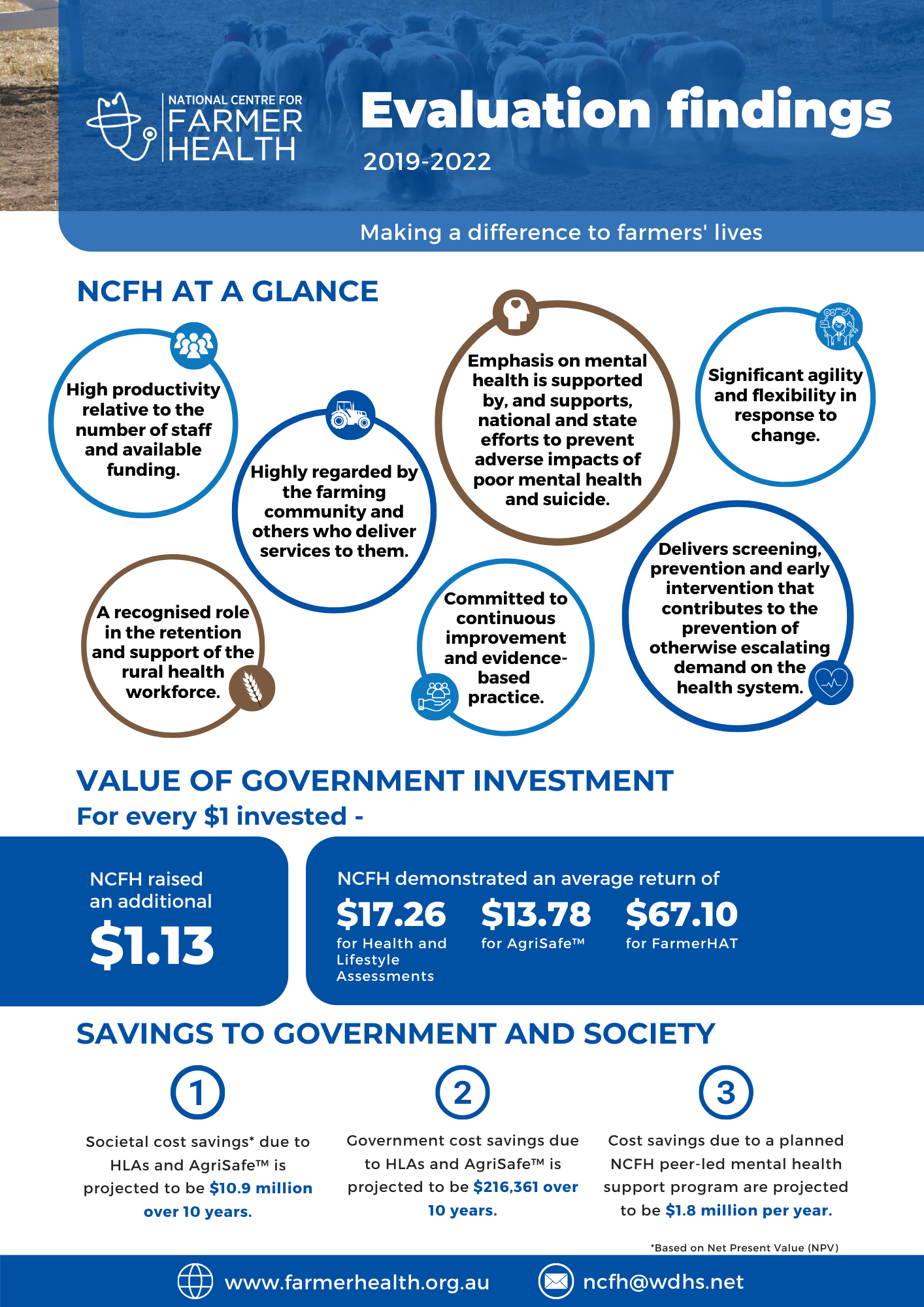
2022 was a year of significant growth and development for the National Centre for Farmer Health. We’re continuing to expand our work with farmers, industry stakeholders, health partners, government and research institutions. In response to the challenges and opportunities faced by the agricultural industry, the NCFH is providing services, education, research, and advocacy to ensure farmers can access support, tools and information to empower them to improve their health, wellbeing and safety.
We created the following summary infographic to highlight our work and impact across 2022. Reach out to our team via ncfh@wdhs.net if you have any questions.
Farmer Health eNews February 2023
Find out the latest from the National Centre for Farmer Health
- Join us to learn how to help your clients out of the mud
- Applications close on February 19th!
- Taking a look back…
- Wellness Wednesday
Do you want to receive our eNews?
Protected: Webinar: Helping your clients out of the mud
Episode 21: “Children and Flood Recovery”
Jane Nursey from Phoenix Australia explores how floods and difficult farming seasons can impact the mental health and wellbeing of children and adolescents in farm families.
Now streaming on Spotify, Apple Podcasts, and below.
This podcast was created as part of the NCFH’s #BuildingFarmSpirit campaign with funding from the Department of Jobs, Precincts and Regions as part of the Victorian Government’s 2022 flood response.
LEARN MORE ABOUT #BUILDINGFARMSPIRIT #BuildingFarmSpirit | National Centre for Farmer Health
Who is on your support team for flood recovery?
Factors in your workplace can impact on your mental health – such as poor workplace support and training, safety, poor workplace relationships, issues with communication and how change is managed. These are called work-related factors, which when not addressed can increase the risks of workplace stress or lead to poor workplace mental health. However, there are some simple ways to reduce these risks on your farm.
Rory admits he has had a tough few months on his dairy farm in central Victoria. With double the average rainfall in October and November, the creeks broke their banks and eighty percent of his farm flooded. That included 400 acres of crop and most of his ryegrass paddocks. His lost 3000 bales of hay and most of his retained seed for sowing next year. Thankfully the house didn’t go under, and nor did the dairy and yards, thanks to the new ring levy we put in after the last flood. Access was certainly an issue for quite a while and the tinny came in handy until the water went down.
He had to do his best to find dry ground for his dairy herd and has been feeding out like crazy. The heifers have been trucked off elsewhere on agistment. Donated hay by the truckload has been really helpful. Animal health issues have kept him busy too.
So Rory is feeling pretty tired and has felt a lot of stress about how his business will survive financially and how he will get through all the work in front of him. He is an optimist though and has been taking things a step at a time. He has to make himself focus on the things within his control and let go of those he can’t. Easier said than done…!
Ten years ago, the last time the farm got flooded, Rory learned a few things about keeping his head straight in the months following. He is trying to put in place the strategy he and Dad worked out through those turbulent months. He definitely wants to avoid reaching the same level of stress as they did back then.
When he feels overwhelmed by the workload he tries to take a break to refresh and recharge. He isn’t always thinking as clearly as usual, and sometimes feels he is chasing his tail. So he has found he needs to make lists of jobs, to prioritise and plan. There are some jobs that will just have to wait.
His wife, Emma has insisted that he doesn’t get so completely buried in his farm work that he skips out on regular catch ups with friends and family. She has been working hard too with extra shifts in the dairy and making sure there are enough workers to cover the milking shifts, when one of the regular milkers needed time off to deal with their own house being inundated in the flood. Emma made sure that the staff always know what is going on, and they have really chipped in and worked as a team, not just with extra hours, but on problem solving some of the issues that have come up. Rory is trying to remember to acknowledge this and encourage them, so has tried to reward the successes along the way. He tries to be positive and upbeat and remember that this is a stressful time for everyone, not just him.
Rory checks in on some of the neighbours pretty often because they got hit pretty hard too. It’s good to talk with each other about their daily struggles and to help each other practically where they can. It makes Rory feel less alone in his struggles. Funnily enough the most helpful bloke to talk with was the agronomist who helped Rory plan out his feed budget and sowing strategy for the next six months. The vet was also great at solving some of the problems with the cows and preventing other issues arising through better management strategies. That really took a big weight off his mind.
Rory managed to work out a bit of a financial plan and took it to the bank manager who adjusted a few of his loan repayments. Even got some money on a government grant to help cover clean up and rebuilding costs and re-sow the lost crop. Rory said the load felt lighter once he had a workable plan and knew he had a team of people who could help support him through these bumpy months of recovery from the impact of the flood. He has even found the time to get back to pre-season footy training so he can hang out with a few of his mates and keep his fitness up which makes him feel much better.
Injuries on the farm can lead to stress, long-term health concerns and loss of income or even fatalities, so preventing them from happening is the best way of protecting your mental health. When it comes to running the family farm, investing in mental health initiatives is not only good for your family and workers, but it’s good for business too.
The NCFH is supporting farmers just like you to manage and respond to work-related risks that impact on workplace mental health – these are factors in your work that can affect an employee’s mental health and include poor environmental conditions, low job control, low role clarity and more.
Managing these factors, means decreasing the risk of work-related stress.
Find out more about being mentally safe on farm at www.farmerhealth.org.au/campfire.
This blog is part of the Primary Producer Knowledge Network led by the National Centre for Farmer Health to promote mentally healthy workplaces. Campfire, part of The Primary Producer Knowledge Network, is funded by the Victorian State Governments WorkSafe WorkWell Mental Health Improvement Fund.
Episode 20: “Thinking through the flood recovery journey”
This episode features speaker Dr Lauren Stracey, from Rural Aid, an experienced and passionate psychologist who expertly manages Rural Aid’s team of counsellors from her Sydney base.
Rural Aid is dedicated to improving the mental health outcomes of rural Australia – offering free, confidential support to farmers and their families.
They are trained to help their communities with a range of services, from early intervention and health promotion, right through to treatment using evidence-based interventions. They usually visit farmers on their properties.
Counsellors – Rural Aid – Supporting Rural Communities
Now streaming on Spotify, Apple Podcasts, and here.
This podcast is part of the Primary Producer Knowledge Network led by the National Centre for Farmer Health to promote mentally healthy workplaces. Campfire, part of the Primary Producer Knowledge Network, was funded by the Victorian State Government’s WorkSafe WorkWell Mental Health Improvement Fund.
Utilizing the Delphi method to develop parent and child surveys to understand exposure to farming hazards and attitudes toward farm safety
Abstract
Children on farms are at increased risk of injury. In Australia, children under 15 years consistently represent ~15% of all farm-related fatalities. This study aimed to develop parent and child surveys to gain a greater understanding of children’s (5–14 years) exposure to occupational risk on farms by exploring their exposure to farm hazards, risk-taking behavior, their use and attitudes toward safety measures, and their experience of farm-related injury. As farming communities are heterogeneous, a modified Delphi method was undertaken to ensure input from a diverse group. Seventeen experts participated in a three-round process—the first two rounds required rating of proposed survey questions in an online questionnaire and the final round was an online discussion. Consensus was defined as 75% agreement or higher. This process resulted in 155 parent questions and 124 child questions reaching consensus to include. The modified Delphi method developed surveys that provide insight into the behaviors and attitudes of children (individuals) and their parents on farms (family) and will assist in informing how community, organizations and policy frameworks can improve child safety on farms. It will assist in identifying and understanding common farming exposures/behaviors of children and their parents to inform the development of targeted and culturally appropriate injury prevention strategies. As farming groups are heterogeneous, these survey scan be used on varying farming cohorts to identify their unique farming hazards and challenges. Child farm-related injuries are a problem globally and must be addressed; children are dependent on adults and communities to create safe environments for them.
Cultivating Mental Health and Social Connection
From The Cultivate Podcast with Cynthia Mahoney
In this episode, Cynthia chats with rural mental wellbeing and disability advocate, Kelly Barnes. Kelly is the Victorian winner of the 2020 Agrifutures Rural Woman of the Year with her concept of using working dogs to encourage social connection and as a support tool to improve mental wellbeing in farming communities. We talk about her love of dogs and the fabulous outcomes of her working dog school workshops, her experience of living with a chronic pain disability (Fibromyalgia) in rural Australia and how she cultivates herself mentally and physically – great lessons for us all. Kelly also shares where her inspiring journey of leadership has taken her as she now embarks on a career as a mental health researcher and facilitator with the National Centre for Farmer Health.
Cultivate is also the title of Cynthia Mahoney’s first book, it’s about how neuroscience and well-being can support leaders to build happier, healthier teams who are ready to thrive.
Listen to the episode here