

Drink / Drug driving
Consuming alcohol or other drugs has a significant effect on your ability to drive safely. Drink and drug driving are important causes of death and permanent injury. You might think that the risk of being ‘caught’ is less in country areas. You also might think that you are okay to drive after a few drinks or recreational drug use, but you may be wrong.
Alcohol and country roads do not mix. Alcohol and working machines or motor bikes on the farm do not mix. Country people make up the majority of those who die on country roads and drink driving is a factor in the rural road toll.
It is well proven that being over 0.05 drastically increases the risk of death or serious injury—for you, your passengers, and people in other cars or pedestrians. As a supervising driver of a learner driver you must also be below 0.05.
While the general rule suggests two standard drinks in the first hour and one drink in every hour after that will keep you below .05, this can vary depending on gender, weight, etc.
If you’re going to an event that involves alcohol, pick someone to be your designated driver—a person who won’t be drinking and will be responsible for getting others home safely. If you’re on your own and you’ve had too much to drink, don’t drive home. Stay with a friend or sleep it off in your car. Alcohol is also a serious contributor to interpersonal violence. Remember, just because you are not the designated driver doesn’t mean you should drink to the point where your judgement and behaviour is impaired.
Increasingly, drug driving (driving while under the influence of illicit drugs) is becoming a concern on rural and regional roads. Driving with illicit drugs in your system makes you 10 times more likely to cause a crash. In Australia, over 9% of all road fatalities involved a driver who had an illegal drug in their system. Across Australia, over 400,000 roadside drug tests were conducted in 2021, with 12.8% of tests recording a positive result. Purpose-built Alcohol and Drug Test vehicles have now been introduced on rural roads.
Be aware that certain types of prescription drugs can also affect your ability to drive safely, including antihistamines and opiates used for pain relief.
Drink driving is one of the most significant causes of road trauma and death. The legal blood alcohol concentration (BAC) limit for drivers in Victoria and all other states in Australia is below .05. Probationary licence drivers (P plates) and learner drivers (L plates) must only drive with a zero BAC. Across Australia, over 8.3 million random breath tests were conducted in 2021, with 0.8% of tests recording a positive result.
Find out more about this topic on Better Health Channel
Fast facts
- Alcohol and other drugs are a factor in many vehicle crashes, causing death and permanent disability.
- In a small community a fatal car crash touches everyone.
- Driving with a blood alcohol level (BAC) of 0.05 or more is not only against the law, but is very dangerous and irresponsible.
- If you’re on P plates or L plates you are not allowed to drive with any alcohol in your system.
- If you’re drinking, have a designated driver who won’t be drinking to make sure you get home safely.
- If you are not the designated driver it doesn’t mean you should drink to excess.
References used for this topic
More information:
Australian Drug Foundation
What is a standard drink?
Better Health Channel
Alcohol
ReachOut Australia
What is alcohol
Research & reviews:
Commonwealth Department of Infrastructure, Transport, Regional Development, Communications and the Arts
Roadside drug tests Australia and Random breath tests Australia
CARRS
Drug Driving – State of the Road
The Centre for Accident Research and Road Safety
Roadside drug testing scoping study
Frontiers in Psychiatry
Cannabis and Driving
Alcohol free events
Alcohol is served at many social events; a family BBQ, birthday parties, Saturday afternoons at the football or netball club and community gatherings. Alcohol is the most commonly used social drug in Australia. When consumed in excess, alcohol can lead to a range of short and long-term health problems and increase the risk of accidents and violence.
Young people are at particular risk from alcohol. Current guidelines recommend that young people under 18 years of age should avoid drinking to reduce the risk of alcohol-related harm and longer-term damage to the developing brain.
Young people’s decision-making ability can be compromised by alcohol which can have serious consequences. Heavy alcohol consumption at a young age is associated with higher levels of alcohol use in adulthood, alcohol misuse, alcohol dependence and increased rates of physical and social harm. Even single occasions of harmful drinking are associated with mental health issues in young people.
There is no safe level of alcohol use during pregnancy, so it is recommended that pregnant women avoid drinking alcohol.
Alcohol and sport
There is a strong link between sport and alcohol, particularly in rural areas. Sporting clubs are often financially supported by alcohol sales and the bar at local sports clubs may be an avenue for socialisation in some rural communities. Social media plays an increasing role in encouraging alcohol consumption linked with sporting matches.
Community sports clubs can contribute to alcohol problems by promoting and accepting excessive drinking. Sport clubs often cater for many age groups and have a responsibility to create a safe environment, particularly for their younger players.
Programs like Good Sports can help community sporting clubs change their attitude to alcohol and model healthy behaviours.
Fun without alcohol
It is possible to enjoy sport and social events without alcohol. Make events special with decorations and serve glamorous, colourful mocktails in special glasses.
Make non-alcoholic options more appealing than alcoholic beverages by serving:
- Homemade iced tea and coffee
- Fancy water with fruit and herbs
- Mocktails
- Fruit punch
- Smoothies and juices
- Tea and coffee
Other things to do to make a party fun:
- Dancing– get people up and moving, it’s fun and lots of people long for a chance to show off their style, put on the Macarena, it’s sure to get people up!
- Games– bring out the inner child in your friends; ask everyone to come up with a suggestion for a game, for example, backyard cricket, charades, card games, twister, the limbo or even pin the tail on the cow! Look up party games on the Web.
- Food– provide lots of interesting food – or ask everyone to bring a plate to share.
- Alcohol-free challenge – ask your guests to bring along the ingredients for their favourite alcohol-free beverage to be served at the event.
- Music– ask around, there may be people of all age groups with a dusty instrument in a cupboard that they could bring out for a ‘Local Talent’ party!
- Themes– encourage some frivolity, have a Halloween party or a red party.
You can have a fun event without alcohol! Try it, you might be surprised and you’ll wake up with a clear head in the morning. Look after yourself and set an example for young people; organise your next alcohol-free event!
When holding an event where alcohol is served, make sure people can check how much alcohol they are consuming by serving alcohol in original containers, or adding a sign next to the punch bowl to indicate what it contains. Use smaller glassware and offer lower-alcohol options.
- Alcohol is a social drug that affects different people in different ways.
- Heavy drinkers and binge drinkers risk serious alcohol-related harm. The less you drink, the lower your risk of alcohol harm. Not drinking is the safest option.
- During pregnancy no level of alcohol is considered safe; the safest option is not to drink during pregnancy.
- If you plan to drive, it is better not to drink alcohol.
Find out more about this topic on Better Health Channel
Fast facts:
- Alcohol is served at many social events, but it’s not essential. You can have fun without alcohol.
- The size of a standard drink varies according to the type of alcohol.
- Create a festive atmosphere with stylish, colourful mocktails in special glasses.
- Serve teenagers special ‘adult’ drinks (without alcohol) that the younger ones can’t have till they’re older.
- Try dancing, games, live music, theme parties and talent quests to make an event fun.
References used for this topic
More information:
Hello Sunday Morning
How to host an event without alcohol
Australian Drug Foundation
Alcohol facts
Australian Drug Foundation
Safe partying for all ages
Australian Drug Foundation
What is a standard drink?
Australian Drug Foundation
The sobering truth about the silly season
Australian Drug Foundation
Good Sports
DrinkWise
Should parents give their teens permission to drink at house parties?
Better Health Channel
Partying safely – tips for teenagers
National Health and Medical Research Council
Australian guidelines to reduce health risks from drinking alcohol
Australian Institute of Health and Welfare
National Drug Strategy Household Survey 2019
Health Direct
How alcohol affects your health
Research & reviews:
BMC Public Health
Parental supply of alcohol to Australian minors: an analysis of six nationally representative surveys spanning 15 years
ANZ Journal of Public Health
Harmful drinking is associated with mental health conditions and other risk behaviours in Australian young people
Drug and Alcohol Review
An examination of how alcohol brands use sport to engage consumers on social media
Australian and New Zealand Journal of Public Health
Is alcohol and community sport a good mix? Alcohol management, consumption and social capital in community sports clubs
2014-02-03 Your last chance for the last places in Agricultural Heath and Medicine program
The National Centre for Farm Health’s HMF701 Agricultural Heath and Medicine program will be run at its Hamilton, Victoria, headquarters from February 24-28.
With only a few places still available it has again attracted an impressive cross section of people working in, or with, rural and regional Australians.
A lineup NCFH director Susan Brumby says includes a paramedic from the Northern Territory, agricultural scientist from South Australia and mental health clinician from Camperdown in Victoria’s Western District.
Associate clinical professor Brumby says HMF701 Agricultural Heath and Medicine is a five-day intensive study unit offered by the School of Medicine at Deakin University and the National Centre for Farmer Health.
She says it aims to develop the next generation of rural and agricultural health leaders to improve the health, safety and wellbeing of rural and remote Australians.
“HMF701 is an excellent fit for a wide variety of graduate level students and professionals from nursing, medicine, health, agricultural science, agribusiness, social work, veterinary and environmental science backgrounds,” she says.
“And HMF701 is also a core unit for the Graduate Certificate of Agricultural Health and Medicine qualification.”
“The course will increase your understanding of the clinical, physical and mental health factors which result in higher rates of injury, illness and death in rural and remote communities.
This information will help professionals who want to improve:
- Agricultural production and sustainability.
- Enhance understanding of health research, policy and literacy in rural and remote communities.
- Gain an understanding of what is required for effective health provision in agricultural communities.”
Based at Katherine, paramedic Felix Ho is also studying medicine and says he considers the course will improve his ability to deliver in his current role and help provide him with a valuable grounding in his medical studies.
“Obviously my interest is in rural health, and even when I am based out of Darwin we are still working with a lot of people working in primary industry,” Felix says.
“From what I have heard about this course I expect what I learn in HMF701 I will be able to use it to help the people I work with, for my own career and to educate my peers,” he says.
A seven-year paramedic veteran in the Top End – and former Young Australian of the Year in community service – Felix says he has been picking up on the course from others in his field as well as from a range of rural bodies.
Which is also where agricultural scientist Dr. Sjaan Davey picked up on HMF701 and while she does not deliver health services she says she sees enormous value in improving her own understanding of the issues in rural health.
Dr. Davey says her role with the SA Research and Development Institute where she is currently focused on work in nematology sees her travel widely in rural and regional areas.
“I have always been interested in this, as the health side of life in rural Australia is so important and I don’t think there is anywhere near enough emphasis placed on it,” Dr. Davey says.
“I see all sorts of people so the more awareness I have the better. I come from a farming background in Zimbabwe, having moved to Australia in 2004, and I am confident that in the right circumstances what I learn in this course will enable me to promote, suggest and recommend what I have learnt,” she says.
“This is the first time I will do a course like this and I got onto it through the GRDC magazine Ground Cover, which was promoting its value.”
For adult mental health team clinician Angela Winkler her involvement in HMF701 is a given.
Angela says she comes from a dairy farm, married a dairy farmer, and has worked in district hubs throughout the Western District in her current role.
She says she found out about the course on the NCFH website and could see its value immediately.
“Never mind six degrees of separation, the people I see are people I live and work with and the more I know to help them the better it will be for everyone,” she says.
“While I am sure I will know about most of what this course contains to be able to formalise it will be a valuable investment for me and the people I work with.
“We deal with people aged 18 to 64 and there is an ever-increasing demand for what we do.
“I think in part that is because today there is less stigma attached to seeking help. When you have senior politicians and high-profile sports people prepared to go public with their problems it helps your average person know they can too.
“And in the bush, sadly, we all know someone who has committed suicide so seeking help is the first step in recovery and having this specialist knowledge will be my next step in helping those people.”
Angela also says she and her colleagues have a good network of support working closely with local GPs, many of whom are also aware of the value of HMF701.
Associate clinical professor Brumby says anyone interested in securing one of the last places for the 2014 course should contact Dr. Jacquie Cotton on (03) 55518585 now.
Ski for Life 2014
Adrian and Alison attended the Ski for Life event March 5-7, in South Australia. (more…)
Agricultural Health and Medicine 2014
Our fifth year offering Agricultural Health and Medicine to students from all around the country, and again we welcome the next generation of rural and agricultural health leaders to improve the health, safety and wellbeing of rural and remote Australians.
Agricultural Health and Medicine is offered by the National Centre for Farmer Health and Deakin University. Learn more about Agricultural Health and Medicine »
-
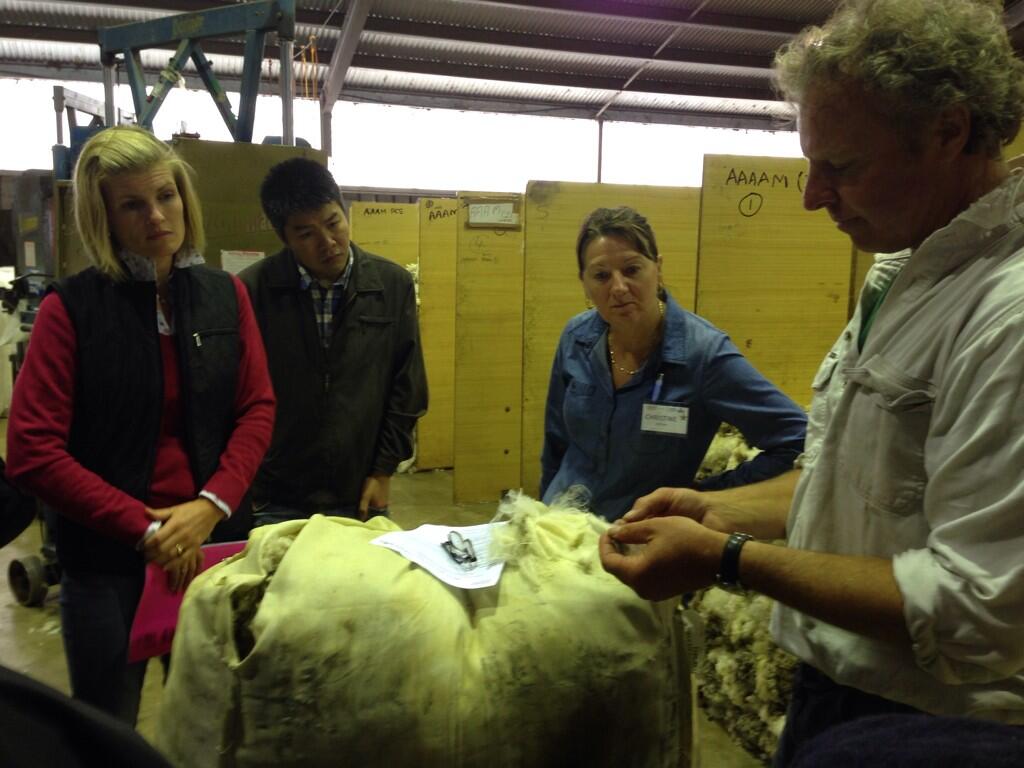
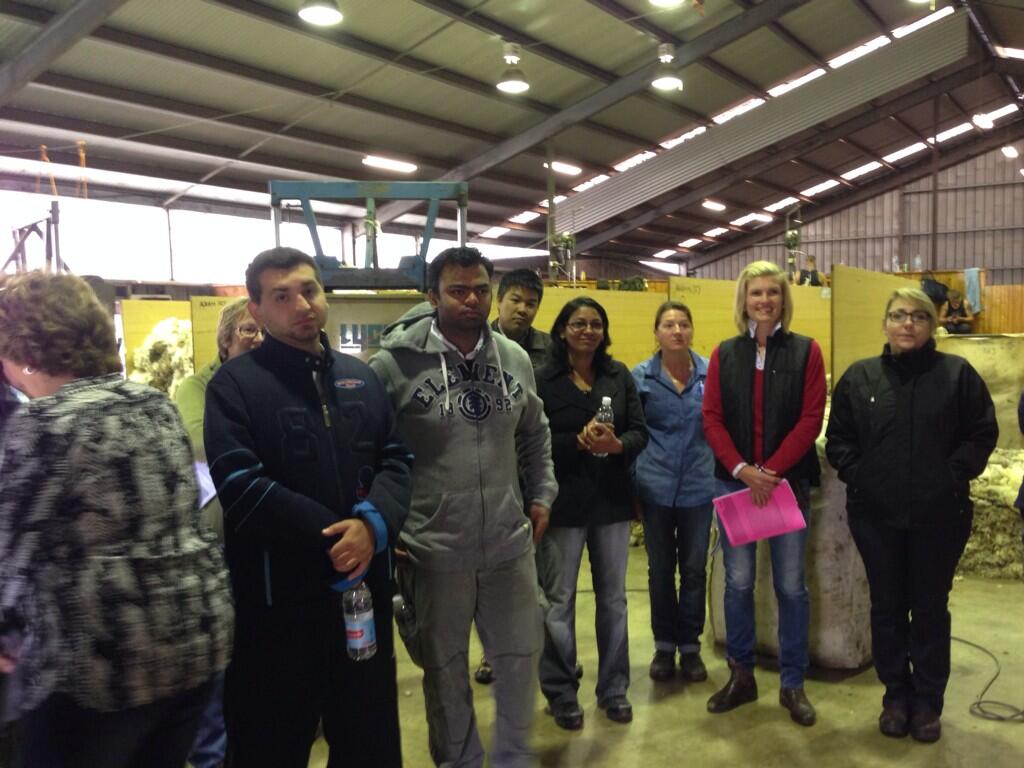
- The #finer details of #wool with Ag Health & Medicine students
-
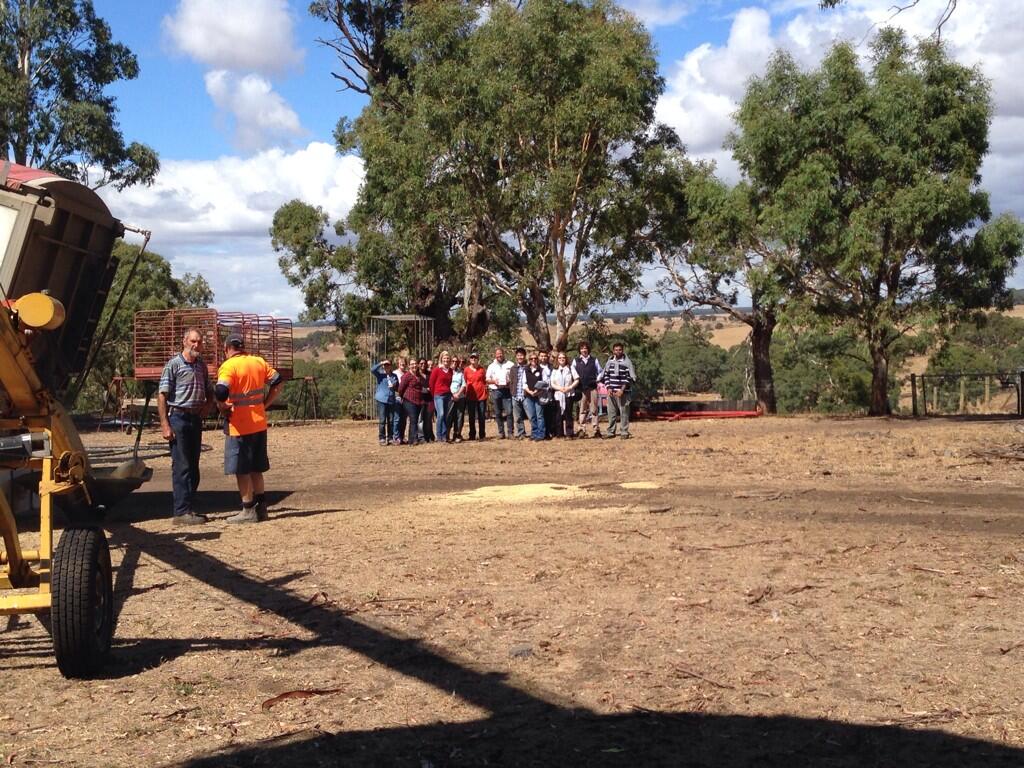
- HMF701 students watching #grain being unloaded at #Mepungah , learning about grain safety
-

- Nick talking to HMF701 students about #shearing and farm safety challenges
-
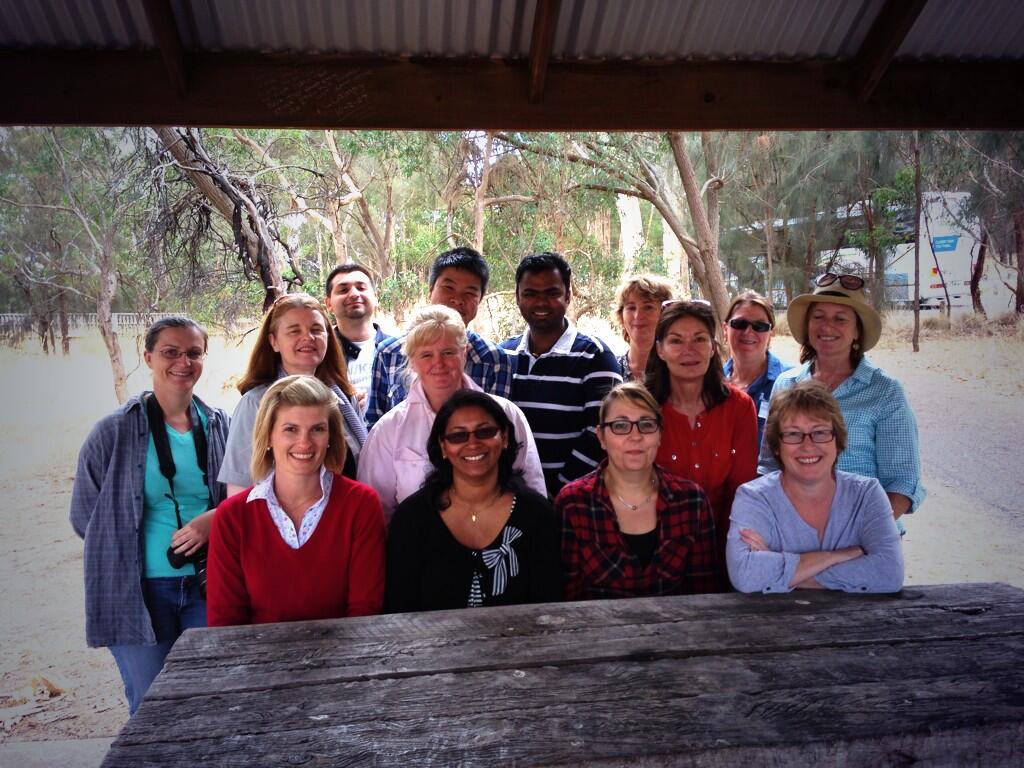
- Great group of students from across Australia currently studying #agricultural health and medicine
Alcohol and farmers
Alcohol is widely used in social interactions but it can cause health, social, and safety problems when not used responsibly. One in four Australians drink at risky levels. People in farming communities are more likely to binge drink (consume alcohol at short-term risky levels) when compared with the general Australian population.
Farmers must take special care not to be under the influence of alcohol while using (or supervising others using) farm equipment, tractors, bikes, and other vehicles; handling animals; or supervising children. Alcohol affects your attention, concentration, coordination and judgement–putting you and others at greater risk of injury or death. The short-term harmful effects of alcohol can be increased when taken with illicit drugs, and prescribed or over-the-counter medications.
Misusing alcohol causes harm to people other than the drinker. Alcohol contributes to violence and family conflict. Alcohol is involved in 23-63% of all family violence reported to the police. Alcohol is associated with an increased risk of violence occurring and an increase in the level of harm that results from this violence.
The less you drink, the lower your risk of harm from alcohol-related disease and injury. Current government guidelines recommend limiting your alcohol to no more than four standard drinks on any one day and no more than 10 standard drinks per week. Drinking at risky levels can cause serious short and long-term health effects. 10-15% of all presentations to hospital emergency departments are alcohol-related. One in four road deaths are the result of drink driving. If you are pregnant or under 18 years of age, it is recommended that you do not drink alcohol at all.
Drinking alcohol increases the risk of a range of cancers including liver, breast, colorectal, pancreatic, mouth, oesophageal and throat. Risk increases as more alcohol is consumed. Alcohol can also reduce the function of the immune system, and cause or exacerbate sleep problems and sexual dysfunction. There is no clear evidence that drinking a small amount of alcohol protects against heart disease or type 2 diabetes.
During the COVID-19 pandemic, alcohol use increased in rural areas. This was particularly notable for people experiencing higher stress and anxiety, those having to manage childcare challenges, and people whose employment was under threat.
Rural issues – alcohol and mental health
Alcohol plays a role in both the development and progression of poor mental health and suicide. Drinking can increase the chances of developing a mental health condition in at-risk people (e.g. people prone to depression or anxiety). Self-medication with alcohol is a common, but unsafe and ineffective coping strategy for farmers and other people living in rural and remote areas. Alcohol only masks the symptoms of depression and stress, and can make you feel worse. Alcohol misuse is also a risk factor for suicide. Support services can assist rural people to find other ways to tackle tough times.
Find out more about this topic on Better Health Channel
Fast facts:
- Alcohol, when not used responsibly, can damage your health and contribute to violence and risk of injury or death
- Food may slow down absorption of alcohol, but it will still hit your bloodstream and affect your judgement.
- Don’t use beer to quench your thirst while working; it will increase your risk of accidents. Drink water or non-alcoholic drinks instead.
References used for this topic page
More information:
Australian Department of Health
National Alcohol Strategy 2019–2028
National Health and Medical Research Council
Australian Guidelines to Reduce Health Risks from Drinking Alcohol
VicHealth
Reducing alcohol-related harm in the workplace
Australian Government Department of Health
Alcohol during pregnancy and breastfeeding
Australia’s National Research Organisation for Women’s Safety
Links between alcohol consumption and domestic and sexual violence against women: Key findings and future directions
Foundation for Alcohol Research and Education
Alcohol use and harms during the COVID-19 pandemic
ABC Conversations Podcast
Shanna Whan’s best sober life
Day Break – An app to help you change your relationship with alcohol
Desktop version: https://www.hellosundaymorning.org/daybreak/
Apple: http://bit.ly/AppleDayBreakApp
Android: http://bit.ly/AndroidDayBreakApp
Clinical care:
The Medical Journal of Australia
New Australian guidelines for the treatment of alcohol problems: an overview of recommendations
Western Australian Mental Health Commission
Counselling Guidelines: Alcohol and other drug issues
Research & reviews:
NHMRC Clinical Trials Centre
Evidence Evaluation Report: Evaluating the evidence on the health effects of alcohol consumption
The Journal of Rural Health
Alcohol Consumption, Obesity, and Psychological Distress in Farming Communities—An Australian Study
Australian and New Zealand Journal of Public Health
Identifying individual- and population-level characteristics that influence rates of risky alcohol consumption in regional communities
Farmer fitness
Farming is still a physically demanding way of life, but it is not as active as it was in the past. Machinery and other vehicles now assist with a lot of the physical work and farmers spend a lot more time sitting down than walking.
Like the rest of the population, many farmers are not as fit as they could be and many are becoming overweight. Being overweight and inactive increases your risk of many serious health conditions like diabetes, heart disease, some cancers, mental health problems and musculoskeletal aches and pains. It is important to be fit in three areas – cardiovascular fitness, strength and suppleness (flexibility/mobility). Therefore, to stay healthy it is important to find ways to be active and take part some form in daily exercise.
This can be done by building exercise into your daily routine, for example, you might choose to walk for short trips and leave the quad bike behind; take a break and do some stretches or lifts.
Looking after yourself is part of looking after your farm
- Walk down to check the stock and leave the quad bike in the shed.
- Do some stretches before you start work and throughout the day, wherever you happen to be, the shed, the house, or out in the paddock.
- Do some gardening – why not dig over the vegie plot?
- Do structured recreational activity like playing golf, water skiing, strength work outs, bushwalking
- 10,000 steps is the recommended daily step goal for a healthy adult
- Safety tips
- Medical checks– if you are over 35, have a pre-existing illness or haven’t done much physical activity for a while, have a medical check-up first.
- Exercise with care– be mindful of traffic and farm equipment when you are exercising.
- Sun– wear hats, sunscreen and clothing that best protects you from the sun.
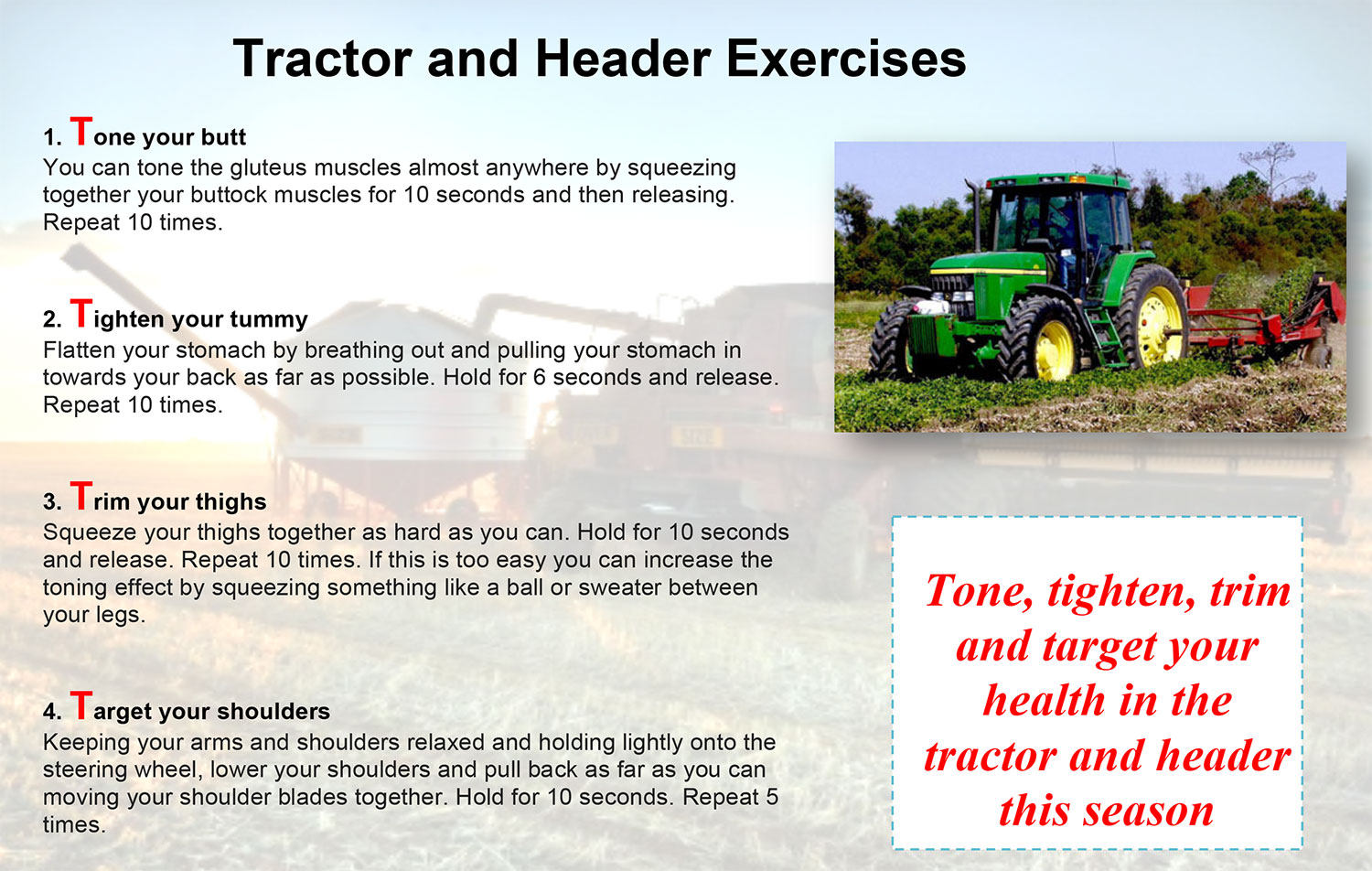
Click here for a downloadable PDF for you to print and put in your tractor/header.
Fast facts:
- Farmers don’t do as much physical activity as they used to, and need to include daily exercise to be more active to stay healthy.
- Build exercise into your daily routine, walk for short trips and leave the quad bike behind; take a break and do some stretches or lifts.
- There are 1440 minutes in every day – use 30 of them for physical activity.
References used for this topic
More information:
Australian Government
Weight and body mass index
Better Health Channel
Physical activity – men
Department of Health (Aust)
Physical activity and sedentary behaviour guidelines
Research & reviews:
American Journal of Preventive Medicine
Occupational sitting time and overweight and obesity in Australian Workers
Centers for Disease Control (US)
Physical activity and health
Cochrane Collaboration
Interventions for promoting physical activity
Current Cardiovascular Risk Report
Too little exercise and too much sitting
Journal of Rural Health
Rural-urban differences in physical activity, physical fitness, and overweight prevalence of children
Farmer e-Health program
Farm life is busy, but it’s important to find time to look after your health. We’re giving Australian farmers a unique opportunity to use an extensive, FREE, and totally confidential, online health program to help you manage your health.
What you can do
• Create your personal health profile (and update it as often as you like)
• Track your personal health status
• Use the extensive library of health information, quizzes and tools
• Receive regular emails with health tips tailored to your personal health needs
This program is used by farmers all around Australia.
VFF sets rural agenda for 2014 State Election
The VFF is calling for $500,000 to fund the National Centre for Farmer Health
Media Release no longer available.
CWA Support for National Centre
Members of the local Country Women’s Association (CWA) have raised $500 to show their support for the National Centre for Farmers Health (NCFH).
The vibrant group of young women from the Hamilton Evening Branch of the CWA organised a successful movie night in October last year and several members visited the NCFH this week to hear more about the Centre’s work.
Branch President Natalie Templeton said the CWA was keen to support the NCFH, which is currently seeking funding from State and Federal Governments to continue its work.
“Quite a few of our members are from farming backgrounds and we recognise the support the NCFH provides to our families”, she said.
“The Hamilton Evening Branch of the CWA provides opportunities for social interaction and to learn new skills. We also support local causes where we can”, Ms Templeton said.
The funds will be used to purchase a portable fridge / freezer for transporting samples collected during research and health assessments.
NCFH Director, Associate Professor Sue Brumby said:
“We are very grateful to the local support shown by the Hamilton Evening Branch CWA and look forward to utilising the portable freezer to improve the health and wellbeing of our farm men and women”.
If you would like to become a member of the CWA Hamilton Evening Branch please contact Natalie Templeton on 0439 336 970.
Caption: NCFH Director, Sue Brumby, Hamilton CWA Evening Branch President Natalie Templeton, Vice President, Yvette Morton and Treasurer, Tina Dunbabin, with NCFH Lecturer / Researcher Dr Jacquie Cotton.
2014 International Year of Family Farming
National Farmers’ Federation (Source: The Rural)
The National Farmers’ Federation (NFF) and its members have hailed the start of the new year, encouraging all Australians to join with them in celebrating the International Year of Family Farming during 2014. Read the full story at The Rural »
Family farming vital to ensure world food security (Source: ABC Rural)
Preserving family farming is the best way to ensure the world’s food security, according to Jose Osaba from the World Rural Forum. Read the full story at ABC Rural »
For more information about 2014 International Year of Family Farming please visit the website.
In search of farmers …
Have you lost someone close to you through suicide, accidental death, homicide or a death by unknown cause or intent?
Are you an adult member of a farming family?
Do you live in Western, Central or Northern Victoria,
Eastern South Australia or Southern NSW?
If you are willing to share your experiences of bereavement or would like more information about the Farming Families Wellbeing and Bereavement Study
please contact Alison Kennedy at the
National Centre for Farmer Health on (03) 5551 8587 or
email alison.kennedy@wdhs.net or akenne31@myune.edu.au
Download Participant Information Sheet [PDF 197kb]