

Farmer Health e-News – October 2015
Find out what has kept us busy this month at NCFH!

2015-10-20: ‘How to survive the good, bad and ugly realities of farming: escape’ – ABC Rural
It was The Colosseum, in Rome, that made Victorian grain producer Nick Shady realise he had to move off-farm and commute to ‘work’.
In his early 30s at the time, Mr Shady had worked consistently since leaving school and was worn down by years of failed crops and financial hardship.
Good years brought just as much pressure, to expand the business and continue to grow.
“I’d lost interest in farming,” he said. “I just didn’t have any more drive about what I wanted to do.
“It wasn’t a job, because with a job you can go away; it was a part of your life.”
Victorian grain growers are facing a disastrous season after the hottest start to October on record decimated crops across the state.
Mr Shady believes the inability to escape such harsh realities, which pervade work life and home life, contributes to the high rates of suicide and depression in rural communities.
“I don’t think they can identify it,” he said of his peers’ mental health issues.
“They will just keep going, keep going, keep going, and then something will break.”
New perspective inspires urge to change…
To read the full article, and listen to the audio:
2015-10-20: ‘How to survive the good, bad and ugly realities of farming: escape’ – ABC Rural
2015-10-15 Scholarships to help build stronger, healthier farming communities
Scholarships to help build stronger, healthier farming communities
Farming is second only to mining for the highest industry death toll.
“For too long too many farmers have not even acknowledged illness, let alone allowed it to slow the hectic work schedule now demanded by 21st century farming”. Dr Susan Brumby, Director of the Hamilton-based National Centre for Farmer Health is encouraging Health and Agricultural professionals to get on board to help our farmers and their families build healthy and sustainable farming communities.
With a sobering record of farmers literally working themselves to death because it is too difficult to access appropriate health services, and a long dry summer forecast for much of Australia, the time is now to ask:
“How can I make a difference to farmers’ lives?”
Scholarships of up to $2,500 are now available to prospective students who wish to expand their knowledge of Agricultural Health and Medicine, a postgraduate course offered by the National Centre for Farmer Health and Deakin University which provides a foundation for those who are on the frontline with our farmers. Scholarships close 30th October, 2015.
“The course has already attracted doctors, nurses, veterinarians, counsellors, agriculturalists and public health specialists from across Australia, some of them travelling thousands of kilometres to participate”.
“Over the 22nd-26th February 2016, students will work with an outstanding line-up of medical and industry presenters who will provide an insight of the challenges facing farmers, their families, their staff and their industry” Dr Brumby said.
The topics cover a broad spectrum of agricultural health, safety and wellbeing issues ranging from agricultural medical conditions, mental illness and addiction, through to emergency medicine, agrichemcials, veterinary chemicals, and agricultural trauma. Students gain hands-on experience at local agricultural businesses, developing practical skills that can be applied as soon as they get home.
Rural GP and former student, Dr. Christel Smit Kroner, explains: “The course helped me gain a deeper understanding of the work and life style factors impacting on my patient population. I feel more confident to open up conversations with farmers about their daily work, stresses, worries and joys”.
Felix Ho, a paramedic in Darwin, NT and previous scholarship recipient agrees: “You’re not just looking at the medical conditions, but the range of factors that impact on these conditions in an agricultural context – the family, community and economic aspects.”
Agricultural and Health professionals living or working in rural and remote areas of Australia, and postgraduate students are encouraged to apply.
Scholarship applications are open until 30th October 2015.
For further information visit the National Centre for Farmer Health website at https://farmerhealth.org.au/page/education/what-is-hmf701 or call (03) 5551 8533.
For course and scholarship details, please contact:
Dr Vanessa Vaughan (Lecturer, Rural Health)
National Centre for Farmer Health.
v.vaughan@deakin.edu.au
Phone: 03 5551 8533
2015-10-14 – Rural banking group to support farmers’ physical and mental health – ABC Radio National
An unusual partnership has been formed to improve the health of Australian farmers.
A rural banking group has joined forces with the National Centre for Farmer Health to provide support for farmers.
Rural Bank staff around the country will be keeping an eye on the financial health of farm businesses, as well as the physical and mental health of their rural clients.
Click below to listen to the interview:
To view the original article and audio:
2015-10-14 – Rural banking group to support farmers’ physical and mental health – ABC Radio National
2015-10-09 – ‘Farmers helping farmers to beat rural suicide’ – ABC Rural
They will not have names, nor faces, but a new community of people affected by suicide is being built in a bid to reduce the statistics in rural Australia.
The Ripple Effect project, funded by beyondblue, recognises that many farmers live in isolation and lack the community connection that metropolitan Australians take for granted.
On paper the idea is to create an interactive website, monitored by health professionals, where anonymous users can share stories of mental illness in a safe environment.
But co-creator Tom Whitty, who also founded social media forum AgChatOz and represents the Victorian Farmers Federation, hopes the result will be a supportive online community.
Mr Whitty said the stigma around mental illness often meant farmers did not seek face-to-face support and the online environment offered a less confronting platform to do so….
To read the full article, and listen to the audio:
2015-10-09 – ‘Farmers helping farmers to beat rural suicide’ – ABC Rural
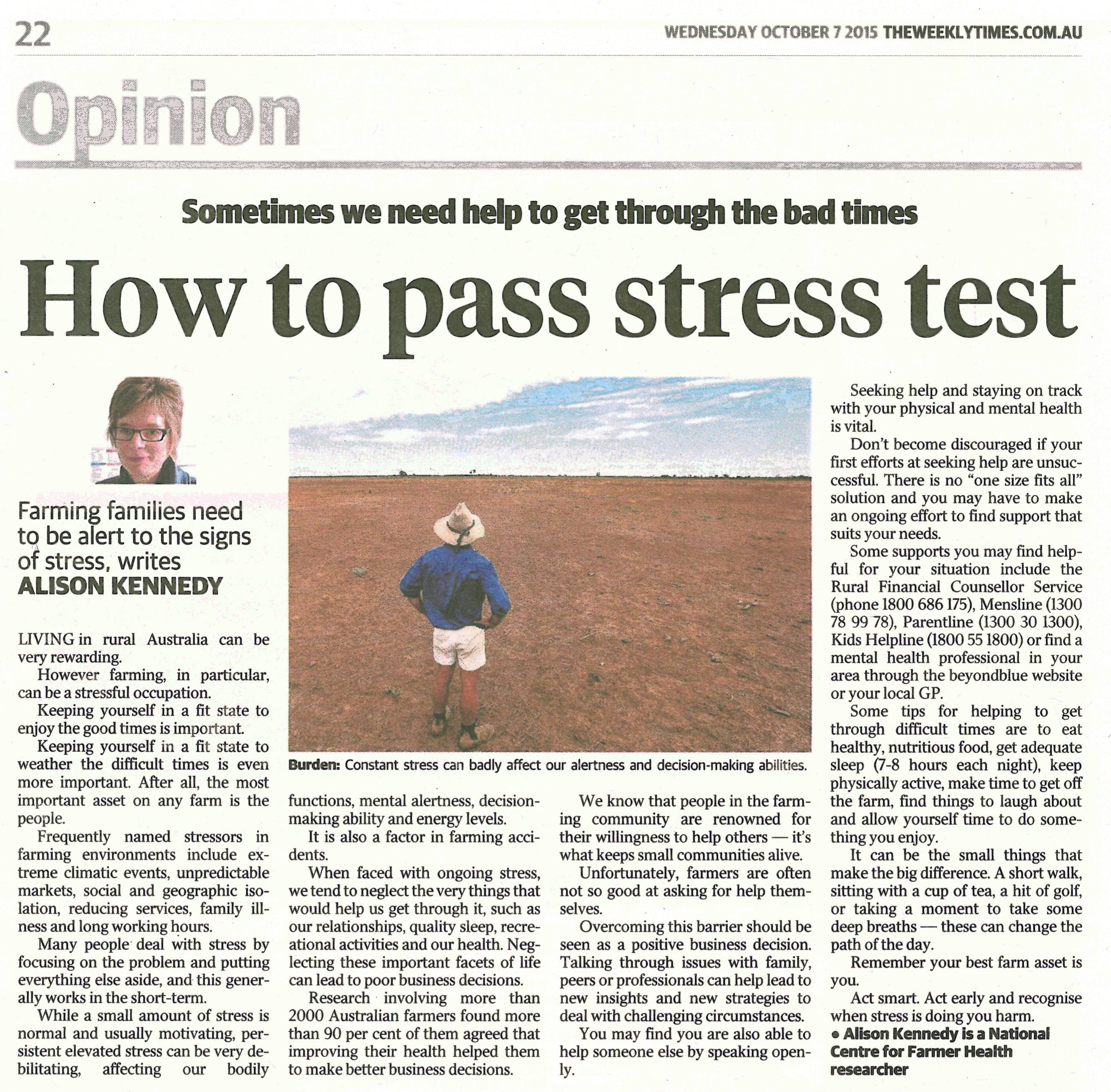
2015-10-07 – ‘How to pass stress test’ – The Weekly Times, page 22
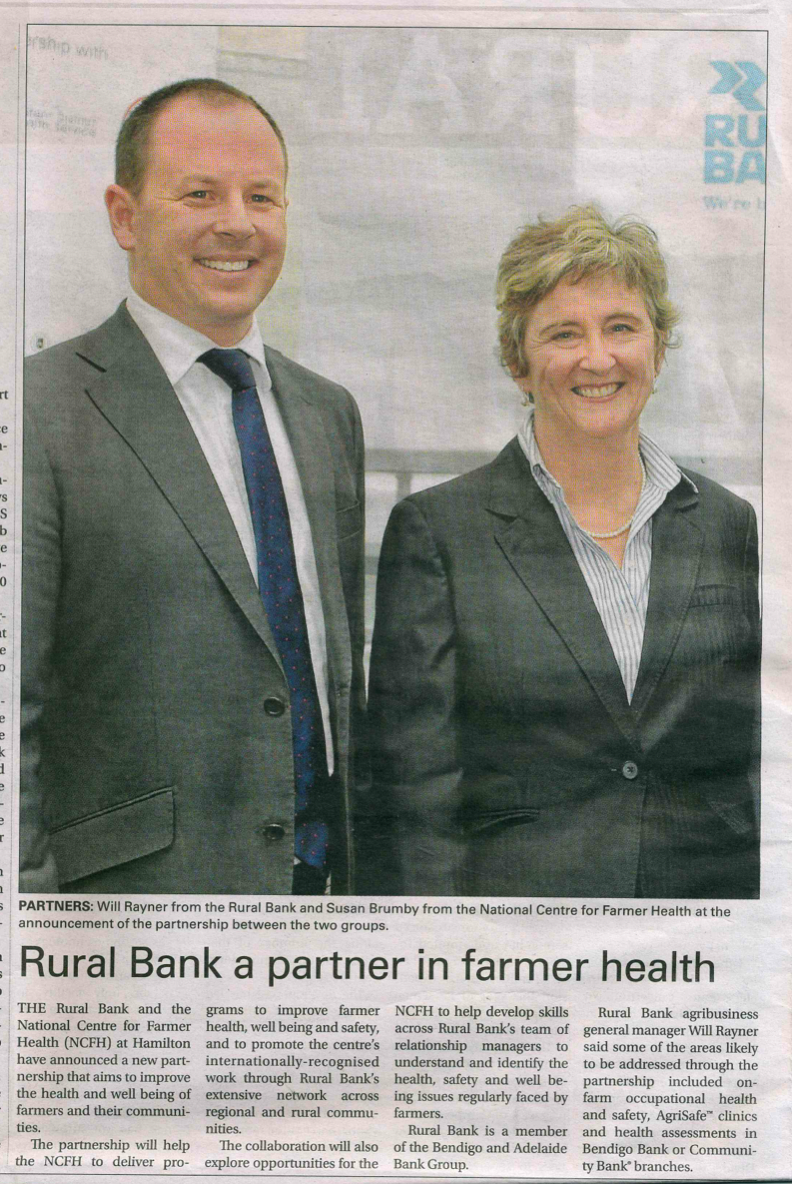
2015-10-01 ‘Rural Bank a partner in farmer health’ – Warrnambool Standard page 16
2015 Winter Edition – Partnership to make ripples in improving rural mental health – Victorian Farmer magazine
The VFF, together with leading agricultural experts, health professionals and academics have been successful in obtaining a $440,000 beyondblue funding grant to reduce the stigma around suicide experienced by males in rural farming communities.
Titled “The Ripple Effect”, the interactive digital program aims to combat the stigma experienced by males, aged 30 – 64 years, from the farming community who have lost someone to suicide, attempted suicide themselves, cared for someone who has attempted suicide, experience thoughts about their own suicide, or been touched by suicide in some other way. VFF will partner with leading digital platform AgChatOz, the highly regarded National Centre for Farmer Health, Deakin University, Mental Illness Fellowships North Queensland, Western District Health Service and digital company Sandpit for the development and roll out of the Ripple Effect.
…
Read the full article…
2015-10-01 – Rural Bank staff to offer blood tests and health assessments after partnering with National Centre for Farmer Health – ABC Rural
Bank managers might soon be offering blood tests, on-farm occupational health and safety assessments and advice about mental health services, due to a partnership between one of Australia’s biggest rural banks and a national health body.
Rural Bank, which says its client base includes about 10 per cent of Australian farmers, has partnered with the National Centre for Farmer Health (NCFH) in a bid to improve health statistics.
As part of the agreement, “frontline” bank staff will be trained in how to recognise and respond to clients suffering from mental or physical illnesses.
NCFH founding director Professor Sue Brumby said it was in recognition of the centre’s core message: profitable farms are entirely dependent on healthy farmers.”
“Good business relies on good health,” she said….
To read the full article, and listen to the audio:
2015-10-01 – Episode Farmer Health – 20Twenty Vision Christian Radio
2015-10-01 – Episode Farmer Health – 20Twenty Vision Christian Radio
Episode Farmer Health – Dr Susan Brumby, Vanessa Vaughan, Alison Kennedy.
20Twenty with Neil Johnson from Vision Christian Radio – www.vision.org.au
2015-10-01 – Farm Partnership – Hamilton Spectator
Farmer Health E-News – September 2015
Find out what has kept us busy this past month at NCFH!