

Sustainable Farm Families™ program recognised as an example of best practice
Victorian Workplace Mental Wellbeing Collaboration recognises SFF™ programs as best practice.
According to the VWMWC Resource Centre, the National Centre For Farmer Health’s Sustainable Farm Families™ program is recognised as an example of best practice for improving the health, wellbeing and safety of farmers. It focuses on connecting farmers and their families with the broader community, industry experts and health services to equip farmers with the knowledge and motivation to look after themselves and their business. Over a three-year period, workshops are delivered to farmers who are encouraged to develop an action plan. Evaluation in the form of health monitoring, surveys and personal follow up has illustrated the ongoing effectiveness of the program.
2016-03-31: The Rural Woman website shares The Ripple Effect story
It is always fantastic to see the “Ripple Effect” happening…
Rebel Black from The Rural Woman has shared her experience:
I learned about the Ripple Effect somehow…you know those random connections that lead you down rabbit warrens!
It’s a great initiative from a consortium of compassionate and caring organisations focused on making the world a better place; mostly they want to raise the awareness…and the conversation around suicide.
The Ripple Effect is an invitation to tell your story of how you or others you know have been impacted by suicide.
“By sharing your message you can start a ripple and help others learn and act to make positive changes for yourself and others.”
It’s as simple as filling out a postcard and sticking it in the postbox.
It’s completely anonymous and will help the research, understanding and conversation about suicide.
Request a postcard by visiting The Ripple Effect
Read more on her website www.therw.biz
2016-03-23: Making a difference through Health and Lifestyle Assessments
The partnership between Rural Bank and National Centre for Farmer Health has created the opportunity for both organisations to invest in the health, wellbeing and safety of our most valuable asset in farming enterprises – farming men, women, families and agricultural workers!
The provision of a free comprehensive health and lifestyle checks during the Sungold and Wimmera Field Days has enabled approximately 200 farm men, women and agricultural workers to access and meet with health professionals trained in agricultural health and medicine whilst having a social day out. This contributes to normalising a routine health and wellbeing check and increasing the awareness of achieving a healthy farming and agricultural workforce.
National Centre for Farmer Health have been providing free Health and Lifestyle Assessments at field days, workshops, and farmer gatherings for many years, however the recent collaboration with Rural Bank has provided National Centre for Farmer Health with the potential to see a greater number of farmers at these events and make a difference to their lives.
In collaboration with Rural Bank, National Centre for Farmer Health will be attending AgFest in Tasmania on the 5th – 7th May, 2016 at site 113. Come and see us then.
2016-03-14: ‘Farmer wellbeing on agenda’ – Stock Journal
by Quinton McCallum
HEALTH and wellbeing often take a backseat for busy farmers, but Sustainable Farm Families workshops run by Primary Producers SA have bucked the trend by addressing common farming health and safety issues.
The program was introduced last year and proved popular, with 90 per cent of participants returning to a follow-up workshop on the Yorke Peninsula last week.
In the initial workshops, participants completed health assessments to get a baseline of their general health and wellbeing, and received education to implement an action plan.
At Minlaton and Spalding, participants underwent follow-up health checks and received further education on issues like mental health, cancer prevention and early detection, respiratory health, and physical activity.
“We had some great outcomes. There was a decrease in blood glucose levels (a key indicator for diabetes) among several participants,” PPSA Healthy Farms adviser Sally Fisher said.
“We had participants who were putting in a consultant to look at their on-farm work, health and safety issues, and put in policies and procedures surrounding that.
“It’s certainly an issue that rural health is not as good as urban health.
“We need to be looking at some of these primary prevention issues so that we can avoid people having unnecessary health problems.”
“Farmers often struggle to address some of their own health issues due to their workloads and the distance they have to travel to access services.”
National Centre for Farmer Health director Susan Brumby was impressed with the adjustments made in farmwork health and safety by participants, and the improvements in health, particularly blood pressure.
The NCFH helps deliver similar workshops across the country and Ms Brumby said there was a simple reason for their success.
“The shared interest of farming. All the people that come are interested in the productivity and the sustainability of their industry. It’s not just health people talking about health,” she said.
“The beauty of the Yorke Peninsula Alkaline Soils group is that they will continue to meet about farming, businesses and other things.
“Hopefully because they’ve all had that shared workshop, health is on the agenda.”
To read the full article: 2016-03-14: ‘Farmer wellbeing on agenda’ – Stock Journal
2016-02-17: ‘Research to examine links between most common pesticides and conditions such as Parkinson’s and cancer’ – ABC Rural
Research to examine links between most common pesticides and conditions such as Parkinson’s and cancer
by Danielle Grindlay
Scientists are examining links between exposure to the most widely used pesticides in Australia and degenerative conditions such as Parkinson’s disease.
The National Centre for Farmer Health (NCFH) will test farmers’ exposure to organophosphate pesticides over 12 months and document the effect on the farmers’ nervous systems.
Flinders University toxicologist Associate Professor John Edwards said aggressive cancers, neurological and psychotic conditions had been linked to long-term exposure, but very little research had been done.
“What we do know is that farmers and pesticide sprayers are at risk of some cancers,” he said.
“We don’t know which pesticides are the contributors to that disease and we don’t know whether it’s the mixture of chemicals or other lifestyle factors that might contribute.
“It’s still quite a speculative argument to say that farmers are more at risk of Parkinson’s due to their exposure to insecticides, and one of the problems there is that the design of the studies that have been done to look for this link are relatively poor.”
Organophosphates attack an insect’s nervous system, causing instant death.
The question is whether they are doing something similar to humans over time.
“We find that it is relatively safe, provided exposure is limited,” Associate Professor Edwards said.
“However, the problem for humans is that it’s an accumulated toxin; that is, the effect accumulates over time with repeated exposure.
“What we’re trying to show to farmers is that the level of exposure they may have had today will have an impact on them.
“Even if they don’t have any symptoms now, they may then accumulate an effect with a subsequent exposure in a week or two or a month later.”
Pesticides banned overseas, but ‘vital’ to Australian agriculture…..
To read the full article: 2016-02-17: ‘Research to examine links between most common pesticides and conditions such as Parkinson’s and cancer’ – ABC Rural
2016-02-09: ‘New research to understand the risks farm chemicals pose to you’ : Media Release
New research to understand the risks farm chemicals pose to you
All farmers know their chemicals are dangerous – but not many realise just how insidious the use of organophosphates really is.
Toxicologist, Associate Professor John Edwards is working with the National Centre for Farmer Health (a partnership with Deakin University and Western District Health Service) to alert farmers to the long-term physical damage they may be suffering and are calling for farmers to be involved in new research.
This new work builds on research recently conducted by the NCFH by using an innovative analysis technique that increases the accuracy of the test result and provides an instant and personalised result. i.e. the level of exposure of 10 – 12 months.
John said the latest research on chronic and low-level cholinesterase exposure – which is associated with a variety of adverse effects that may include Parkinson’s disease and other degenerative neurological and psychiatric conditions – is a wakeup call for farmers.
Cholinesterase (ko-li-nes-ter-ace) is one of many important enzymes needed for the proper functioning of the nervous systems of humans. Cholinesterase inhibiting products are intended for insect pests but can also be poisonous, or toxic, to humans in some situations.
Human exposure to cholinesterase-inhibiting chemicals can result from inhalation, ingestion, or eye or skin contact during the manufacture, mixing, or applications of these pesticides.
“We have been working in the South West and we have certainly surprised a few farmers with the results we have discovered,” John said.
“Organophosphates are still the most widely-used insecticide in the world, even though some countries are starting to ban them,” he said.
“All we need to do with farmers who come to see us is conduct a short interview and do a finger-prick blood test.
“They will now get almost immediate feedback on the state of their health with regard to overexposure.”
John said many farmers who have worked long term with OPs “cop a fair bit – from handling, mixing, breathing and even spray drift”.
“When we get them to come into a farmer health clinic we are discovering the enzyme activity affected by the insecticide has become significantly depressed in some of them,” he said.
“While that vital enzyme activity in humans has a reserve, with further exposure it can reach an acute tipping point. “OPs will wash out of your system over time, but not if there is repeated exposure” he said.
“People on the borderline as a result of longer-term chemical use may present as sick, and they could get sicker,” John added.
“For some of the farmers we have seen it, has been like an epiphany, and their previous approach to managing their chemicals instantly takes on a whole new meaning”
The good news is the National Centre for Farmer Health is looking to set up 3 localities of interest and will travel to the local community to save farmers valuable time.
The National Centre for Farmer Health is now calling for farmers in Western Victoria and the Wimmera to be involved across a 10 -12 month period to accurately monitor any changes to cholinesterase.
“This is vital work for the industry and individual farmers also have a lot to gain.
“Please contact the NCFH about our research and make the most of the opportunity to be involved it might just be the best decision you ever make,” John said.
The organophosphate research project is being supported with funding from the Shepherd Foundation in Victoria, in conjunction with the National Centre for Farmer Health.
Please go to: https://farmerhealth.org.au/page/research-centre#PCAP
Further Information:
Dr Jacquie Cotton
NCFH 0355518533
J.Cotton@deakin.edu.au
2016 February – Director’s Blog – Pulses!
Pulses!
by Susan Brumby.
When I read it was the International Year of the Pulse, I immediately thought of measuring heart rates. Having a pulse and keeping it pulsing is particularly important for rural and remote populations where sadly the number of deaths from heart disease is higher than in urban populations. If Australians living in rural and remote areas had the same death rates as urban Australians, there would have been 3,632 fewer deaths due to coronary heart disease in rural areas in 2009-2011.[1] Confronting? I’m thinking of three towns with populations of around 1000 people — Coleraine, Wee Waa and Keith — gone.
The further you live from a metropolitan centre, the greater your risk of hospitalisation and death from cardiovascular disease. Therefore, the greater the need is, to care about your heart. If you were going to purchase a pump to replace your heart, this is what you would need to ask your pump dealer:
“I want a light weight pump (280 – 340 grams) that can pump 11,500 litres per day through 80 – 100,000 kilometres of pipe, run 24 hours a day, 7 days a week for 80—90 years and pump around 4.1 mega litres per year. I can’t bring it in to be serviced”.
So if you want your heart pump to do this:
- Know your numbers – this includes blood pressure, cholesterol, glucose and waist measurements.
- Know your family history – heart disease risk is heritable so knowing what your family has suffered or died from is important.
- Know how to perform CPR
- Act early and seek help with chest pain. Research has found that the further you live away from a health service the longer you wait at home[2]. Exactly the opposite of what you must do to increase your chance of living.
- Exercise regularly, eat a diet that meets the new Australian guidelines[3] and that includes eating pulses!
- Know your ambulance and hospital numbers.
- Be an advocate to make healthy choices the easy choice and have access to health services that understand our risk. If transferred to a large hospital make sure they know that you are returning to a rural area and connect with local services for support.
Anyway, back to the International Year of the Pulse (IYP)[4] as declared by the 68th United Nations General Assembly. It is actually about promoting and eating more pulses (lentils, chickpeas, beans and peas). Two new systematic reviews of more than 3000 papers demonstrate the health benefits of eating one serving or more of pulses daily.[5],[6]
So, as it turns out, eating pulses may help your pulse.
We would love to hear your thoughts. Please feel free to leave a comment below, and if you have any questions we’ll get back to you.
Kind Regards,
Dr Susan Brumby
Director – The National Centre for Farmer Health
Clinical Associate Professor, Deakin University
The National Centre for Farmer Health can be contacted via email: ncfh@wdhs.net or phone: +61 (03) 5551 8533.
You can also follow us on Facebook and Twitter.
——
References
[1] National Rural Health Alliance (2015) Cardiovascular Disease in Rural Australia accessed at http://ruralhealth.org.au/sites/default/files/publications/cardiovascular-disease-fact-sheet-may-2015.pdf
[2] Baker, T., S. McCoombe, et al (2011). “Chest pain in rural communities; balancing decisions and distance.” Emerg Med Australas 23(3): 337-345
[3] https://www.eatforhealth.gov.au/guidelines/australian-guide-healthy-eating
[4] Food and Agriculture Organisation, International Year of the Pulse (2016) accessed at http://www.fao.org/pulses-2016/en/
[5] Ha, V., J. L. Sievenpiper, et al (2014). “Effect of dietary pulse intake on established therapeutic lipid targets for cardiovascular risk reduction: a systematic review and meta-analysis of randomized controlled trials.” Canadian Medical Association Journal 186(8):
[6] Li, S. S., C. W. C. Kendall, et al (2014). “Dietary pulses, satiety and food intake: A systematic review and meta-analysis of acute feeding trials.” Obesity 22(8): 1773-1780.
2016-01-21: ‘Take a look over the farm gate and help out’ – Stock & Land
OUR farming communities continue to face tough seasonal conditions, with many battling to water their stock while others are left with failed crops.
It’s at times like these that farming communities work together to help each other through tough times. Victorian Farmers Federation members, the state government and our partners are doing all we can to help.
That’s why the VFF has come together with the Country Fire Authority, Country Women’s Association, National Centre for Farmer Health and the Victorian Royal Flying Doctors Service, in conjunction with the Victorian government, to deliver the Look Over the Farm Gate program.
We are encouraging neighbours to help neighbours and improve their health and well-being by looking over the farm gate and reaching out for a chat….
To read the full article:
2016-01-21: ‘Take a look over the farm gate and help out’ – Stock & Land
2016-01-22: ‘Program to fight suicide stigma’ – Sunraysia Daily
FARMERS in Victoria’s Mallee are being encouraged to take part in a program which aims to reduce the stigma surrounding suicide.
The program involves encouraging farmers affected by suicide to tell their stories using digital technology or by sending a postcard.
National Centre for Farmer Health research fellow for the Ripple Effect program Alison Kennedy said a steering group has been formed to conduct the national project, but there still wasn’t a representative from the Mallee.
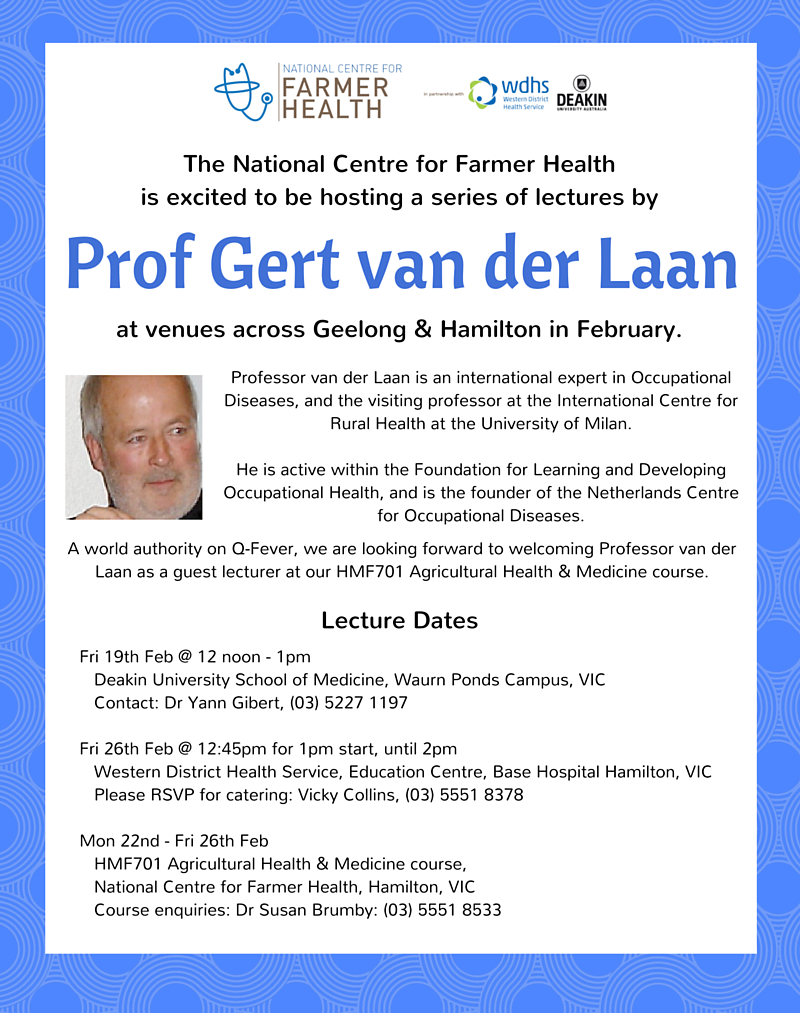
NCFH to host Professor Gert van der Laan in February 2016
2016-01-19: ‘Website and postcards set to help reduce stigma around suicide in Australian farming communities’ – ABC Rural
Website and postcards set to help reduce stigma around suicide in Australian farming communities
by Nathan Coates
The National Centre for Farmer Health (NCFH) is concerned about the community left behind when an Australian farmer commits suicide.
The centre has developed a website designed to reduce the stigma experienced by those communities, and has recently launched new initiatives such as pre-paid postcards, the recruitment of community champions and a digital storytelling workshop.
It is all part of what is called The Ripple Effect and it began last year.
NCFH’s Alison Kennedy said The Ripple Effect was helping farmers open up about their problems.
“There are heightened risks of suicide within farming communities,” she said.
“And there are some cultural aspects within farming communities that suggest people are less likely to seek help when they are struggling.
“That comes down to an increase in stigma around the issues of help seeking, having any emotional problems and suicide.”
[… more]
To read the full article and listen to the audio interview: 2016-01-19: ‘Website and postcards set to help reduce stigma around suicide in Australian farming communities’ – ABC Rural
2016-01-14 World disease authority is keynote speaker at ag health training
World disease authority is keynote speaker at ag health training
A world authority on occupational diseases will be a keynote speaker at the National Centre for Farmer Health’s 2016 Agricultural Health and Medicine (HMF701) post graduate course run through Deakin University School of Medicine.
Five years ago Dr Gert van der Laan, founder of the Netherlands Centre for Occupational Diseases, was involved in the world’s largest outbreak of Q Fever.
In 2009-2011 the Netherlands faced around 2500 cases and 24 fatalities as well as slaughtering thousands of goats.
Dr van der Laan said the outbreak was the inevitable result of too many goats living in close proximity to humans with poor hygiene practices.
He said the proximity of livestock and humans per square kilometer in the Netherlands was not a challenge faced by Australians but still provided a frightening insight of the rampant nature of the disease.
“In European agriculture, occupational health services and good working conditions are lacking in contrast to a lot of other industries,” Dr van der Laan said.
“There are a lot of accidents and disease challenges and the reason I would like to see courses like HMF701 Agricultural Health and Medicine worldwide is to further develop occupational health,” he said.
“That is what our Committee on Rural Health from the International Conference on Occupational Health is about.”
“These courses should be made available to doctors, nurses and to other ag-related services.
“I expect to take as many ideas back to Europe with me as I can offer during my presentation in Australia.”
Currently visiting professor at the International Centre for Rural Health at the University of Milan, and active within the Foundation for Learning and Developing Occupational Health,
Dr van der Laan said there is a course similar to HMF701 in the US and Sweden.
He said countries need to learn from each other, with teaching material shared through international networks to deliver “this valuable and essential” training.
Director of the National Centre for Farmer Health, Dr Susan Brumby, said HMF701 was still the only course of its kind in Australia, and that the Swedish and American experience showed its ability to adapt to other countries.
“Just looking around our own borders I have no doubt it would be a perfect fit for New Zealand and Indonesia,” Dr Brumby said.
“More than 120 people have completed this ground-breaking course in agricultural health, wellbeing and safety with every state and mainland territory represented,” she said.
“This growing number of health professionals are addressing the health disparities in our agricultural and rural populations and making a real difference to the lives of farmers and their families and employees.
“The 2016 course begins with a one-week intensive from February 22 to 26 and if you have a staff member with a passion and interest in rural health and injuries support them to increase their skills and knowledge with this innovative course, and make a difference.
“People with this training are uniquely placed to become leaders within your organisation in agricultural health and medicine.
“Alternatively, if you have any staff undertaking post graduate studies, such as diabetes education, masters of nursing, agribusiness, social work, critical care, midwifery, policy or pharmacy, HMF701 can also be taken as an elective.
“Doctors enrolled with the Royal Australian College of General Practitioners (RACGP) or Australian College of Rural and Remote Medicine (ACRRM) fellowships can claim two credit points towards their Graduate Certificate in Agricultural Health and Medicine once completed.”
Places are available and enrolments for the 2016 course are open through Deakin University. For more information visit www.farmerhealth.org.au or contact the Course Director, Dr Susan Brumby on 03 5551 8533.
Dr Susan Brumby, National Centre for Farmer Health
03 5551 8533
susan.brumby@deakin.edu.au