

2016-07-12: Giving farmers the tools to share their stories – Beef Central
By Beef Central, 12 July 2016
Australian farmers affected by suicide recently came together to participate in a workshop that helped them to creatively record and share their personal stories.
To view full article: 2016-07-12: Giving farmers the tools to share their stories – Beef Central
2016-07-08: The Ripple Effect lets farmers share their lived experiences of suicide – Bendigo Advertiser
by Mark Kearney
The grief and stigma experienced by people whose loved ones have taken their own life can be isolating, especially for those living in rural communities.
But The Ripple Effect, an initiative from the National Centre for Farmer Health, is encouraging rural residents with lived experiences of suicide to share their stories online.
The website contains video messages and postcards from people bereaved by suicide as well as stories from those who have considered taking their own life.
Research fellow Dr Alison Kennedy said sharing survivor accounts was a powerful way to help those experiencing difficult times.
“We also know that people in farming communities are renowned for helping each other – that’s what keeps small communities alive,” Dr Kennedy said.
“By sharing a story of what has helped you, you can help others learn and take action to make positive changes for their health and wellbeing.”
Barham avocado farmer and Ripple Effect steering committee member Katrina Myers lost her father, Sandy, to suicide when she was 15 years old. Ms Myers said troubled successions plans for his property and an expectation farmers remain stoic contributed to the depression that eventually claimed her father’s life.
To view full article: 2016-07-08: The Ripple Effect lets farmers share their lived experiences of suicide – Bendigo Advertiser
2016-07-07: Stoicism has to go to save Australian lives – Bendigo Advertiser
by Mark Kearney
At a televised leaders’ debate in Queensland midway through this year’s federal election campaign, Opposition Leader Bill Shorten asked his audience a question.
“How many of you have been touched by suicide?”
The response was startling.
Nearly all of the people in the crowd raised a hand to acknowledge they knew someone who had taken their own life.
It was a powerful display of how pervasive suicide is in our country and it was a pity few people had tuned in to see it.
But despite its all-too-common incidence, suicide continues to be a topic laden with stigma.
Some families, ashamed or guilt-stricken at their loved one’s death, close themselves off from the outside world.
Some friends, afraid of saying the wrong thing to families bereaved by suicide, choose to say nothing at all.
What makes this stigma so troubling is that an inability to talk about despair is a driving factor for many people to take their own life.
The “she’ll be right” mentality might be a cornerstone of the traditional Australian character, but it perpetuates a fear of vulnerability.
And there is nothing shameful about being vulnerable.
There is nothing weak about reaching out for help.
For a man to share his story does not undermine his masculinity.
The Ripple Effect is a welcome addition to the growing cannon of suicide prevention and support projects on offer in Australia.
It targets our country’s farming community, so often celebrated for their stoicism in the face of hardship, but too often succumbing to anxiety and depression.
The Ripple Effect also operates on the same premise that underscored Bill Shorten’s question; that one suicide sets in motion a series of events for an exponential number of family members, friends and acquaintances.
To view full article: 2016-07-07: Stoicism has to go to save Australian lives – Bendigo Advertiser
Farmer Health eNews July 2016
Find out all the latest from the National Centre for Farmer Health
-
Check your No.1 Farming Asset @ Sheepvention, Hamilton 1-2 August 2016 – Visit Us!
-
Suicide — Taking on the Last Taboo
-
Agricultural Health & Medicine HMF702 – LAST CHANCE – ENROL NOW – Course Online
-
Wellness Wednesday Topics
2016-07-01: Farmer’s battle shows there’s light at the end of the tunnel – Dairy News Australia
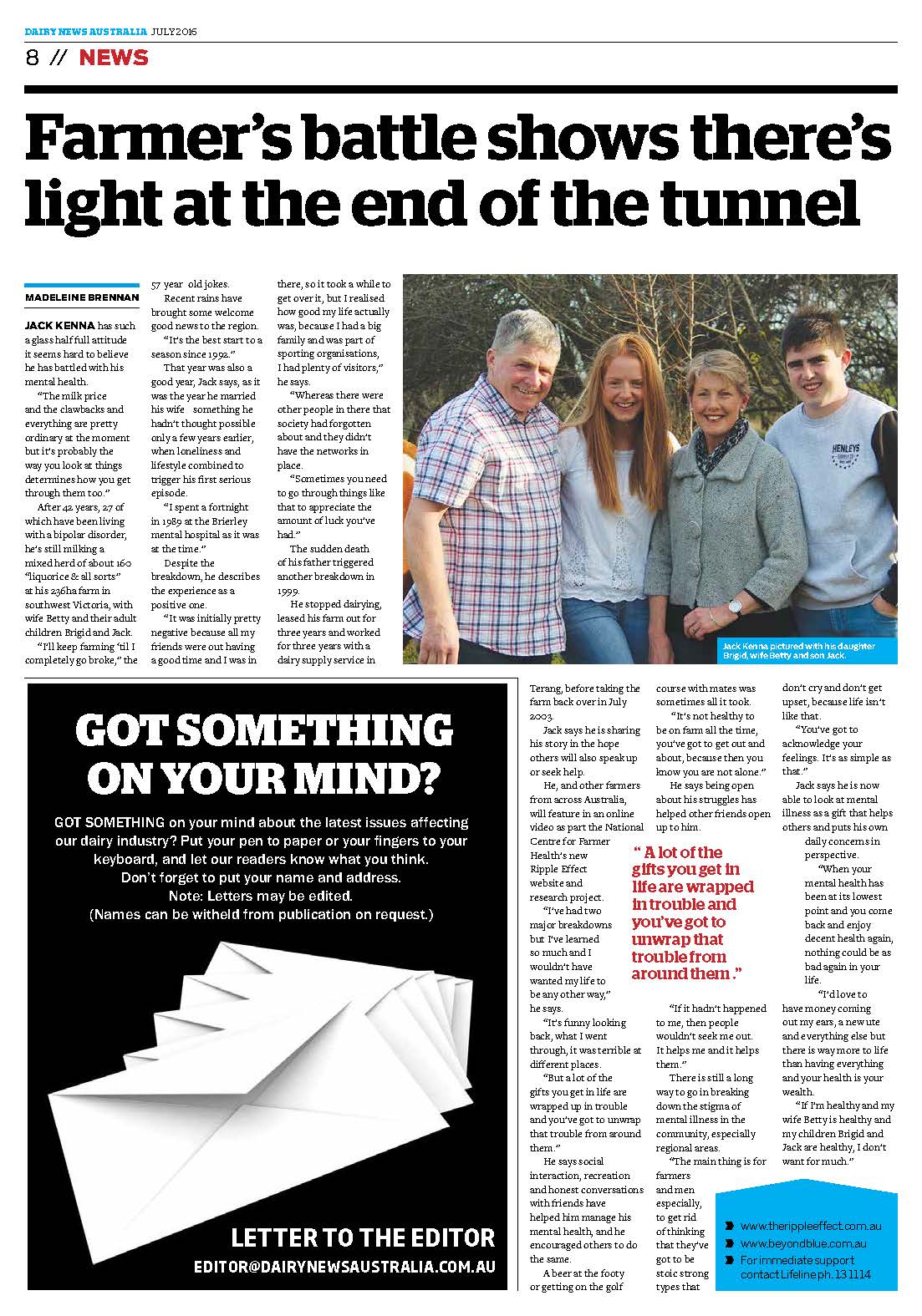
Click to view full article: 2016-07-01: Farmer’s battle shows there’s light at the end of the tunnel – Dairy News Australia
2016-07-01: ICOH Newsletter – HMF701 Review by Gert van der Laan
Teaching Agricultural Health and Medicine Observations on an Australian Experience Gert van der Laan (g.vanderlaan@occmed.eu) International Centre for Rural Health, University of Milan www.icrh.eu, Italy and Foundation Learning and Developing Occupational Health (LDOH) www.ldoh.net
Introduction
The National Centre for Farmer Health in Hamilton, part of the Deakin University’s School of Medicine, Australia organizes annually an intensive multidisciplinary training in agricultural health and medicine. It aims to develop the next generation of rural and agricultural health leaders to improve the health, wellbeing and safety of rural and remote Australians. It is inspired by the work of Kelley Donham in the USA, whose book2) is used as teaching material. In this note some observations of the Australian February 2016 Training Unit are made.
Participants
The Unit is open for graduate level students and professionals from nursing, medicine, health, agricultural science, agribusiness, social work, veterinary and environmental science backgrounds. This course was attended by 20 students including 8 registered nurses, 1 medical doctor, 1 paramedic, 4 agricultural/biological scientists, 2 agribusiness/farmers, 4 allied health professionals and included students from most states of Australia and 2 international students. Most of the participants have an agricultural background and some of them also run a family farm, which provides practical application and deep involvement in the course content.
Read more: ICOH Newsletter Vol 14, No 2 July 2016
2016-06-30: New ripple effects for wellbeing – The Northern Daily Leader
A NEW program has launched to help address suicide in regional and farming communities.
The Ripple Effect, an online platform launched by the National Centre for Farmer Health allows people to anonymously share their experiences living in rural communities.
Research fellow Alison Kennedy for the farmer centre, said sharing a story could help others “take action to make positive changes for their health and wellbeing”.
“The Ripple Effect combines the strength of storytelling with rural people’s natural enthusiasm for supporting each other,” Dr Kennedy said.
“Participation in the Ripple Effect is anonymous, personalised and with people who understand what life in a rural farming community is really like.”
People can access the story-sharing platform at www.therippleeffect.com.au
To view article: 2016-06-30: New ripple effects for wellbeing – The Northern Daily Leader
2016-06-30: Join this Motley Crew – Forbes Advocate
by Marg Applebee – Photo Marg Applebee, Central West Lachlan Landcare.
Hi Landcarers, this week we finally said goodbye to the eucalyptus melliodora that have graced the front of our building.
Due to the potential hazard that they pose they had to be removed, but it was sad to see them go. The arborists did an amazing job in wet weather.
Have you heard about ‘The Ripple Effect’? After nearly 12 months of preparation the site is expanding on 30 June.
The Ripple Effect is an online tool designed to investigate what works to reduce the self-stigma (negative attitudes you have towards yourself) and perceived-stigma (negative attitudes you believe others have about you) among males from the farming community, aged 30-64 years, who have been bereaved by suicide, attempted suicide, cared for someone who attempted suicide, have had thoughts of suicide, or been touched by suicide in some other way.
The website provides an opportunity for anonymously sharing experiences in a peer-supported environment, increase knowledge and literacy about the experience of suicide and encourage a positive cycle by which the disruption of the negative feedback of self-stigma and perceived-stigma will also reduce stigma in others.
The Ripple Effect has been funded by beyondblue and is made possible through partnerships with many organisations all working together with one goal.
To read the full article: 2016-06-30: Join the Motley Crew – Forbes Advocate
2016-06-27: Stories of hope to tackle suicide – Bairnsdale Advertiser
A group of 11 farmers from across Australia gathered in Melbourne recently to record their stories of suicide.
“I’ve been living with this agony trapped inside me for a lot of years. Some days it felt like a life sentence for me, too. It feels good to finally get it out,” Bill, a farmer from rural South Australia who participated in the three-day story telling workshop after battling for two decades with thoughts of taking his own life, said.
“Working alongside other farmers who understood what life in the bush is like certainly helped, too. I know I’m not the only one who has been through tough times like this. The way I think is, if telling my story can help someone else out there, it will be worth it.”
These stories of loss, hope and recovery have become a valuable part of the Ripple Effect website (www.therippleeffect.com.au) being launched this Thursday, June 30, by the National Centre for Farmer Health.
The Ripple Effect, of which local farmer and psychologist, Maria Parente, is a member of the national steering committee, website provides the opportunity for members of farming communities affected by suicide to anonymously share experiences in a peer-supported environment.
“People can learn more about why suicide happens, how they can support people in their community going through a tough
time and find links to support where this is needed,” National Centre for Farmer Health Research Fellow, Alison Kennedy, said.
“Importantly, they can watch the farmers’ stories that are provided. There is also information about suicide, stigma, how you can help support the wellbeing of yourself and others, and set personal goals to achieve this.”
The Ripple Effect has a focus on men aged 30-64 years who have been bereaved by suicide, attempted suicide, cared for someone who attempted suicide, have had thoughts of suicide, or been touched by suicide in some other way, though everyone belonging to a regional or rural community affected by suicide is welcome to participate.
Jen is from a farming community in South Australia. Her story tells of her experience following the unexpected suicide death of her husband.
“Telling my story made me realise I need to get past the guilt and start living again. I’ve got to concentrate on looking after the
family and friends I’ve got left,” she said.
“If my story makes one other person tell the people they love how desperate they are feeling, then it’s been worth it.”
Through telling about personal experiences and learning more about suicide, Dr Kennedy says the website aims to reduce the
negative attitudes people affected by suicide have towards themselves and others.
“Too often people feel isolated, shamed or guilt after an experience of suicide and can’t bring themselves to ask for support,
even when they want to,” she said.
“They think other people will think less of them if they do seek support. We want to turn this around by people more effectively
supporting each other and reduce the numbers of rural suicides.”
Dr Kennedy is looking for a least 500 farmers and farming community members from across Australia to participate in the
Ripple Effect.
“If we are going to turn back the tide of suicide in rural farming communities, we need to know what people are thinking,” she
said.
“We need to know the extent of the problem, and start developing ways to address it. We can only do this by listening to those who are affected first hand.”
The Ripple Effect is a collaborative effort led by the National Centre for Farmer Health (NCFH), in partnership with Deakin University, Victorian Farmers’ Federation, AgChatOZ, Sandpit, Western District Health Service and Mental Illness Fellowship North Queensland.
Dr Kennedy said the Ripple Effect is funded by beyondblue, with donations from the Movember Foundation, as part of a broader national effort to reduce stigma associated with suicide.
The reduction of stigma and suicide is important for beyondblue and the Movember Foundation because nearly eight Australians die by suicide every day—twice the rate of the national road toll—and of those six are men, according to the Australian Bureau of Statistics, with the highest number of suicide being by men aged in their 30s and 40s.
If you are experience troubles, contact Lifeline 1311 14 or beyondblue 1300 22 46 36.
2016-06-27: Stories of hope to tackle suicide – Bairnsdale Advertiser
2016-06-25: Spirits high at Cobden’s Dairy Day football match – The Standard
Article: Rachael Houlihan, Picture: Vicky Hughson
THE message at Cobden’s Dairy Day for farmers was to stick together and look out for each other.
The day was an opportunity for farmers to take a few hours away from the farm, and enjoy a game of country football at the Cobden Recreation Reserve.
Essendon Football Club legend Kevin Sheedy, cricketing great Merv Hughes, Warrnambool’s favourite son comedian Dave Hughes and 1975 AFL premiership player John ‘Mopsy’ Rantall were the ambassadors of the day, and delighted more than 180 people at a luncheon held in Cobden Football Club’s function room.
Sheedy urged farmers to fight for their livelihoods.
“Stay together, care for each other and love your country,” he said.
“Keep your spirits up. Not every day is a winning day in football. I’ve been in it for 50 years and when you look back on it, you put a hell of a lot of work in over your life and you don’t win every game. You put an enormous amount of work into your crop, your field, your cattle or sheep, but sometimes you just don’t get the win every time and you have to fight. In the end it will turn around. Never, ever, ever give up in life.”
To read the full article: 2016-06-26: Spirits high at Cobden’s Dairy Day football match – The Standard
2016-06-20: New website tackles suicide taboo Written – Dairy News Australia
By Dairy News Australia
IF YOU are a farmer, or work anywhere in agriculture, you know, or know of, someone who has taken their life.
Suicide is incredibly tragic and in most cases preventable.
Too many families and friends of people who have killed themselves have had to survive the fallout.
The ripple effect of such a loss tears apart the fabric of families and communities.
Australia needs to turn the negative ripple of suicide and stigma into a tsunami of action and support, according to the National Centre for Farmer Health.
Which is why it is about to launch a website to learn what is happening, and how regional communities are thinking about suicide.
To be launched later this month, the Ripple Effect website will enable farmers to anonymously register and view other farmers’ stories of suicide, share their own insights and find out what they can do to support the wellbeing of others and themselves.
Article no longer available. 2016-06-20: New website tackles suicide taboo Written – Dairy News Australia
Farmer Health e-News – June 2016
Find out all the latest from the National Centre for Farmer Health
-
How can you make a difference to farmers’ lives in your local area?
-
Look over the farm gate – Additional Workshops
-
Run 4 Farmer Health
-
Agricultural Health & Medicine HMF702 Scholarships Extended – 1 day left!!!
- View the June e-News