2017-01-30: ABC Mental Health interview with Tom Dawkins
Discussing rural mental health initiatives ‘Look Over The Farm Gate’ and ‘The Ripple Effect’ on ABC South East SA radio.
Listen here: 2017-01-30: ABC Mental Health interview with Tom Dawkins
2017-03-11: NCFH inspires interest from Indonesia – The Hamilton Spectator
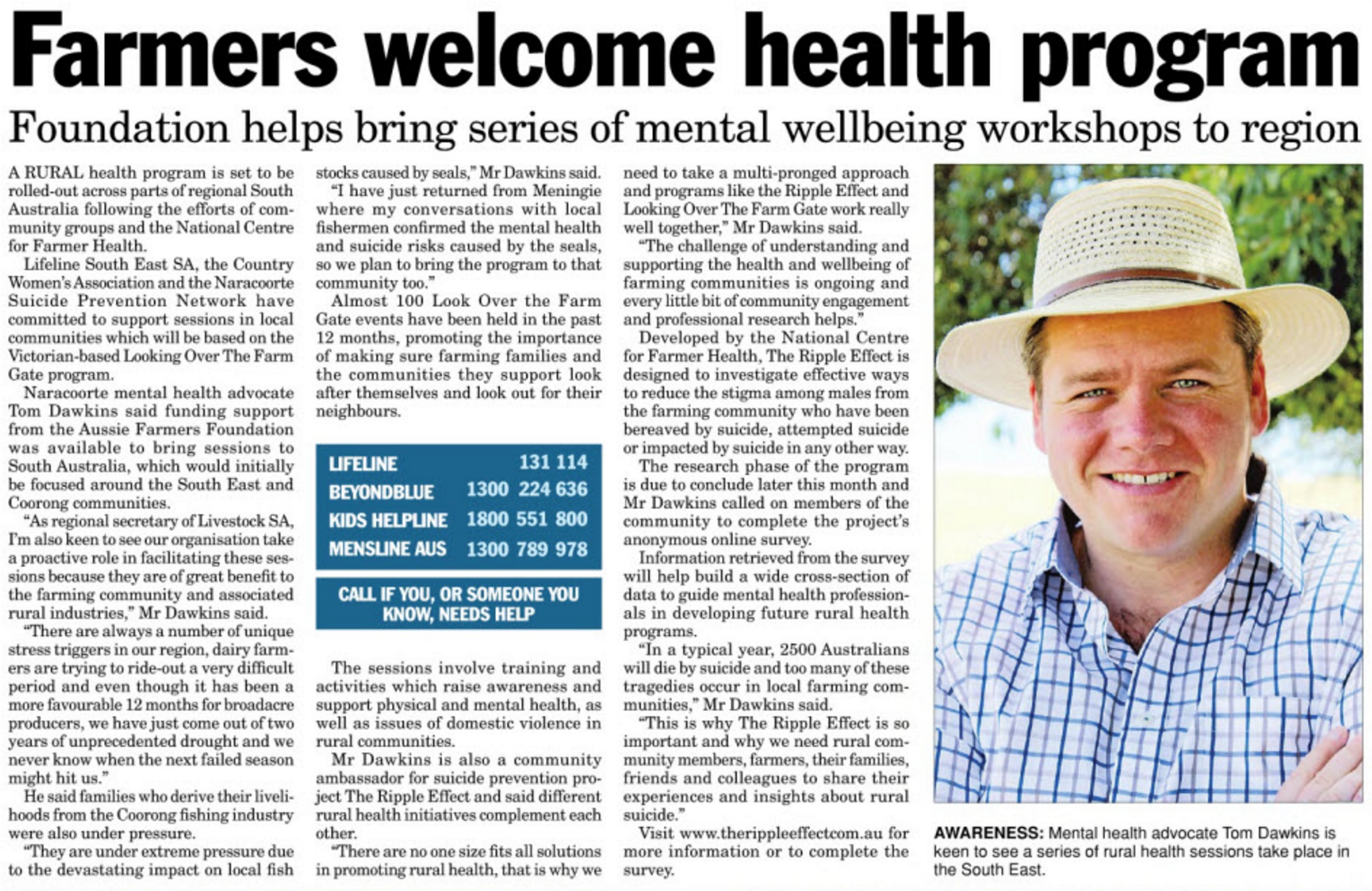
2017-03-10: Farmers welcome health program – The Border Watch
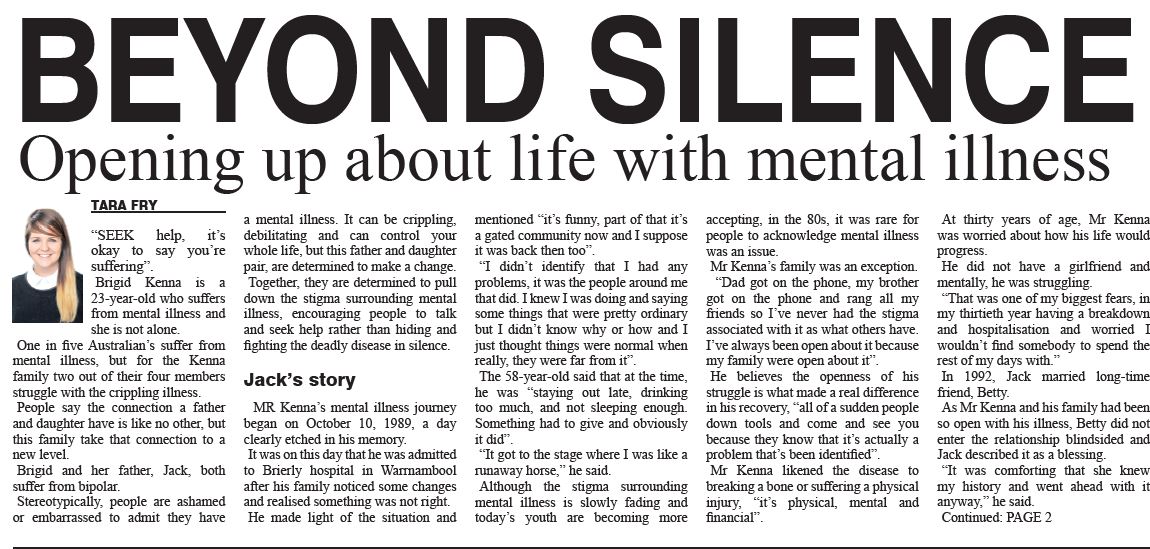
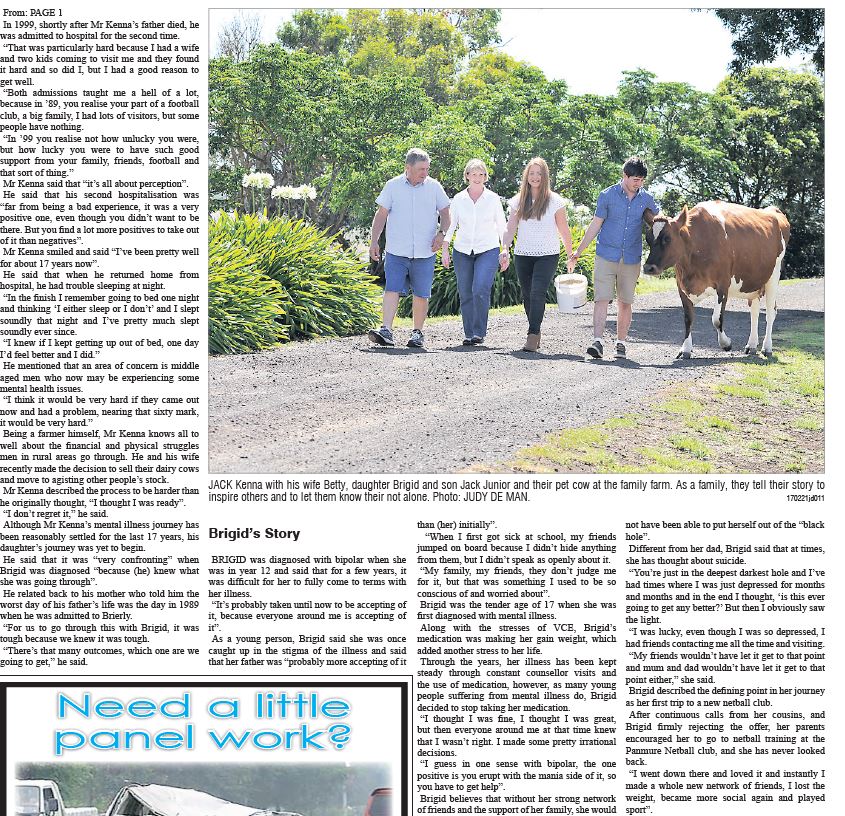
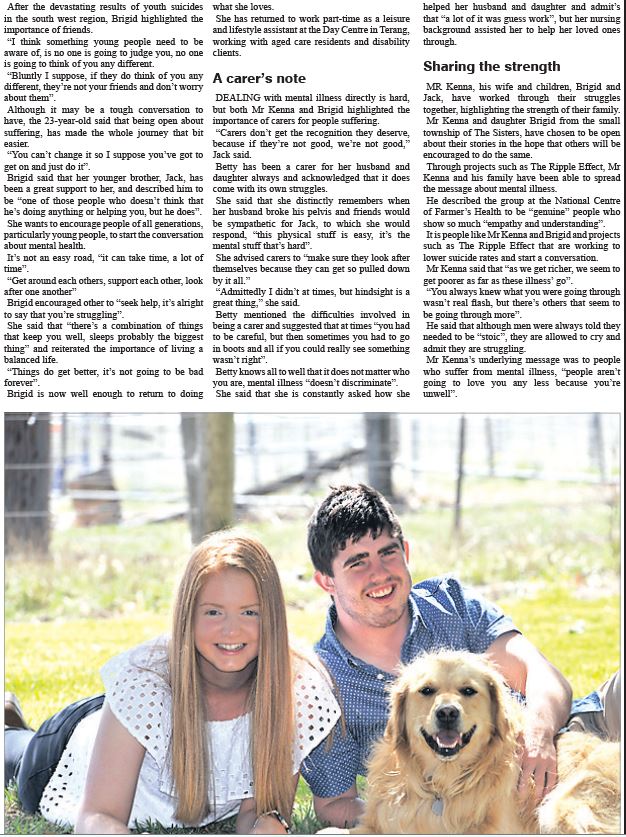
2017-02-28: Beyond Silence – The Hamilton Spectator
Farmer Health eNews March 2017
Find out all the latest from the National Centre for Farmer Health
- Looking forward to seeing you back at Wimmera Machinery Field Days 7-9th March 2017 Site D27-28
- Don’t dawdle…have your say about rural suicide!
- Nuffield Scholar visits NCFH
- Wellness Wednesday Topics
View the March 2017 e-News
Sign up to receive eNews straight to your inbox! Click here
2017-02-21: Farm safety is goal of Nuffield Scholar Jim Chapman who lost arm in tractor accident – ABC Rural
In 2005 British farmer Jim Chapman lost his left arm after he got too close to an unguarded tractor shaft.
“It was like [in] a matter of seconds, it grabbed hold of my jumper, wound me in and I went over the top of the shaft and landed on the floor without my left arm,” he said.
Mr Chapman is visiting Australia from the United Kingdom as part of the Nuffield Farming Scholarship he was awarded last year.
His goal is to explore methods of reversing what he calls the “appalling safety record in agriculture”.
Life after farming accident
For 12 months Mr Chapman struggled to deal with the aftermath of the accident that left him without his arm.
Eventually, his friends dragged him out of the house and he became involved in a young farmer’s organisation and was later asked to be part of a farm safety campaign.
“They wanted a disabled farmer who didn’t mind telling their story about having an accident on the farm and how it affects your life,” he said.
Mr Chapman now goes around telling his story to other farmers in the hope he can change attitudes to farm safety.
“My aim really is to make safety sexy once again,” he said.
“I say that for a bit of a laugh and it gets people in a bit of a smile but really it’s about changing that attitude.”
Taking a look at Australian farms
Mr Chapman stopped by Jigsaw Farms near Hamilton, in south-west Victoria where he was impressed by owner Mark Wootton’s approach to safety.
“The guy’s a fantastic farmer,” he said.
Read more: 2017-02-21: Farm safety is goal of Nuffield Scholar Jim Chapman who lost arm in tractor accident – ABC Rural
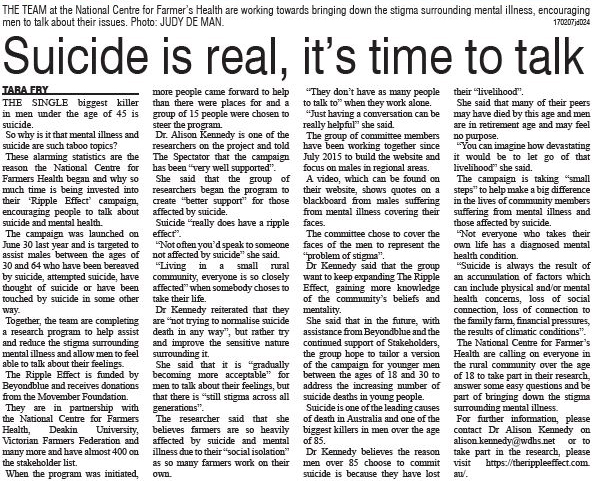
2017-02-09: Suicide is real, it’s time to talk – Hamilton Spectator
By Tara Fry
2017-02-07: Sungold Field Days renews itself again – The Standard
by Everard Himmelreich
Sungold Field Days chairman Tony Rea doesn’t like to highlight new things at the event too much because “every exhibitor has something new.”
“That is the wonderful thing farmers like about the field days,” Mr Rea said.
“They can see so much equipment in the one spot at the one time,” he said.
Mr Rea said the 11.5 hectare site was fully booked with all 260 exhibitor sites taken.
“Some exhibitors wanted extra space but we haven’t been able to accommodate them,” he said.
Exhibitors have come from throughout Victoria, NSW, South Australia and New Zealand.
Mr Rea said good spring and summer rains and recovering milk prices had given dairy farmers more optimism than last year.
About 30 millimetres of rain fell on the Allansford site on Sunday afternoon to leave the site looking green.
Mr Rea has been involved with the event’s management for 36 years and as chairman for the past 31.
He has found it a great source of new technology and innovation, not just in equipment but also in techniques.
Among the innovations on show this year are new ryegrass varieties that grow longer in winter and stay green later into the summer.
Event coordinator Emma Kavanagh said the event catered to the whole community with lifestyle exhibits as well as those for dairy and other agricultural industries.
Entertainment this year includes demonstrations by whip cracking virtuoso Nathan Griggs, wood chopping, cooking demonstrations and performances by musicians Kayla Dwyer, Cooper Lane and Mitch Power.
A parade of vintage tractors and other vintage farm machinery at 11am each day will be led by a massive 1910 Chas Burrell steam traction engine.
The National Centre for Farmer Health (NCFH) will again be providing free health assessments, measuring body mass index, cholesterol, blood pressure and glucose levels. Eyesight testing and diabetes assessment will also be available.
View Article: 2017-02-07: Sungold Field Days renews itself again – The Standard
Farmer Health eNews February 2017
Find out all the latest from the National Centre for Farmer Health
- Sungold Field Days 8 – 10th February 2017 Site N36
- Spread the Ripple
- Keep in touch with NCFH – stay social!
- Wellness Wednesday Topics
View the February 2017 e-News
Sign up to receive eNews straight to your inbox! Click here
2017-01-30: Farmer suicide: Participants needed for The Ripple Effect survey – The Weekly Times
By: HANNAH DRISCOLL, The Weekly Times
A SURVEY aimed at reducing farmer suicide needs more men to take part.
The Ripple Effect online survey aims to investigate ways to reduce the stigma of suicide — particularly among 30- to 64-year-old males — in farming communities.
The survey, in which participants detail their own experiences, set a target of 473 male participants. But of the 370 respondents so far, only about 30 per cent were male.
National Centre for Farmer Health research fellow Alison Kennedy, who is conducting the survey was “a way for us to gather information about rural suicide and the experience of how people feel best supported and where perhaps that support isn’t forthcoming and how they would prefer that to be offered”.
Dr Kennedy wants to glean as much information as possible from the target age group.
“That’s not to say we don’t want anyone else to participate, but we certainly do need a good chunk of blokes,” she said.
Dr Kennedy agreed “without a doubt” the number of survey participants to date was indicative of the stigma of suicide — that “people are very much behind suicide prevention but when it comes to opening up about their own experiences they’re much less likely to do that”.
“That is the point of the project, to try to reduce the stigma associated with suicide,” she said.
Dr Kennedy said support for the initiative needed to translate into more active participation.
• Visit therippleeffect .com.au
2017-01-30: Live Rural to help with farmers’ study – The Ararat Advertiser
Applications have opened for the next round of Live Rural study scholarships following the 2016 Mellow in the Yellow fundraiser at Tatyoon.
The program will award two farmers up to $2000 to contribute to the productivity of the farming business they work in or own.
Mellow in the Yellow was hosted at Tatyoon and raised the cash for scholarships to be awarded in the Ararat district farming community.
It also raised $5000 for the National Centre for Farmer Health based in Hamilton.
The scholarship covers expenses such as course and accommodation costs.
The applicant must be an Australian citizen or permanent resident in the Ripon or Lowan area and work on a farm or is a farm owner.
They must be studying an agriculture-related course, have been working in the industry for at least two years and able to complete the course within 12 months.
Mellow in the Yellow spokesperson Leila Sweeney-McDougall said more information can be found at liveruralaustralia.com, and applications close on April 27.
The Ripple Effect Final Report
This report details the design and evaluation of The Ripple Effect—a technologically-innovative, digital
intervention to reduce the stigma associated with suicide for males aged 30-64 years in rural and remote
Australian communities. The findings presented are the product of 23 months of engagement with rural and
remote farming community members affected by suicide—those bereaved by suicide, those who have
contemplated or attempted suicide, those who have cared for someone who has attempted, and those who
have been touched by suicide in other ways. The Ripple Effect recognises that males in rural Australia, in
comparison to males in the urban population, experience higher rates of suicide. This is despite similar levels of
diagnosed mental health conditions in rural and urban areas. Contextual elements such as geographic isolation,
traditional gender and cultural expectations, and close-knit communities restrict open discussion about suicide
and reinforce the effects of stigma (A. J. Kennedy, 2015). This inclination to avoid emotional vulnerability can be
detrimental when combined with feelings of weakness, shame, guilt, selfishness and the sense of rejection often
associated with an experience of suicide. The self-stigma and perceived-stigma that manifests can lead to
obscured behaviour and aversion to help-seeking, which may have life-altering effects and, ultimately lead to
increased ongoing suicide risk.

