2017-11-22: Telling farm stories – The Telegraph
f you are a Victorian woman living in a rural farming community and have a story to tell, the National Centre for Farmer Health wants to hear it from you.
If you live on the land, you must have lived through some tough times and the centre wants you to share your experience, tell your story and help others by taking this supported opportunity to participate in a From Inside the Farm Gate digital storytelling workshop.
The centre’s Deakin University research fellow Alison Kennedy said feedback from previous digital storytelling workshop participants included:
‘‘It was a powerful, fantastic and at times quite full on experience.’’
‘‘It reinforced that people can understand… the underlying problems in peoples lives by watching and listening to their personal story.’’
‘‘Watching my video I am very proud of the outcome. Several people have watched it and have given back so much positive feedback.’’
‘‘Participating in the digital storytelling workshop was both a very humbling experiences well as inspirational, in working so closely with such a small group of other amazing farmers… shared their (stories) to initially a room of strangers, who three days later had then become very special friends. This could never have occurred without the amazing support from the (workshop facilitators) … Well done to all who participated.’’
Dr Kennedy said the centre was looking for 24 enthusiastic rural Victorian women whose lives had been affected by tough times in some way, such as physical health, wellbeing challenges for themselves or someone they have cared for, financial hardship, bereavement, natural disaster or leaving the farm.
She said participants needed to be comfortable using a computer, attend a three-day workshop and be passionate about telling their story to give voice to rural women and build knowledge and understanding of the rural experience in the broader community.
‘‘The good news is we can provide accommodation and most meals, and travel allowance to recognise the time off-farm or away from your community,’’ Dr Kennedy said.
‘‘We want to make a short movie/video (digital story) using sound, narrative, images and voiceover.
‘‘Typically, digital stories run for two to four minutes and contain an emotional component that enables personal perspective to be communicated.’’
More information can be found at https://en.wikipedia.org/wiki/Digital—storytelling
The sessions will be in Hamilton from January 30 to February 1 (workshop one) and February 6 to 8 (workshop two).
The $2500 places are free to participants. To register your interest and learn more about the workshop, phone Dr Kennedy on 55518533 or email alison.kennedy@wdhs.net
This project has been supported by funds donated by the Victorian Women’s Benevolent Trust and the William Buckland Foundation.
View article here: 2017-11-22: Telling farm stories – The Telegraph
2017-10-17: ICOH Symposium – Zagreb, Croatia
Professor Susan Brumby was one of 9 invited keynote speakers at the round table discussion on Experiences in training health professionals: Current situation and unmet needs around the globe. Prof Brumby Chaired a Special Session on Education and training in agricultural health and safety – Exchange of experiences in teaching methods, b-learning and organising a repository of e-materials and presented Blended learning courses in farmers health, lessons learnt.
Round table discussion: Experiences in training health professionals: Current situation and unmet needs around the globe
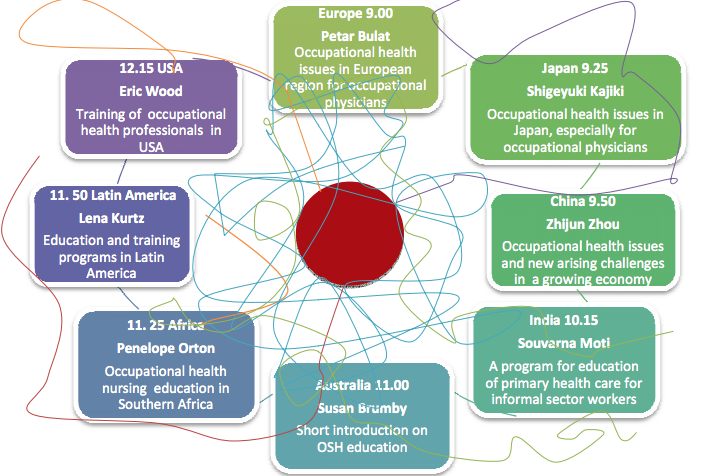
A short introduction on OSH in Australia
Current situation: In Australia the industry with the highest number of fatalities during 2015 and the second highest over the last decade was in the Agriculture, Forestry and Fishing Industry. Whilst there has been improvements in other industries, Agriculture, Forestry and Fishing has remained constant over the last decade. There are numerous reasons for this. In Australia, the major killer of people on farms is the four wheel bike (or all-terrain vehicle) as it is known. It has replaced tractors as the major cause of death. Currently there is a variety of schemes and government responses to address these fatalities including a focus on roll over and crush injuries from Quad bikes. Unmet need: There remains a lack of knowledge, awareness and will in some areas of the industry as well as the tyranny of distance, working alone, poor phone and internet coverage, vast distances and access to services should assistance be required. This discussion will present and show a variety of methods currently being used in Australia to reduce OSH risk, injury and fatalities.
About Professor Susan Brumby
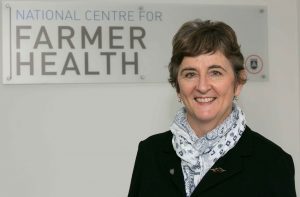
Professor Susan Brumby is the founding Director for the National Centre for Farmer Health, a partnership between the Deakin University’s School of Medicine and Western District Health Service and is based in Hamilton, Australia. The Centre provides leadership to improve the health, wellbeing and safety of farmers, farm workers and their families across Australia.
She leads the implementation of five key strategies which includes inventive and award winning service delivery models, farmer research, education and training, the farmer health website https://farmerhealth.org.au and works with an Advisory committee comprised of academics, farmers, health professionals and government representatives in order to achieve the mission of ‘making a difference to farmers’ lives’.
Susan is the course leader for the Graduate Certificate in Agricultural Health and Medicine, Principal Investigator of the award winning SFFTM project, Chief Investigator on National Health and Medical Research Council grants and previously Chief Investigator on Australian Research Council, Rural Industries Research Development Corporation and beyondblue grants. She has been recognised for her contribution to rural health, awarded a Victorian travelling fellowship in 2006 and an overseas study program in 2013 to examine farmer health. Her PhD was on Farm Work and Family Health across selected Agricultural Industries in Australia. In 2014 her team was awarded the Vice-Chancellors award for Excellence in Teaching. She is an appointed member of the Victorian Rural Advisory Council that advises the Minister for Agriculture on matters such as rural adjustment, regional issues, training, drought and other matters as requested by the Minister. A graduate of the Australian Rural Leadership program, Susan has presented and published nationally and internationally.
Farmer Health eNews November 2017
Find out all the latest from the National Centre for Farmer Health
- HMF701 Round 2 Scholarships OPEN!
- 2017 Run 4 Farmer Health wrap up
- 2017 Honours Students
- Wellness Wednesday Topics
2017-11-01: Working towards healthier farms – GippsDairy Newsletter – How Now Gippy Cow
Now entering its ninth year, Australia’s only postgraduate agricultural health and medicine unit for professionals servicing farming communities continues to attract participants from across Australia.
Designed to confront the high morbidity and mortality rates in the agricultural industry, the internationally recognised course better equips health providers, rural professionals and our farming communities with the knowledge and skills they need to help turn things around.
To date, 150 professionals working in agriculture, medicine, allied health and nursing from all over Australia have undertaken the course. The National Centre for Farmer Health’s (NCFH), Dr Susan Brumby said that a healthy workforce is vital for a productive agricultural industry, but through the work of the NCFH, we have learnt that farming families and their communities face poorer health outcomes than their urban counterparts.
“Agricultural workers have a high rate of injuries including fatalities and suffer chronic diseases at high rates,” she said.
“A growing number of agricultural and health professionals are addressing the health disparities in our agricultural and rural populations and making a real difference to the lives of farmers and their families and employees.”
Moira Tulloch, a Registered Nurse and Clinical Manager from Briagolong received a GippsDairy scholarship in 2017 which helped her manage rural patients better.
“The knowledge I have gained has become an integral part of my [rural] nursing practice,” she said.
“It was a great experience learning from other rural professionals from both Australia and overseas.”
This was also the case for 2017 GippsDairy scholarship recipient, dairy farmer and registered nurse, Kathryn Croatto.
“I now try to include as much health information into my consultations, I am more aware of patient occupations and potential hazards,” she said.
GippsDairy regional manager Allan Cameron said GippsDairy saw the scholarships as a practical way to improve health outcomes for the dairy community.
“The scholarships put knowledge in the hands of local health professionals who then take that into the wider community,” he said.
“Each scholarship recipient adds to the store of information on health issues for farmers, which is already making a difference to the way health professionals are approaching patients from farms.”
Round Two Scholarships are now open for the exciting 5-day-intensive Agricultural Health and Medicine unit (HMF701), being offered through Deakin University and the National Centre for Farmer Health (NCFH) in Hamilton, western Victoria, from February 26th to March 2nd 2018. The presented topics cover a broad range of agricultural health, safety and wellbeing issues ranging from mental illness and addiction through to emergency medicine, agrichemicals and agricultural trauma. The course has also been accredited for professional development points in areas of medicine, veterinary science, social work and nursing. Applications for Gippsland health and agricultural professionals are now open and close 5th December 2017.
The HMF701 unit can be completed as a stand-alone course, and has been accredited for professional development points through selected colleges and associations, with some health professionals eligible to become AgriSafe™ providers.
For more information about Agricultural Health and Medicine and how you can get involved, contact Dr Jacquie Cotton, Lecturer Rural Health at NCFH on 03 5551 8533 or Salle Clynes, Gipps Dairy on 03 5624 3900 visit https://farmerhealth.org.au for further information.
Course details are also available at http://www.deakin.edu.au
To read full newsletter CLICK HERE
2017 Glove Box Guide to Mental Health – The Land

View full issue: 2017 Glove Box Guide to Mental Health
2017-10-10: Victorian Country Hour – ABC News
Interview with Dr Alison Kennedy and Nick Shady about farmer mental health in the context of Mental Health Week.
 Click here and listen from the 22 minute mark.
Farmer Health eNews October 2017
Find out all the latest from the National Centre for Farmer Health
- Looking for information on farmer health? Read this recent literature review by Siggins Miller
- Don’t compromise your health this harvest – plan ahead to stay ahead.
- Rush to the ‘G’ for Run 4 Farmer Health
- Wellness Wednesday Topics
Farm safety – harvest health
There are simple safety measures that can ensure harvest occurs safely and efficiently. As harvest approaches, it’s crucial that all machinery is checked to ensure a smooth and timely harvest. But simply mending the header and servicing the tractor won’t cut it if you want to protect the key component – you. Considering your health, wellbeing and safety is so important with the upcoming long hours and pressure to get the job done.
Have a quality harvest this year – don’t compromise your health
Take some time to protect yourself against injury and accidents by planning ahead with these tips:
- Check your tractor cabin to make sure you’ve got the right filter in place.
Harvest can be a dusty business so make sure you have an appropriate – and clean – dust filter fitted into your cabin. If you’re using chemicals, an activated carbon filter is recommended. These should be recharged every 6-12 months (or after 400 hours of service). If you have cabin dust, or if you can smell the chemicals you’re spraying, you need to recheck your filter. For more information, read: Useful tips on carbon filters
- Check the safety of your equipment.
Does your auger have a guard in place, and how about the PTO? These two pieces of equipment are the main cause of injury to hands and feet. Also consider the risks unguarded equipment has for children and pets – they don’t understand the equipment you use or how dangerous it can be. To make sure you have considered everything on tractor and machinery safety – Click here
- Plan a healthy harvest diet.
Sitting in the tractor or header all day, you won’t need to eat as many calories as you usually would. Have a good breakfast of low-GI carbohydrates (oats, barley- or bran-based cereals, grainy breads, eggs and/or cooked veggies). Don’t skip meals – pack a wholegrain sandwich and some fruit, nuts and veggies to nibble on. Avoid ‘convenient’ snacks like muesli bars, biscuits and chips as these are often high in sugar, salt and saturated fats. For lunchbox ideas, visit our page: Diet and Nutrition – Fuelling Farmers’ Lunch Boxes
- Avoid dehydration.
Plan to drink a few litres of water a day – have plenty of fresh water on hand to make this easy. Doing this will help avoid the constipation that can result from sitting for hours on end. Keep an eye on your urine – if it smells or is dark yellow, you need more water.
- Exercise.
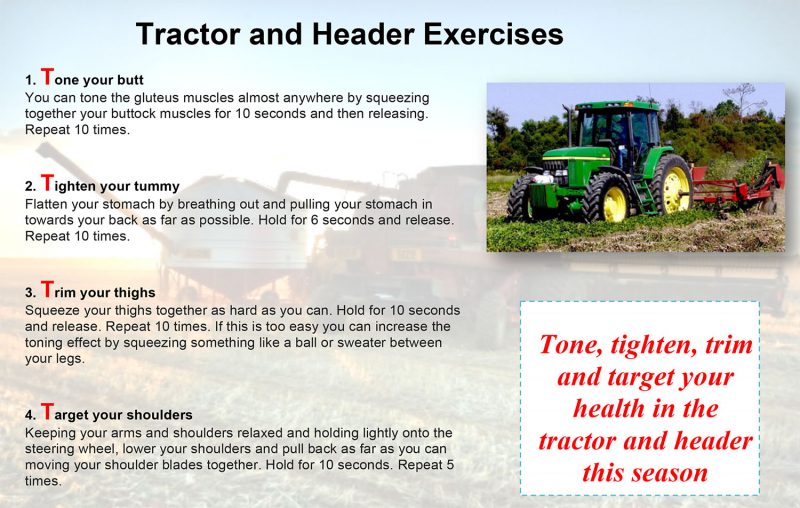
Sitting in a bent or rotated position puts you at increased risk for of spinal and joint pain. Plan to make regular stops to get out of the cabin and walk around. Here are some exercises you can do in the cab, too:
- point your toes and use your big toe to write your name in the air,
- do some marching on the spot (while sitting down),
- sit up straight and gently twist side to side,
- arch your back then straighten up tall, and,
- turn your head side to side to stretch out your neck muscles.
They might sound a bit silly, but it’s better than a sore neck or lower back pain!
Why not stick up our Tractor and Header Exercises sheet in the cabin! Click here
- Manage fatigue
Your body needs sleep to regenerate, refresh and repair. Despite the pressure to get the crop off, make silage or hay, you need to plan your sleep so that your mind and body can function properly. To familiarise yourself with the symptoms and fatigue-management techniques: Click here
“It sounds basic – and it is,” says Professor Sue Brumby of the National Centre for Farmer Health, “But it never seems to amaze how many people neglect to do all, or any, of the above. Yet we all know, or know of, someone who has suffered, and suffered badly, during harvest.”
“It might have been an accident because they have fallen asleep, suffered a heart attack, hurt themselves in machinery, or tripped and sprained. With the proper planning, however, nearly all this can be avoided”.
Don’t forget the impact an incident or injury can have on your family and business.
Reduce the risks – plan ahead.
Fast facts:
- Farmers’ health, wellbeing and safety are often neglected when facing the pressures of harvest
- Simple safety measures can dramatically reduce the risk of injury and illness
- When planning for harvest, take time to integrate these measures to protect the health, wellbeing and safety of you, your family and other farm workers.
References used for this topic
Resources:
National Centre for Farmer Health
Filters – Useful tips on carbon filters
Diet and Nutrition – Fuelling Farmers’ Lunch Boxes
Stick up our Tractor and Header Exercises sheet in the cabin!
Farmsafe Australia
Safe tractor operation guide
Machinery guarding guide
Better Health Channel
Familiarise yourself with the symptoms and fatigue-management techniques
AgHealth Australia
Preventing Falls for Older Farmers
More information:
Australian Centre for Agricultural Health and Safety
Farmsafe Australia
Safe use of Quads and Side by Side Vehicles on Australian Farms
Emergency Preparedness
Better Health Channel
Farm safety – Machinery
Risks and hazards
2017-09-30: Deakin University survey finds members of commercial fishing industry experiencing high levels of psychological distress – NT News
MEMBERS of the commercial fishing industry are experiencing levels of psychological distress almost double that of the general population, new research has revealed.
A survey conducted by Deakin University showed a 19 per cent rate of depression among commercial fishers, compared to the estimated national diagnosis of 10 per cent.
Of the 1000 workers that responded to the 13-page survey, only 9 per cent of said they had experienced no bodily pain in the month prior, with 58 per cent saying they had experienced moderate to very severe pain.
Thirty nine per cent said they hadn’t addressed their physical and mental health problems with a GP because they felt they didn’t understand the pressures of the fishing industry.
Lead researcher Tanya King, an anthropologist within Deakin’s School of Humanities and Social Sciences, said, while the data is worrying, it wasn’t surprising.
“For many years those working in the fishing industry have shared their stories of depression, anxiety, substance abuse and suicide but we’ve never had the statistical data with which to support the overwhelming anecdotal evidence – until now,” she said.
Dr King said many respondents felt their work was “culturally undervalued” or misunderstood, with the health of Australian fisheries themselves often put before the health of those in the industry.
“Despite the industry contributing more than $3 billion to the national economy each year and supplying more than one billion serves of seafood, Australians don’t culturally value fishers like we venerate farmers,” she said.
“While there have been some fantastic awareness campaigns and health outcome successes in relation to mental health among rural and regional Australians, and particularly Aussie farmers, the men and women who catch our local seafood have tended to go under the radar.”
The team at Deakin’s Centre for Farmer Health has been working to adapt its Sustainable Farm Families wellbeing workshop program for fishers.
It has been successful in assisting 2300 farm families across the country and delivered its first ever fishing-specific event on the Bellarine Peninsula this year, with another workshop and pilot program launching in coming weeks.
If you or anyone you know is dealing with thoughts of suicide or psychological distress, call Lifeline on 131 114 or visit lifeline.org.au
View article: 2017-09-30: Deakin University survey finds members of commercial fishing industry experiencing high levels of psychological distress – NT News
26-9-2017: Regional towns push for slice of lucrative business conference and events industry pie – ABC News
Regional Australia wants to tap into the business conferences and events market to add to its economic base beyond industries such as mining and agriculture.
The prevailing view may be that business conferences and events are little more than junkets for those who go, but for the cities that host them they play an important part in that economy.
According to the most recent report published by the Business Events Council of Australia, business conferences and events contribute close to $30 billion in direct expenditure.
On top of that the value-add component, such as additional spending by delegates on goods, services and local tourism, is worth $13.5 billion.
That was generated by 412,000 business conferences and events in a single year.
But those events, and that spending, is almost exclusively confined to capital cities and very large urban centres such as the Gold Coast.
Now some from regional Australia want to seize the opportunity to be part of that sector and add another economic string to their bow beyond typical rural industries such as mining and agriculture.
Look at your town with new eyes.
Arianne Webb was heavily involved in tourism in the mining town of Kalgoorlie-Boulder in Western Australia for more than a decade.
The town is known as the unofficial mining capital of Australia and already hosts the international mining conference Diggers and Dealers.
Thousands of delegates descend on the town every year and pump millions into the local economy.
Ms Webb decided to launch Goldfields Conferences and Events, seeing synergies between conferencing and tourism and building on the region’s diversity.
“There’s rural health, we have training schools here and some very diverse things that happen here in rural health that you wouldn’t get in a city location.
“Obviously we have Indigenous agencies and the market is there to attract a conference on the Indigenous environmental management.”
The spend by business conference delegates is up to six times higher than tourists, backpackers and grey nomads — retired Australians travelling around the country with a caravan.
In 2014 more than 37 million people attended business conferences and events, international visitors spent on average $440 per day, and Australian delegates spent an average $586.
If those delegates attended a conference in a regional town, that spend would be very much within the area.
“One of the benefits of having it in a regional area is we contain those delegates in close proximity,” Ms Webb said.
“But when they’re contained they are generally in walking distance to their accommodation, to the conference venue, local business, and tourism sites.”
Business conferences outside of major centres hamstrung by facilities and know how
Renee Bennett, a director of Perth-based Encanta Event Management agreed business conferences and events were more lucrative than tourism alone.
“Conference delegates bring in a much higher spend to any economy as opposed to what we call ‘visiting friends and relatives’,” she said.
“When visiting a family member you’re unlikely to spending on accommodation, and you’re probably going to be eating at home a lot more.
“A conference delegate is usually sponsored by their organisation or business, so what we tend to see is that they have more disposable income to actually spend within that local community.
“They do need to stay in a hotel, they need to eat breakfast, they need to go out to dinner. It’s over a shorter time line, but it can really generate a significant multiplier effect that we find travels through that business events community.”
Ms Bennett said regional areas needed to play to their local strengths to attract business conferences.
“An agriculture conference for example, that would work in an agricultural area like Newcastle in New South Wales.
Margaret River in Western Australia is a good area for a wine conference.
“Likewise Port Hedland in the Pilbara should be able to have a mining event.
“It allows delegates to get up close and personal to the topic they’ve focused on, to go on field trips, and technical tours.”
However she warned without precision and planning, a lot could go wrong and have a lasting effect on the region in terms of future events.
“You need to really focus on the infrastructure which ranges from a good transport company to take delegates to and from different venues.
“A bad meal and a non-functional PowerPoint can be a long-term disaster.”
High cost regional airfares stymie industry growth
One of the biggest challenges for regional centres is the high cost of airfares.
It can be cheaper to fly overseas than to fly to regional centres such as Alice Springs in the Northern Territory and Mount Isa in Queensland.
Carriers Qantas and Virgin have been hauled before a Senate Inquiry in Western Australia to explain why internal flight costs are so high.
Qantas has responded by reducing the prices to seven regional towns in WA, but they still remain comparatively high.
Ms Bennett said prices needed to drop to make business conferences in regional centres more viable, but she said prices were part of the problem, but so was distance.
“Sometimes to get to regional centres requires three to four flights for international delegates.
“So you could be talking about 36 hours in the air.
“So it’s far easier for those travellers to go direct to a city centre.”
Governments need to get serious about decentralisation
The central Victorian town of Hamilton is the National Centre for Farmer Health (NCFH).
The farming town is around 400 kilometres from Melbourne and has been successfully running rural health and veterinary medicine conferences for years.
The town no longer has an operating airport and head of the NCFH and conference convenor Sue Brumby admitted it could be difficult to entice delegates to drive up to five hours to get there.
Once people actually get to Hamilton they love it; the ambience, the venues and coffee shops,” she said.
“And because we’re an agricultural hub the region can really offer a unique experience in terms of agricultural health and medicine.
“And going out on field visits is what makes the conferences here work.
“They can have that face-to-face experience, with real people, look them in the eye and they learn more.”
Ms Brumby believed there was a strong argument for support from Federal and State Governments as well as industry, to put the infrastructure in place to attract high yielding business conferences and events.
“It is tricky as it obviously costs more so we can’t charge too much for conference fees for example, because we know that people are already committing an extra day, five hours driving here, and five hours driving back.
“But if we’re serious about decentralisation, and trying to help rural and regional communities stay vibrant and active, then that is an area that extra assistance would be greatly appreciated.”
Read more:
2017-09-12: Live Rural and the National Centre For Farmer Health collaborate for series of free workshops on women’s health – The Ararat Advertiser
LIVE Rural and the National Centre For Farmer Health have collaborated to deliver a series of free workshops focusing on women’s health.
Each workshop will focus on different aspects of women’s health and the first 16 to register will receive a free health check with the staff from the National Centre For Farmer Health.
The first workshop will be held on September 14 at the Maroona Recreation Reserve, focusing on diet, nutrition and women’s health.
Money raised from Mellow In The Yellow has assisted in making these workshops free to women living in rural communities.
The workshop has a line-up of great guest speakers and presenters. Sarah Carter will be speaking about the importance of breast care and Jess Fishburn from Gen Health Hamilton with be talking about diet and nutrition.
Tractor and Header Exercises