

Agrichemical exposure in Australian farmers – monitoring, measuring and making a difference
Exposure to organophosphates at low levels over time has been associated with neurological conditions. In-field Personalised Cholinesterase Assessment Project (PCAP) is identifying the effect on cholinesterase (ChE) inhibition in Victorian (Australia) farmers caused by the application of organophosphates (OPs) and ChE inhibiting insecticides. Accurate field assessment is particularly important for remote rural communities and current available measurement does not accurately estimate individual risk. Funded by the Shepherd Foundation and commencing in April 2016 this work trials an innovative, transportable assessment tool, identifying farmers with reduced ChE activity, who are at risk of neurological symptoms and/or unknown chronic low level exposure. Using oxime regeneration to stimulate recovery ChE in vitro—a more accurate and meaningful estimate of the percentage inhibition of cholinesterase—is generated for the farmer. This new approach will provide farmers with instant results from a measurement tool using their own ChE inhibition range. Validated across 10 time points in 5 Victorian farming locations, the study involves 61 farmers and agricultural workers (crop and/or livestock) aged between 20–75 years. This presentation will discuss the results generated using this novel, objective and portable field test including post participation behavioural changes. This research is providing farmers with fast evidence of personal exposure with individual results, resulting in practice change, attitude shift, prevention of further exposures and possible reduction or change of pesticide use.
Farmer Health eNews April 2018
Find out all the latest from the National Centre for Farmer Health
- From Inside the Farm Gate – Stories of rural women thriving and surviving now live
- 2018 National Photography Competition ‘Farmer Health in a Changing World’ is now open
- Our new partnership with Metalcorp will see the launch of new ‘soap box’ style presentations at field days nationally, our first being Farm World Lardner Park
- Wellness Wednesday Topics
Do you want to receive our eNews?
2018-04-05: Rural depression story told by Emma, John Tanner – The Northern Daily Leader
A former Upper Hunter resident has told the story of her Quirindi-born husband’s struggle with depression, in a powerful series of rural stories launched by the National Centre for Farmer Health (NCFH).
Emma Tanner said she hoped her video How are you travelling? would inspire people to check in with each other – and themselves.
After young Emma and John met and wed, they began their married life at Wingen and Aberdeen, starting a family and working towards buying land at Murrurundi.
Their happy lives were interrupted by “destructive and consuming” drought.
They moved back to western Victoria, but then Mr Tanner lost his job on a sheep property there.
“We had nowhere to live, no income and two frightened children,” she said.
View all our Video Stories here: From Inside the Farm Gate
Read the full article here: 2018-04-05: Rural depression story told by Emma, John Tanner – The Northern Daily Leader
2018-04-01: Don’t get sprung by Farmer’s Lung – How Now Gippy Cow Newsletter NCFH Contribution
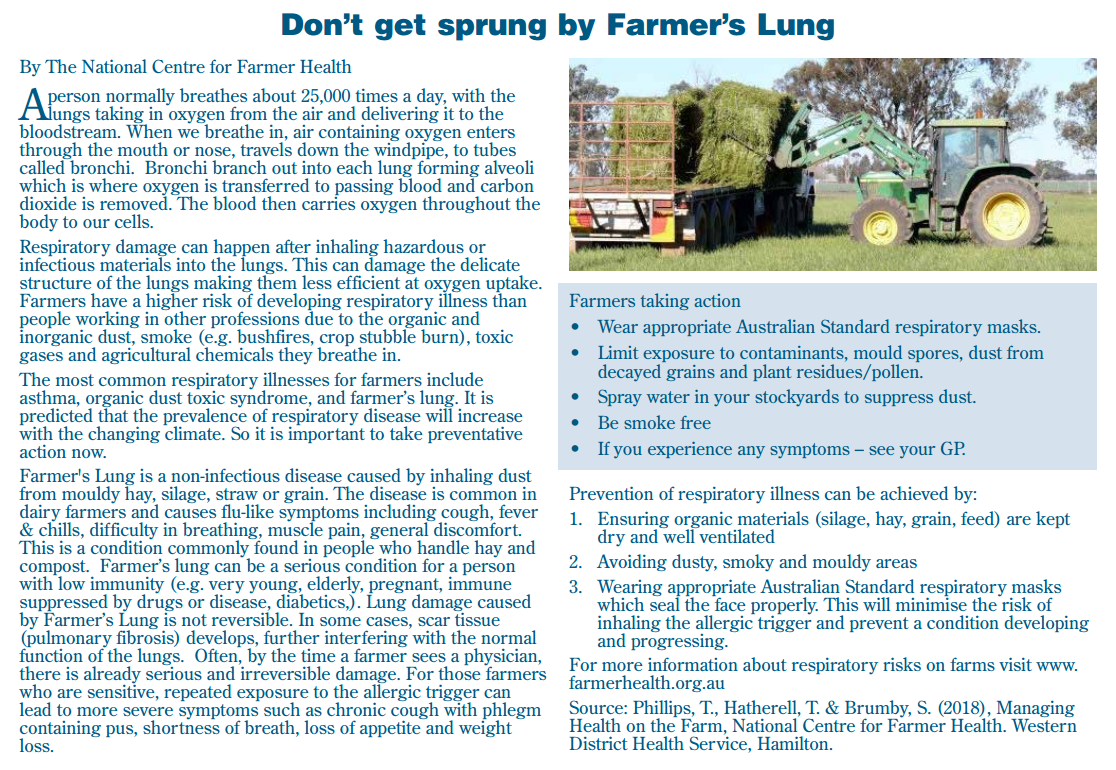
Source: Phillips, T., Hatherell, T. & Brumby, S. (2018), Managing
Health on the Farm, National Centre for Farmer Health. Western
District Health Service, Hamilton.
2018-03-16: Surviving and thriving: Storytelling initiative gives new platform to women in the bush – ABC News Rural
By Jess Davis
When Lyn Kelson was 26, her husband Phil died by suicide — and she still had two small kids and a farm to look after.
“You didn’t come home so I went to find you, and find you I did, hanging so high,” Ms Kelson said, in a quote from her online short film.
Lyn made the short digital film to tell her story as part of a project led by the National Centre for Farmer Health.
They invited 24 rural women to take part in a digital story telling workshop, to share their stories of survival through times of hardship.
Ms Kelson said she made the film to show others that may be experiencing hardship, that things do get better.
“I think showing people that resilience comes over time, there is no silver bullet, you just have to keep going and life improves,” she said.
Her story has moved many of its viewers to tears, a reaction that surprised Ms Kelson.
“I guess because it’s my story, I’ve lived it,” she said.
“But for people who see it for the first time, they actually get very emotional about it.
“I’m always quite surprised that that’s the reaction, because I hoped it would be a story of not quite triumph, but I guess success.”
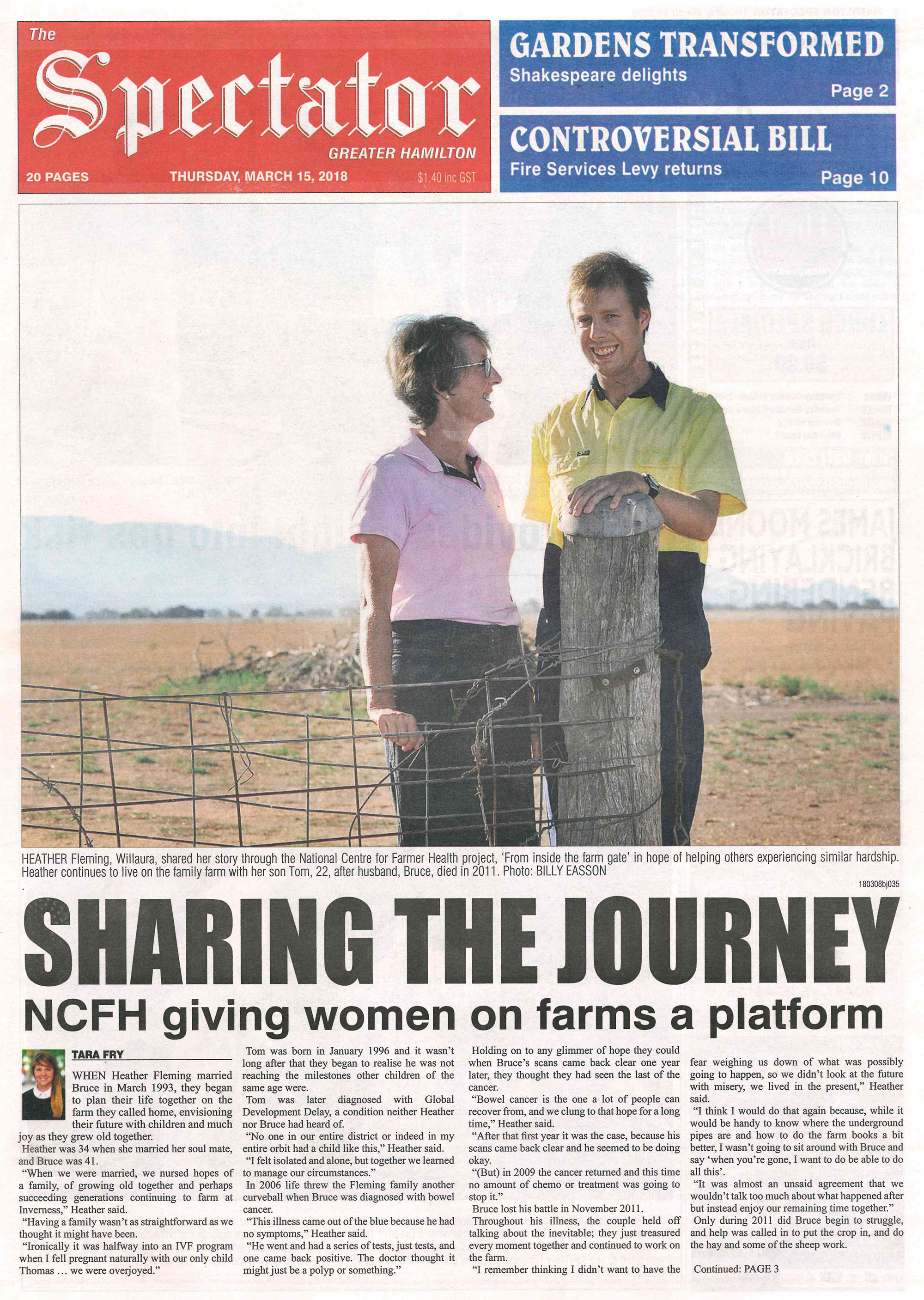
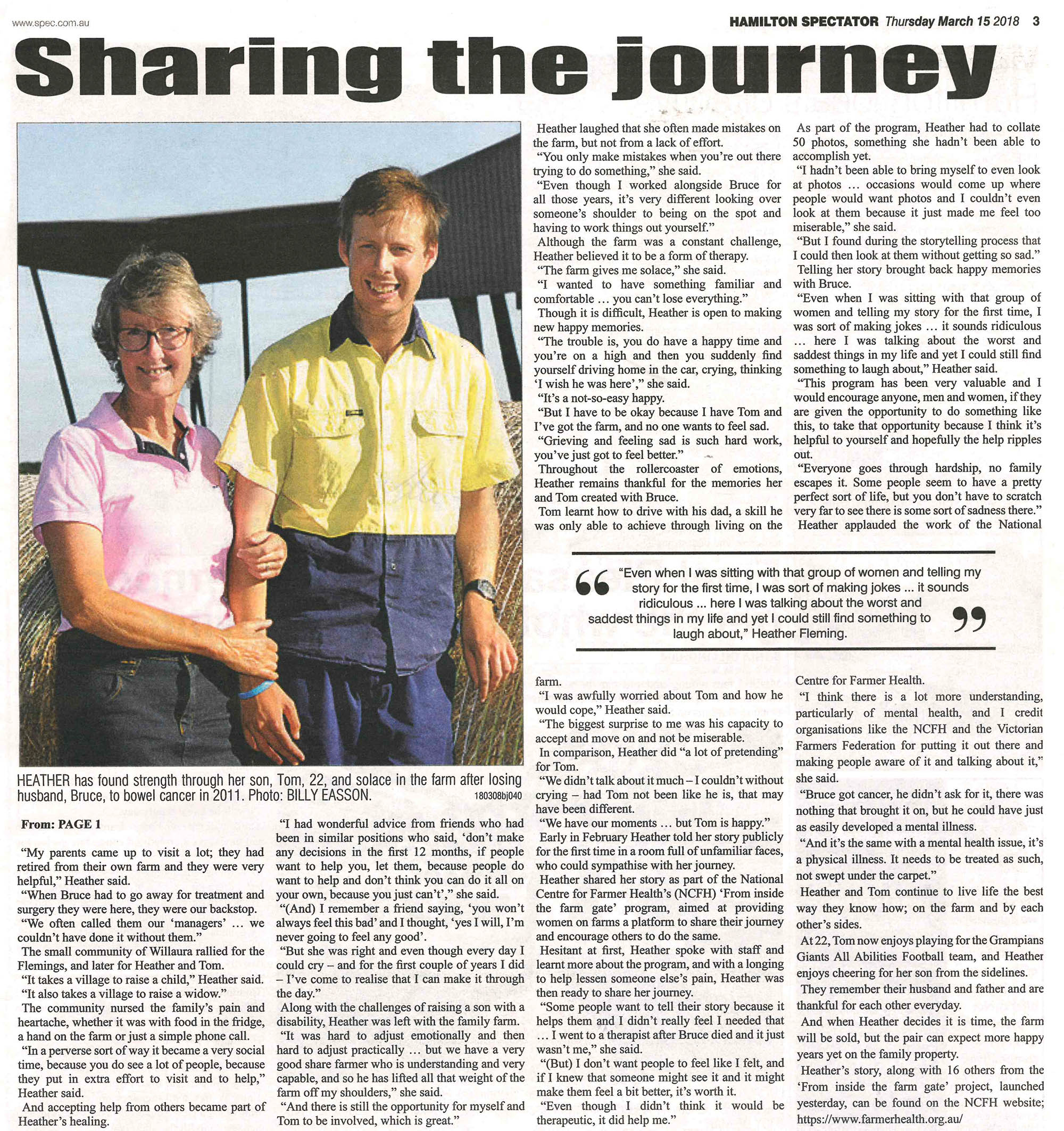
2018-03-15: Sharing the Journey – The Hamilton Spectator
by Tara Fry
To view the ‘From Inside the Farm Gate’ Digital Stories Online CLICK HERE
2018-03-18: PRESS RELEASE: National Centre for Farmer Health to partner with Metalcorp
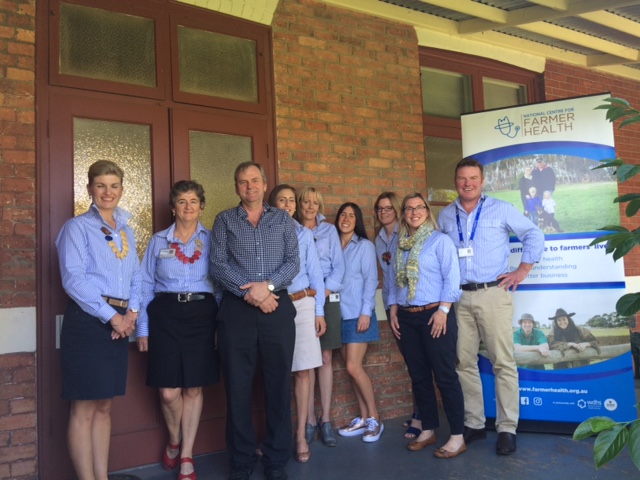
The National Centre for Farmer Health (NCFH) is pleased to announce a new sponsorship agreement with Metalcorp, supporting our mission to “make a difference to farmers’ lives” by striving to improve the health, wellbeing and safety of farmers, farm workers and their families.
Dr Susan Brumby, Director of the National Centre for Farmer Health said, “As the rural brand for the land, Metalcorp’s corporate support of the NCFH makes sense and provides vital funding to aid our research and support our ongoing activities to improve farmer health.”
In a recent report by Grains Research Development Corporation (GRDC) it was revealed that, “farmers were half as likely to visit a general practitioner (GP) or a mental health professional as non-farm workers.”
The NCFH has been operating since November 2008, as a partnership between Western District Health Service and Deakin University’s School of Medicine. It is unique in Australia in its capacity to undertake clinical activities, academic research and education and training within the specialist field of agricultural health and medicine.

“Our new association with Metalcorp, will enable us to extend the reach of our service delivery across rural Australia as well as enhance our research capabilities. Better positioning the NCFH to close the existing gap between the health, wellbeing and safety status of Australian farmers and agricultural workers and their urban cousins.” Dr Brumby said.
Dr Brumby explained, “The NCFH researches ways to reduce illness and injury among agricultural workers and corporate support, that does not compromise the integrity of our research, is greatly appreciated,” she said.
“One of the important research projects we have recently undertaken is the Ripple Effect, which is an online intervention program, designed to reduce the stigma around the experience of suicide among males from the farming community aged 30-64 years. Developing an association with corporate partners such as Metalcorp will enable us to expand the reach of established programs such as these,” Dr Brumby said.
National Sales and Marketing Manager for Metalcorp Lester Kirkwood said, “Metalcorp will help raise awareness of programs such as these by providing space at our Field Day sites to enable customers access to free presentations by agrihealth professionals from the NCFH.”
“As many of the Metalcorp customers are active on the land this partnership makes good sense. With a safety focus in the design and manufacturing of all Metalcorp’s products, we will take a further step to have our livestock handling equipment reviewed by NCFH to enable a tick of approval indicating it can be operated effectively and safely by both women and men, that work in the rural sector,” Mr Kirkwood said.

To identify that this safety review has been completed, look for the NCFH “tick of approval” sticker located on the Metalcorp livestock handling equipment.
This is a first for the rural sector and lifts the bar on safe use of equipment for handling rural livestock.
Metalcorp provides a percentage of every sale to help fund the NCFH’s research programs and field work, which is designed to deliver better health, wellbeing and safety outcomes for farmers.
For further information please contact: Prof Susan Brumby susan.brumby@wdhs.net
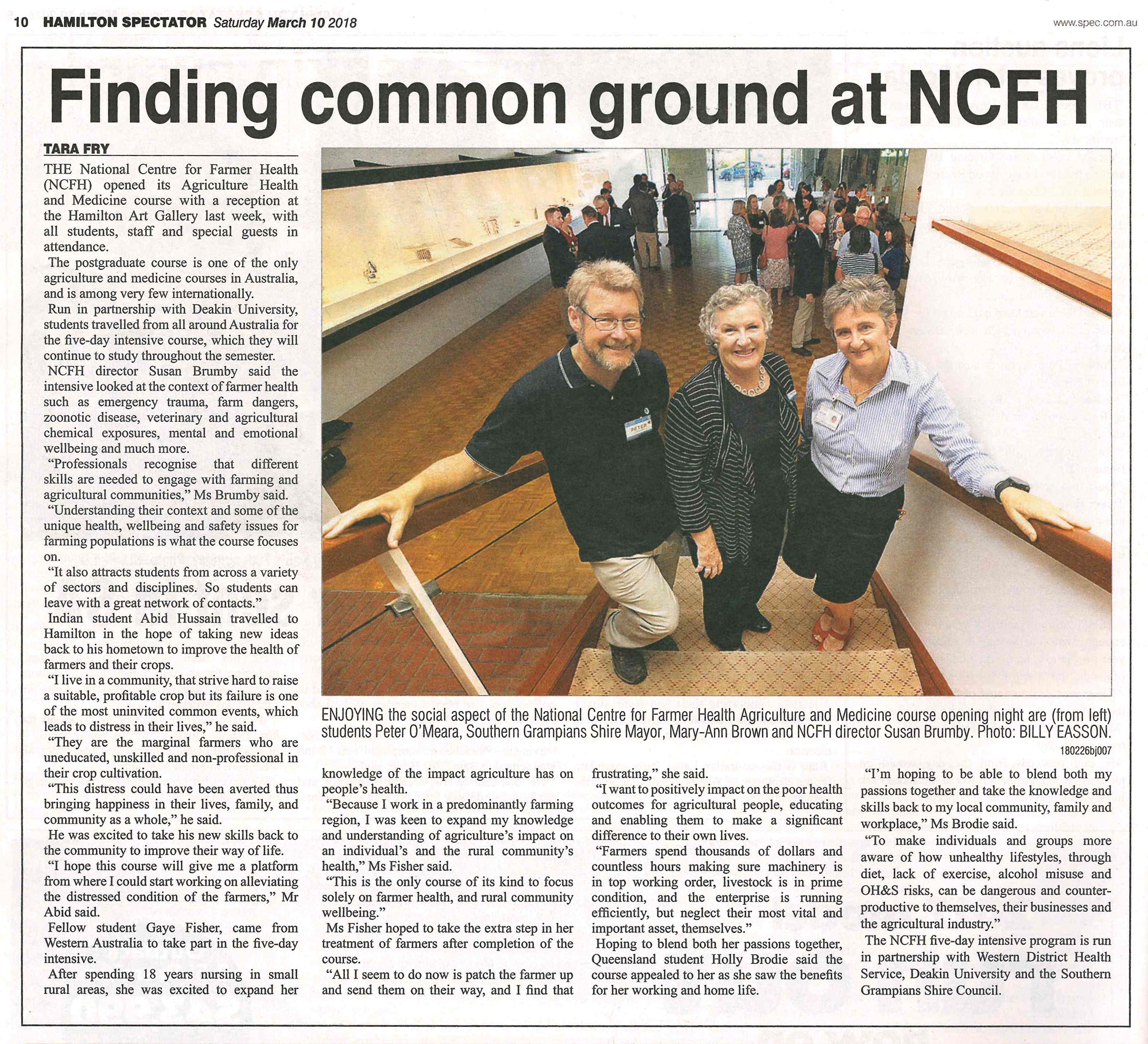
2018-3-10 – Finding common ground at NCFH – Hamilton Spectator
Farmer Health eNews March 2018
Find out all the latest from the National Centre for Farmer Health
- NCFH Health & Lifestyle Assessments hit your Community Bank Branch
- Visit us at 2018 Wimmera field days for your free Health & Lifestyle Assessment
- ifarmwell.com.au is a new online tool kit to help Australian farmers cope effectively with life’s challenges and get the most out of every day
- Wellness Wednesday Topics
Do you want to receive our eNews?
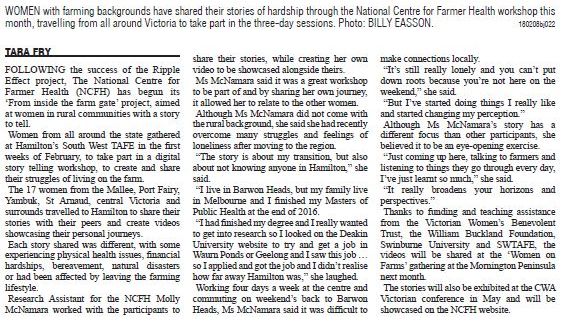
2018-02-27: Women’s Stories From Inside the Farm Gate – The Hamilton Spectator
2018.02.05: Blood test for farmers using pesticides, chemical the key to preventing long-term health problems – ABC News
By Jess Davis
It was only 10 years ago that Russell Mitchell, a sheep farmer from Glenthompson in western Victoria, started wearing gloves when dealing with farm chemicals.
But as a growing body of evidence points towards detrimental health impacts, more farmers like Mr Mitchell are taking safety precautions.
“I realised, ‘Gee, if we don’t use best practice for handling our chemicals, we can really develop some long-term health problems’,” he said.
Mr Mitchell was part of a study by the National Centre for Farmer Health (NCFH) tracking pesticide exposure in farmers.
Every month for a year he underwent a finger-prick blood test that detected exposure to a common group of insecticides called organophosphates.
“Every time I used a chemical, my levels would go up — especially with an insecticide,” he said.
“From that, when I spray I actually wear a mask in the tractor too.”
The NCFH showed that making this test part of a regular health check-up could prevent future exposure to pesticides, simply by raising farmer’s awareness.
Organophosphates work by attacking an insect’s nervous system — the chemicals attack humans in the same way but on a lesser scale.
Lead researcher Dr Jacquie Cotton said while humans may not display any symptoms, they could still be experiencing low-level exposure.
“That’s where monitoring exposure is really important, and that’s where the research we’re doing here at the centre comes in,” she said.
There has long been speculation that exposure to organophosphate pesticides could lead to Parkinson’s disease.
In 2016, researchers found a cluster of Parkinson’s disease cases in cropping regions of western Victoria, where pesticides were commonly used.
But Dr Cotton said there was a lack of data to prove the two were linked.
“What we don’t have a lot of is longitudinal studies to really get an indication of whether neuro-degenerative disease is a result of chemicals they’ve been using,” she said.
“That sort of data just doesn’t exist, because these types of tests weren’t conducted 20 or 30 years ago.”
The NCFH is hoping to change that by making the pesticide exposure test available in regular health check-ups for farmers.
Making tests available to all farmers
Dr Cotton’s team has started training nurses and clinicians across Victoria to conduct the tests.
“It’s really important that farmers across Australia have access to this type of testing,” she said.
“And from a research perspective we’re able to gain a better picture of what’s going on.”
Tam Phillips, a registered nurse at the NCFH, said farmers responded well to the test, and wanted to know what was going on in their bodies.
“To be able to present them with a number in a place it shouldn’t be sitting, that identifies there may be a low-level exposure, helps us with educating them with wearing personal protective equipment,” she said.
The NCFH wants more farmers like Russell Mitchell to get involved, but Mr Mitchell said some farmers did not understand why he wears gloves and a mask.
“But hopefully long-term it might just help,” he said.
View full article: 2018.02.05: Blood test for farmers using pesticides, chemical the key to preventing long-term health problems – ABC News
2018-02-15: CWA celebrates past year, looks to future – Shepparton News
by MADELEINE CACCIANIGA
The Eastern Goulburn Valley Country Women’s Association gathered yesterday along with their state president to discuss their achievements during the past year and plans for the new year.
CWA group president Gwenda Metzke, although stepping down this year, said she would remain a member for years to come.
‘‘It’s in my blood, my grandmother was a member, my mother was a member and my granddaughter has just joined up also,’’ Mrs Metzke said.
Mrs Metzke led the group for the past two years and has seen an increase in membership of the younger generation.
‘‘We’ve had an increase in membership, but we’ve also lost some near and dear ladies that have guided us up to this point,’’ Mrs Metzke said.
CWA state president Lynette Harris always enjoys coming to Shepparton to catch up with the Goulburn Valley.
‘‘This group is a really lovely and welcoming group, which makes my job easier,’’ Mrs Harris said.
This year the CWA is focused on studying or supporting the lamb and wool industries, elder abuse prevention, the country Peru, partnering with the National Centre for Farmer Health and raising funds for and continuing upgrades at Umina Bed and Breakfast.
‘‘The big thing for this year is the theme for 2018, celebrating 90 years of diversity,’’ Mrs Harris said.
Mrs Metzke hoped the Eastern Goulburn Valley CWA would continue to increase member numbers and have success in donating to various charities and schools in the area for another 90 years.
‘‘It’s all about friendship and helping the community,’’ Mrs Metzke said.
View article: 2018-02-15: CWA celebrates past year, looks to future – Shepparton News