2018-8-1: Press Release – 2018 Conference Keynote Speaker Announced

International expert to build local knowledge about agrichemical exposure on our farming families

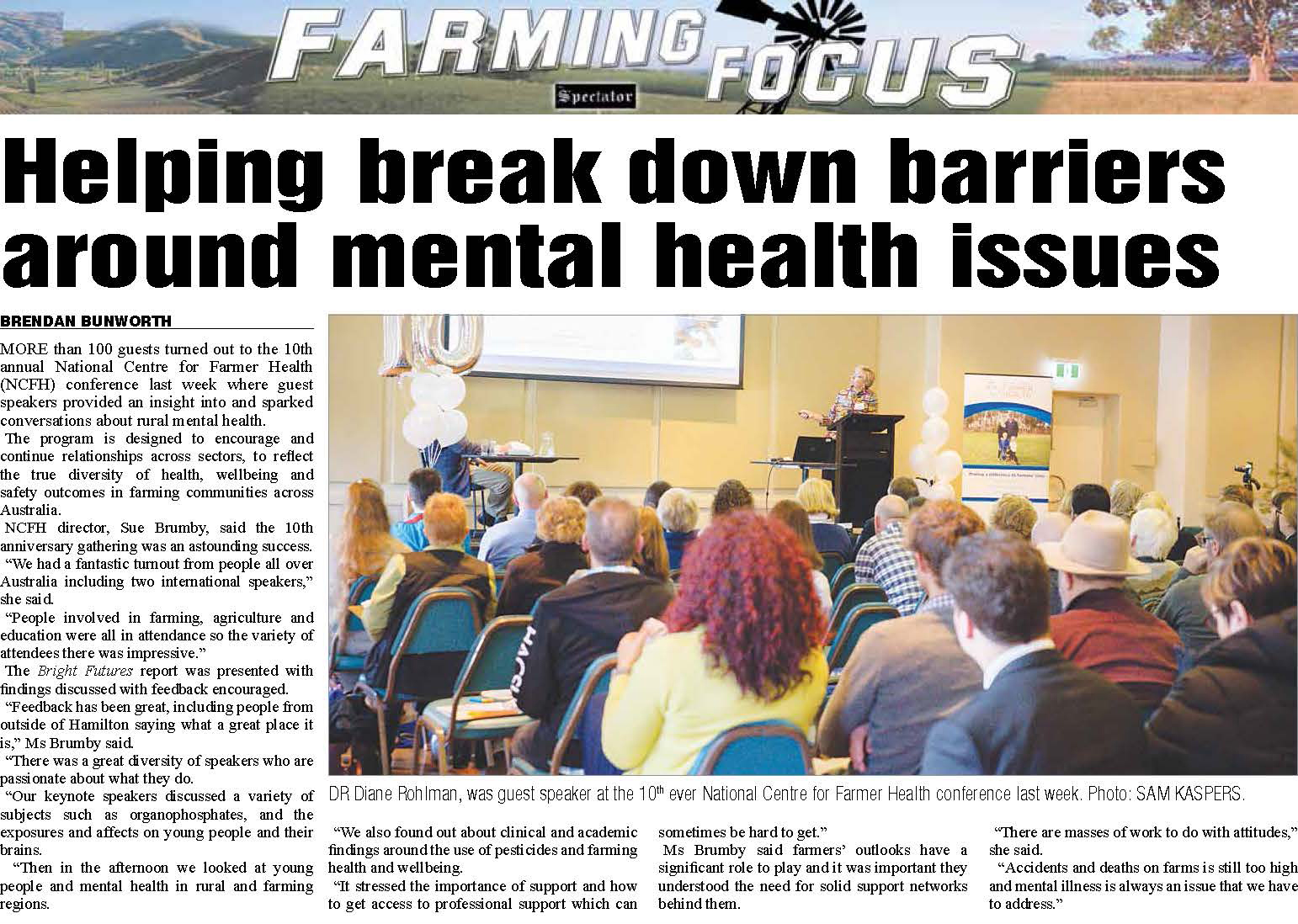
The National Centre for Farmer Health is excited to announce internationally renowned Occupational and Environmental Health specialist Associate Professor Diane Rohlman as a keynote speaker at their Conference in September.

As one of the world’s most hazardous industries, there are many risks associated with working in agriculture, including the risk of injury and exposure to agrichemicals. Pesticides, particularly organophosphorus pesticides (OPs), are widely used throughout the world. However, research examining the effects of exposure to these agrichemicals has tended to focus on acute effects in adults. There has been limited research looking at the impact of repeated, low-level exposure to agrichemicals, particularly in children and adolescents. Dr Rohlman describes her research as “examining the impact of low-level occupational exposure to organophosphorus pesticides in adult and adolescent farmworkers”.

Associate Prof. Rohlman’s research has also extended to examine environmental pesticide exposure among children living in agricultural communities. Since many chemicals, particularly OPs, can attack the brain and nervous system, her research has focused on early detection of changes in memory, attention and learning.

Dr Susan Brumby—Director of the National Centre for Farmer Health—is excited by the prospect of Dr Rohlman’s involvement in the NCFH Conference, with the theme ‘Good health, wellbeing and safety: Making a difference to farmers’ lives’: “Dr Rohlman has been conducting very topical research that will be of significant interest to both health professionals and farmers across Australia. We’re thrilled to host this expert from The University of Iowa, where they have the only Agricultural Safety and Health program in the United States. It was this cutting-edge training program that inspired the development of our own Graduate Certificate in Agricultural Health and Medicine.”

Dr Rohlman will be presenting at the National Centre for Farmer Health Conference on Wednesday 12 September in Hamilton, Victoria. Farmers, health professionals, researchers and others working in areas with links to agriculture and health are encouraged to attend the Conference. Registration to attend the conference is free and can be made online via the Farmer Health website: https://farmerhealth.org.au/conferences/conference-2018. Registrations close on Friday 17 August.

Media contact: Images relevant to this article are available on request from the National Centre for Farmer Health via Cecilia Fitzgerald (03) 5551 8533 or cecilia.fitzgerald@wdhs.net

KEYNOTE SPEAKERS ANNOUNCED – READ MORE
VIEW CONFERENCE PAGE
REGISTER FOR CONFERENCE NOW – Registrations close 17|8|18

Farmer Health eNews August 2018

Find out all the latest from the National Centre for Farmer Health

View the August 2018 eNews

Read past issues of eNews

Do you want to receive our eNews?

2018-7-28: Mental Health Crusader – The Hamilton Spectator

2018-07-24: NCFH $4M Promise – The Hamilton Spectator

2018-07-19: Farmer health is about growing awareness – Health Direct

If you are one of the 300,000 Australians who earn their living from the land, you’ll know how difficult and uncertain farming can be.

There are health and safety issues, such as working long hours in the sun, or with animals, chemicals and farm machinery. And a drought or severe flooding can affect a farming community for years, including the mental health of its families.

This year’s National farm Safety Week (16 – 22 July) aims to raise awareness of the health issues that face the farmers who put food on Australian tables.

Mental health and stress

A tough, sometimes isolated life — and often financial insecurity — can challenge the mental health of farmers. And as well as the stress and uncertainty of farming, it can be difficult to find the same mental health resources in rural and remote areas that you would expect to find in towns and cities. Recognising when help and support are needed, either for yourself or for someone else, is very important.

Kids’ safety on farms

Growing up on a farm can be a great start to a child’s life, but it also has its hazards. Each year in Australia, around 5 or 6 children drown in farm dams and water bodies, including creeks, troughs and irrigation channels. Frequently this occurs when a toddler wanders away from supervision without being noticed. Kids in farming communities — and their visitors — often play where farmers work and without a safe play area, they risk dangers from farm machinery, motorcycles, horses and other farm animals.

Injuries and accidents

Almost 22,000 people were hospitalised after being injured on farms between 2010 and 2015. Just getting around the farm can be dangerous, and riding motorcycles and quad bikes is a particularly risky part of farm life. Injuries involving motorcycles and quad bikes accounted for 42% of hospitalisations in children up to 14 years old. Quad bikes are not stable vehicles and are not safe for use in all terrains, says the National Centre for Farmer Health. Users should always wear a helmet and protective clothing, and children should never be allowed near quad bikes.

Lung conditions and respiratory diseases

Farmers and farm families are more likely to be exposed to dusts from pollens, animal dander, grain and hay, which can irritate airways and trigger asthma in susceptible people. Organic dust toxic syndrome (‘farmer’s fever’) is common and is caused by inhaling mouldy dust. ‘Farmer’s lung’ affects people whose immune system is sensitive to fungal spores inhaled from mouldy hay, straw, grain or compost. Farmers who experience flu-like symptoms should always tell their doctor if they have been exposed to dust.

Getting medical help in a rural environment

Farming communities often find that living in a remote location means accessing health services is challenging. Having a contact list of health and emergency services is important. Phone and online support can also be helpful. When searching on the internet for health services, it is important to use reputable sources, such as healthdirect’s service finder. You can also call healthdirect’s free 24-hour helpline on 1800 022 222 for health advice and non-urgent assistance.

Read more: Visit the Healthdirect website

2018-07-01: Beyond the farm gate – Quest Magazine | Adult Learning Australia


In May 2016 Victorian farmer Karrinjeet Singh-Mahil sat fascinated during a vet’s presentation on calf rearing at a dairy women’s conference in New Zealand when her phone pinged. It was a text message that would change her life. Around the room other women’s phones started going off.

The message was from Fonterra dairy co-operative informing its suppliers it had dropped the price of milk from $5.60 to $1.91 wiping out 70% of Karrinjeet’s family income.

‘With one text message and no warning they grabbed over $100,000 from our budget,’ Karrinjeet says in the short film she has made about the event.

Karrinjeet’s story is one of 24 put together by women farmers as part of a National Centre for Farmer Health (NCFH) project to teach rural women in Victoria how to tell their stories in digital form. The result is ‘From Inside the Farm Gate’ a collection of stories that explore the struggles of life on the farm – from dealing with financial hardship, natural disasters, bereavement and the grief of leaving the farm altogether – and aim to educate, inspire and benefit others living in rural communities.

For Karrinjeet, the aftermath of the Fonterra decision was devastating. ‘When I look back I can’t remember what we did in those days I was so consumed by anger and shock. I was staying at my Mum’s place in New Zealand during the conference and  that night she had a whole bunch of people round to see me before I left but I can’t remember who came to see me off that night, it was all a blur.

‘It took our feet out from under us and we were scrambling to cope. Things were super tight, and for a while we didn’t have a brass razoo. One day at the greengrocer’s my debit card was declined and I had to race round to the Rural Financial Counsellor to get some IGA vouchers. But we sold lots of cows and that kept us going.

‘While my husband Brian’s reaction was to doubt himself, mine was to get really, really angry. I’ve never had issues with my blood pressure before but it shot up and I had to go on medication to keep it under control. Brian lost his voice, he says it’s not related to stress but I think it is.’

Karrinjeet’s digital story turns on the moment she realised something had to change. ‘One day Brian and I were in the dairy and he asked me a question and I just barked an answer back at him. He said, “Did you hear the way you just spoke to me? I’m not the one you should be angry with.” And I was about to snap back but I stopped myself and I thought, “Yes, he’s right”.

‘That was when I thought I need to come up with some strategies for handling this. And we began to fight back.’

Taking charge

Karrinjeet has learned ways of finding joy in the everyday to counter the stress of hard times. She’s taken to hugging loved ones and wearing her headphones and singing along to music that lifts her spirits as she goes about her daily chores, milking cows and tending to the garden.

But the joy of giving has been a revelation. She gathers excess vegetables from her own and others’ gardens and donates them along with her fresh eggs to other farmers doing it hard.

‘It doesn’t matter if you’ve got nothing yourself it feels so wonderful to give. People have said to me, “You could sell those eggs” and I could but I just find I get more out of it by giving them away. Giving to others has been enormously healing for me. It’s hard to put into words but it gives me energy to do more. Focussing on what you’ve lost saps the life out of you. Turning it around and helping other people is extraordinarily powerful.

‘The thing I’d like people to take away from my digital story is that there are ways to cope and the ways we cope are different for each of us.’

Karrinjeet along with 12 other women created and crafted their digital stories in a three day workshop facilitated by Swinburne University and NCFH. Participants learned how to develop and put together a short film using photos, audio recordings, and video footage.

‘The voices of rural women are missing from past and recent history and this was an opportunity for us to hear those voices and to educate and inspire others by sharing their stories.’ Dr Alison Kennedy, National Centre for Farmer Health.

Research shows benefits of digital storytelling

Dr Alison Kennedy, Research Fellow at Deakin University’s National Centre for Farmer Health says ‘People generally come along to workshops with a desire to use their story to help others, but many don’t realise that it will have benefits for them too. Research shows that enabling people to tell these very personal stories in a supportive environment can have powerful mental health benefits. One woman told me that when she finished her digital story it was like a huge weight had been lifted off her shoulders. So it can have a huge cathartic effect for people who come along. People are quite amazed at the impact of expressing feelings that they’ve carried around and kept to themselves for so long.’

Karrinjeet agrees. ‘After you’ve faced a problem and talked about the worst that could happen it doesn’t hold the same power over you.’

With the first stage of producing the stories complete, the next phase is sharing them with as many rural women as possible both on the web and at meetings and conferences.

‘Shaping that story in the workshop and paring it down to its essence helped me understand
more about myself than I had before.’ Karrinjeet Singh-Mahil

Photo: Samantha Kaspers

Personal stories offer lessons

People are often moved to tears when they watch Lyn Kelson’s story of being just 26 with two small children when her husband died by suicide.

‘You didn’t come home so I went to find you. And find you I did, hanging so high,’ she says in her digital story. Lyn says she wanted to tell this story to give hope to others.

‘I think there’s an altruistic element in our telling our stories. When new audiences see them for the first time I think they recognise an element of their own lives and see that they have that same strength in them as the woman whose film they’re watching.

‘My digital story really hit the mark because it shows how we have an inbuilt ability to overcome rather than be engulfed. Life is full of peaks and troughs but the stories show that we have true grit.

‘At my husband’s funeral I recognised then that a number of people were looking at me thinking “Thank God it’s not me”. But I remember thinking even then that others have done this before me and survived and I can do the same. When things were hard I saw opportunity through that loss that there could be some good to come out of it.

‘I wanted to do the course because I had lived through a tough time, and I thought in telling the story I could give hope to others through my own lived experience.’ Lyn Kelson

‘After my husband died, the community rallied around me. That’s a strong thread in all the stories, how vital a cohesive community is in times of hardship, how it forms a backbone when you need it, whether it’s financial or emotional.

‘People cared for me, for us. It was like a lobster when it’s injured has to grow a new shell and until it does it’s vulnerable. In my case the community protected me until I’d grown a new shell.

‘I think it is so important for us to share these lived experiences and to show that we can grow through hardship. Resilience is a skill that is so vital for today.

Learning technology together

Photo: Samantha Kaspers

‘I am so proud to be involved in this NCFH project. It was a huge learning curve. Meeting that wonderful group of women where we created a family of people through shared experiences and then filtering our stories out to the wider community has been fabulous.

‘The course was so well thought through, so well coordinated and delivered, and the care afterwards has been great. The facilitators were really great at establishing a transparent and trusting environment so there was this openness and honesty and acceptance that really helped that process along.

‘There were tears for a lot of us in revisiting those events, as we remembered the loss of a loved one or the loss of financial capacity, but it was worth it.’

‘The technology of using the computer and video programs was a bit daunting but the facilitators offered great support. And even when I had to wait for someone to come and help me that time was never wasted because at the same time I was learning the techniques of video production and having these wonderful conversations with other women.

‘At the end of the three days we sat and watched each others’ stories. There were 8 or 9 finished videos and you could see the pride in the women’s faces and we all recognised that we are all quite remarkable women, even though when we all arrived we felt we were just ordinary. But watching those videos we could see that “Hey, we are really something quite special.”’

From Inside the Farm Gate is funded by the Victorian Women’s Trust and the William Buckland Foundation and project support was provided by Swinburne University, Southwest TAFE and the Western District Health Service. You can view and comment on the stories online.
farmerhealth.org.au/inside-farm-gate

View Quest Magazine Online: CLICK HERE

Farmer Health eNews July 2018

Find out all the latest from the National Centre for Farmer Health

View the July 2018 eNews

Read past issues of eNews

Do you want to receive our eNews?

2018-6-30: Katrina Myers is on a mission to change the story of rural suicide – ABC News

Fourth-generation avocado farmer Katrina Myers was pulled from her boarding school classroom at 15 and told her father had died by suicide on the family property. Now, she’s helping boost mental health in rural communities, where male suicide is twice as common. She told her story to ABC’s Sian Gard.

Dad was very much a community man, he had heaps of friends, very charismatic. He was warm and so much fun to hang out with. Every year we used to have this pony club camp and Dad would take us on a massive ride.

He didn’t have a history of mental health issues, long-term.

I had no idea he was sick at all; I didn’t even know he was depressed.

In one morning, everything changed. Then, it was like living a double life. I’d had this awesome, perfect, normal childhood and then suddenly everything was different.

I went back to boarding school within a week. I carried on as if nothing had happened. But I could feel this stigma.

I didn’t want to tell people it was suicide because I knew they would feel uncomfortable or really sorry for me.

It wasn’t until I got older and had my own children that a lot of stuff started to come up as I got closer to the age that Dad died.

I now have a good understanding of why Dad got to the point where he felt like he needed to take his own life, so I’ve never had any resentment — just sadness and wishing he was still here for my kids. Wishing it could have been different for him.

My mental health went downhill

After my third child Poppy was born I realised my mental health wasn’t too good.

I was feeling very negative about things, worrying too much about small things and feeling down a lot of the time.

I thought, what’s going on here?

I decided to do something about it. I saw a therapist then started investigating what else I could do myself. It took me about 12 months.

There is so much we can do for our own mental health, it’s incredible really.

Looking after our minds is just like looking after our bodies.

I meditate every day and practise gratitude, I have my own blog, keep a journal and exercise as part of my daily routine.

That’s what I advocate for: work out what works for you to make your mind stronger.

Bringing help into the home

I got involved with The Ripple Effect projectthrough the National Centre for Farmer Health.

It’s an interactive approach to engage people who might be feeling isolated using an online platform, that could reduce stigma around suicide in rural areas.

Often, people don’t realise they’ve got a mental health problem and then they don’t know where to start.

I realised that just by sharing my story and what worked for me, I was helping others. People were approaching me and messaging me to say thank you so much for talking about this.

Markets a meeting of minds

We’ve also developed ways to connect our community offline with local farmers’ markets.

As well as promoting this wonderful agricultural area, they’re a really nice way for people and producers to get together to share their ideas and what their struggles might be.

The recognition makes you feel good about your produce.

Read more & view video interview: 2018-6-30: Katrina Myers is on a mission to change the story of rural suicide – ABC News

2018-06-14: NCFH Press Release – 2018 Photo Competition

FARMER HEALTH IN A CHANGING WORLD – CALLING ALL BUDDING AND KEEN PHOTOGRAPHERS

The National Centre for Farmer Health is providing an opportunity for every Australian to celebrate, educate and inspire the nation about life in a rural farming community.

To commemorate their 10 year anniversary, the National Centre for Farmer Health is running their 4th national photography competition. The competition, titled ‘Farmer Health in a Changing World’, aims to engage farming and non-farming communities in raising awareness and positively promoting the benefits that farming provides to individuals, families and society.

Judging the competition are renowned photographers Ewen Bell, Jill Frawley, and Robert Drummond.

Entry categories include images representative of farming families, safe farming practices, wild weather, mental wellbeing and young farming innovators. A unique element of this year’s competition calls for photographs highlighting fresh food alongside an original recipe showcasing the produce. A People’s Choice Instagram category gives members of the public a chance to cast their own vote.

Generous cash prizes will be awarded across open, secondary student and primary student entry levels along with participation awards to the primary and secondary schools with the highest proportion of participating enrolled students.

The competition closes on Sunday 22 July 2018. Winners will be announced on Wednesday 12 September at the Hamilton Art Gallery, as part of a networking event for the National Centre for Farmer Health Conference, ‘Good health, wellbeing and safety; Making a difference to farmers’ lives’.

A public exhibition of selected photos will take place during the conference, to be followed by a travelling exhibition at a range of venues across Victoria (locations to be announced). Entries will also be available for viewing on the National Centre for Farmer Health website (www.farmerhealth.org.au).

Submit your entry at www.farmerhealth.org.au/farmer-health-changing-world-2018-photo-competition).

Quote from Director, National Centre for Farmer Health, Dr. Susan Brumby

“The ‘Farmer Health in a Changing World’ photography competition offers a fantastic opportunity to showcase diversity in Australian agriculture”

 “By acknowledging and engaging with our farming community, we can better understand and promote how we, as a society, benefit from their hard work”

Media contact: Samantha Kaspers (03) 5551 8533  samantha.kaspers@wdhs.net

2018-06-12: GEAR UP Teaching Students Ag Safety™ – Flow FM Radio Interview

A new agriculture safety program supported by the National Centre for Farmer Health (NCFH) is empowering the next generation of workers by travelling to schools and educating students first-hand.

Called ‘Gear Up for Ag Health & Safety™‘, the program recognises that agriculture is one of the most hazardous industries in the nation, while aiming to encourage safer workplace practices into the future.

Gear Up is being rolled out across Australia at a secondary and tertiary student level. For more information and to get your school involved, visit farmerhealth.org.au/gear-up-for-ag-health-safety.

To discuss collaboration opportunities or obtain a sponsorship package, you can contact Elizabeth Barrett at NCFH on (03) 5551 8533.

Hear more about it on Flow FM – Radio Interview

Farmer Health eNews June 2018

Find out all the latest from the National Centre for Farmer Health

View the June 2018 eNews

Read past issues of eNews

Do you want to receive our eNews?

2018-05-08: ATVs give farmers false confidence warns safety expert – Farming Independent Ireland