

2019-04-08: Gear Up for Ag Program at Billabong High School – School Newsletter
On Thursday, 4 April, the junior elective Agricultural class and the Year 11 Primary Industries class spent 3 hours learning all about health and safety issues and management of these issues facing people working (and sometimes living) in this industry. The National Centre for Farmers Health delivered the very informative, encouraging and interactive workshop. A big thank you to the Rural Bank and Henty Community Bank for sponsorship of the program. Each student went home with a full kit of PPE they can use when working in the agricultural industry now or in the future.
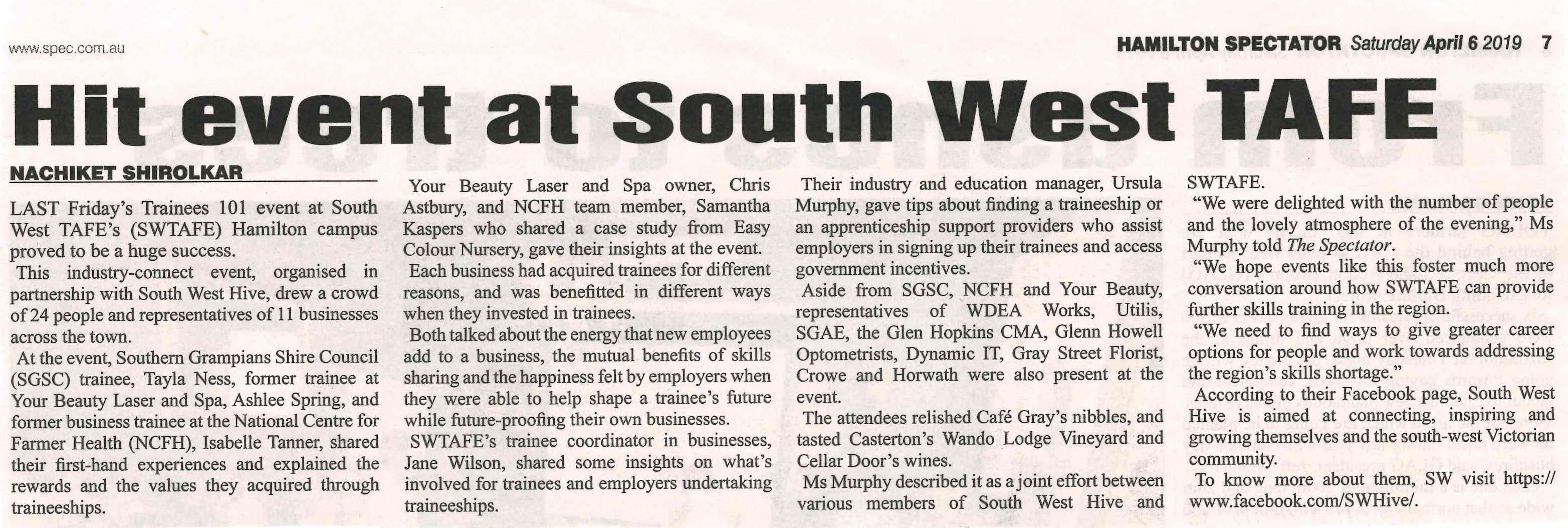
2019-04-06: Hit event at South West TAFE – Hamilton Spectator
Farmer Health eNews April 2019
Find out all the latest from the National Centre for Farmer Health
- 23rd IUHPE World Conference on Health Promotion
- We’re heading to Farm World for Health & Lifestyle Assessments – Agriculture Victoria Site
- Supporting farmers and rural communities – Drought support
- Wellness Wednesday
Do you want to receive our eNews?
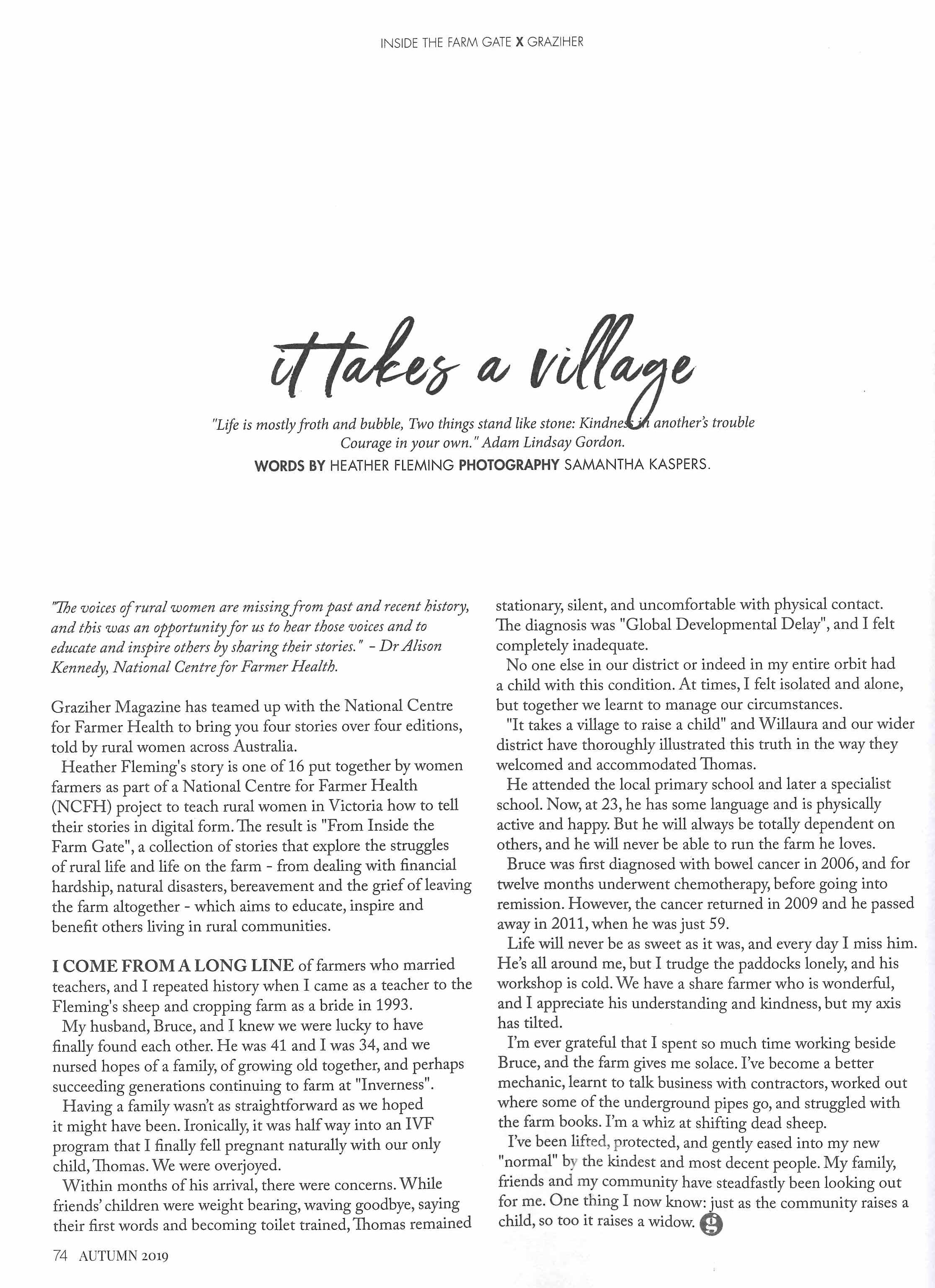
2019-03-01: It Takes a Village Heather Fleming Digital Story – Graziher Magazine Autumn Issue
2019-03-15: Dubbo farmers turn out for free health checks at Metalcorp – Dubbo Daily Liberal
PHOTO: TESTS: Tony Fenwick, Kylie Tolmie and Morna Semmens come together at Metalcorp Dubbo which partnered with the National Centre for Farmer Health to offer free health checks for farmers on Friday. Photo: BELINDA SOOLE
About 2pm Mrs Tolmie’s husband nudged her towards a back room of the business in Jannali Road where 22 farmers had gone before her.
Mrs Tolmie was met by National Centre for Farmer Health clinician Morna Semmens who had been expecting 16 farmers or agricultural workers to visit between noon and 4pm.
She welcomed the flood of drought-affected farmers for tests including blood pressure and cholesterol with “almost all of them” told to go and see their GP based on the results.
Metalcorp Steel’s NSW rural manager Tony Fenwick said farmers tended to “bottle up” their health concerns but they had been “opening up because these guys know what questions to ask”.
“This has been a good way to give back to the community that has helped us through tough times,” he said.
View article: 2019-03-15: Dubbo farmers turn out for free health checks at Metalcorp – Dubbo Daily Liberal
2019-03-10: Metalcorp Dubbo hosting free farmer health checks on March 15 – Dubbo Daily Liberal
CHECK-UP: Tony Fenwick (centre) and his staff (from left) Adam Morton, Justin Whitney, Jason Hill and Steve Tolmie are keen to see farmers take advantage of the free health checks. Photo: Contributed
Dubbo farmers are being encouraged to take a break from the demands of the drought and do something about their health.
They are being offered free health checks on Friday, March 15, that could prove “life-saving”.
The Metalcorp Dubbo branch is working with the National Centre for Farmer Health to offer the service.
The 20-minute health checks conducted by agrihealth professionals will be held in private rooms at the newly-relocated branch at 2 Jannali Road between 12pm and 4pm.
Rural landholders and workers are being offered vision, BMI, blood cholesterol and blood pressure tests along with diabetes-risk assessments.
Metalcorp Dubbo branch manager Tony Fenwick said its partnership with the National Centre for Farmer Health “closely aligns with our commitment to the safety, health and well-being of our staff and customers”.
“Your health is the greatest investment you can make in your farming business and we hope these free health checks encourage the Dubbo rural community to visit our branch, taking half an hour out of their day to have their health assessed – it might be life-saving action,” he said.
“Your health is the greatest investment you can make in your farming business and we hope these free health checks encourage the Dubbo rural community to visit our branch, taking half an hour out of their day to have their health assessed – it might be life-saving action.”
Tony Fenwick
A spokesman for the National Centre for Farmer Health agreed with Mr Fenwick.
“The health checks can identify serious health problems that, if left unidentified, could place farmers at significant risk,” he said.
“It also provides a risk assessment around farm safety and education on how to improve general health and well-being.
“Providing participants with a health passport containing the results of their health check provides farmers with information to take action of their own or pass on to a health professional for follow-up support.”
There are 16 appointments available. To make an appointment send an email to salesdubbo@metalcorp.com.au.
View full article: 2019-03-10: Metalcorp Dubbo hosting free farmer health checks on March 15 – Dubbo Daily Liberal
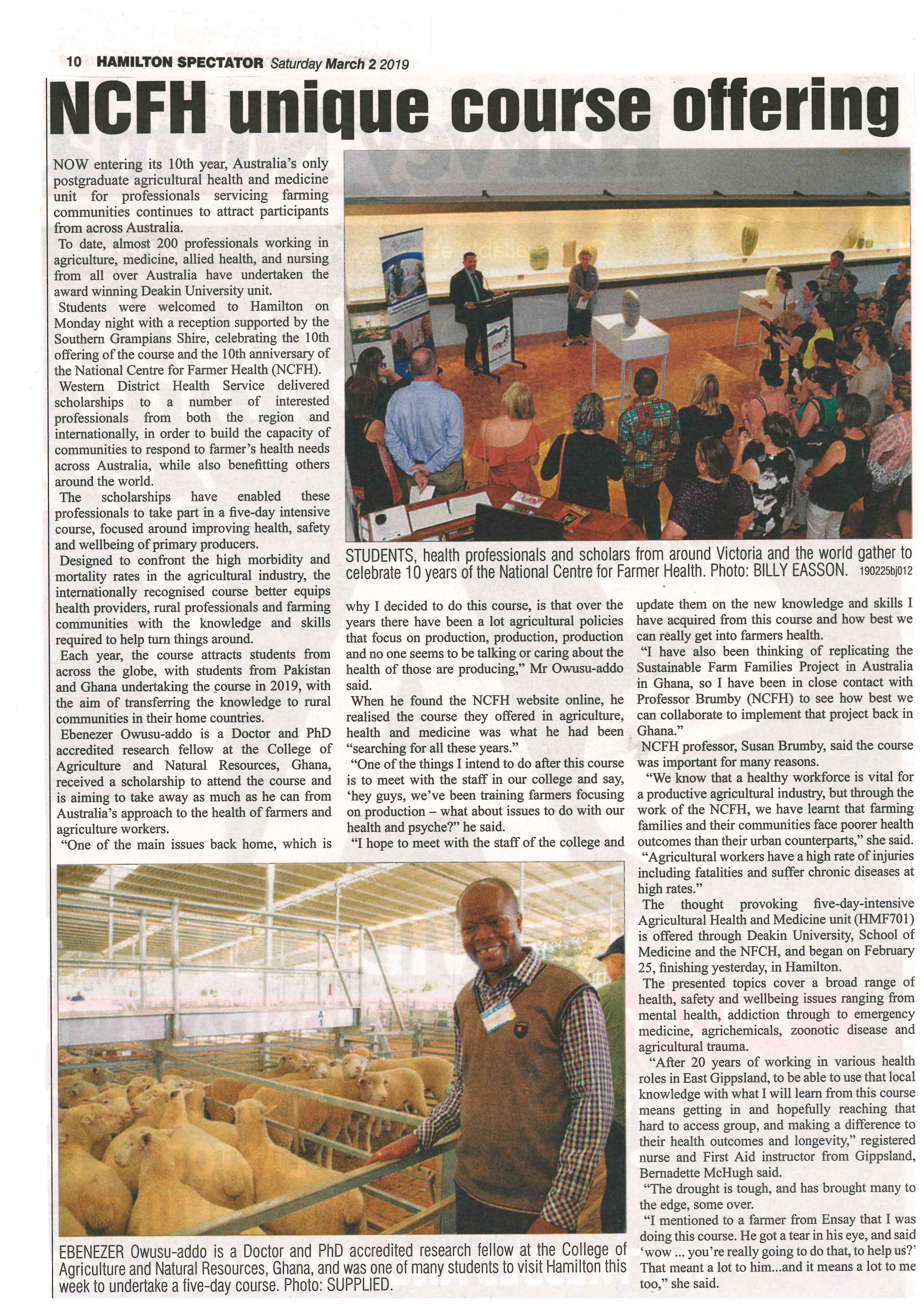
2019-03-02: NCFH unique course offering – Hamilton Spectator
Farmer Health eNews March 2019
Find out all the latest from the National Centre for Farmer Health
- Wimmera Field Days – Agriculture Victoria Site
- Gear Up for Ag Health & Medicine™
- Rural Bank Farmer Health Roadshow
- Wellness Wednesday
Do you want to receive our eNews?
2019-02-21: New look Ag Vic stand at Wimmera Machinery Field Days – Department of Ag
Horsham’s Agriculture Victoria team has a new home at this year’s Wimmera Machinery Field Days, joining other local agribusinesses and services in the Field Days Agri Marquee.
Situated just inside the door of the marquee, visitors can come and talk to staff about the latest grains research, plant diseases, animal health, managing dry conditions, the Australian Grains Genebank, how to apply for a Property Identification Code (PIC) and much more.
Grains Innovation Park Site Leader and Agriculture Victoria Research Director, Traci Griffin, said the Wimmera Machinery Field Days provide a great opportunity for Agriculture Victoria to showcase the latest research and new technologies that are relevant to the Wimmera.
“The field days also provide an important opportunity for farmers to talk directly to Agriculture Victoria staff to gain a better understanding of what is happening and how it could apply to this season.”
Agriculture Victoria’s Dry Seasonal Conditions Coordinator for the north west, Rob O’Shannessy, will be on hand with information about support and assistance for farmers navigating dry conditions.
Mr O’Shannessy will be joined by agrihealth professionals from the National Centre for Farmer Health who will conduct free farmer health checks.
Taking just 20 minutes, the farmer health assessments include a lifestyle survey covering health behaviours, farm practices and social and emotional wellbeing. Participants will also have their cholesterol, blood glucose, blood pressure, BMI and diabetes risk measured, and their eyesight tested. They can also discuss cholinesterase testing.
There will be information about workshops coming up in the region addressing stubble management, soils, weed control and other issues, and copies available of the ‘hot-off-the-press’ 2019 cereal and pulse disease guides.
Staff from the Australian Grains Genebank in Horsham will bring the Genebank to life, revealing what goes on inside and presenting some of the genetic material stored there – even some of the ‘wild relatives’ researchers are looking to in a bid to improve diversity in crop varieties.
Adding to the display will be some of the high-tech equipment, such as drones and infra-red sensors, that are being used by Agriculture Victoria researchers to ensure new varieties and farming practices can be adopted by farmers faster.
Farmer Health eNews February 2019
Find out all the latest from the National Centre for Farmer Health
- Supporting farmers and rural communities – Drought support
- Filtering the facts kidney research
- Agricultural Health & Medicine HMF701 – call for final enrolments
- Wellness Wednesday
Do you want to receive our eNews?
2019-01-23: Western Victorian study into kidney disease – Warrnambool Standard
Kidney disease is becoming an issue in rural communities in Victoria and globally but no one is really sure why.
Professor Karen Dwyer, a nephrologist and investigator, said 10 per cent of Victorians had chronic kidney disease with a higher rate, 13.5 per cent, in rural Victoria.
It is doing a study to determine the prevalence of chronic kidney disease in rural communities in western Victoria and to identify traditional and novel risk factors.
Many people can be unaware they have chronic kidney disease because 90 per cent of kidney function can be lost without experiencing any symptoms.
Screening for chronic kidney disease is simple.
A blood and urine sample can ascertain the presence and stage of chronic kidney disease.
The National Centre for Farmer Health is recalling people who have completed a Health and Lifestyle Assessment with the centre at an agricultural field day or other event, are aged between 18 and 75 years and have at least one traditional risk factor for kidney disease.
The risk factors include being over the age of 60, having high blood pressure, obesity, diabetes, smoking, heart problems or stroke, family history of kidney disease, history of acute kidney injury and being of Aboriginal or Torres Strait Islander descent.
Participating in the study is a once-off.
It involves coming into a clinic at Hamilton, Warrnambool or Horsham and completing a brief health assessment and providing a blood and urine sample for pathology analysis, and a conversation with a doctor.
It will also require filling out a questionnaire. Participants’ results will be sent to them and participation is free.
Participants from the study can benefit from identifying the presence of chronic kidney disease early, improve their understanding and awareness of their own health and contribute to research of chronic kidney disease in rural communities.
If participants have chronic kidney disease, they can be referred to an appropriate health professional.
People interested in participating should contact research assistant Jessie Adams at the National Centre for Farmer Health, email: jessie.adams@wdhs.net or phone 5551 8508. Places are limited.
Farmer Health eNews April 2019
Find out all the latest from the National Centre for Farmer Health
- NCFH Presenting at 23rd IUHPE World Conference on Health Promotion in Rotorua, New Zealand
- Health & Lifestyle Assessments at Farm World with Agriculture Victoria
- Supporting farmers & rural communities
- Wellness Wednesday