

Royal Commission into Victoria’s Mental Health System – Witness Statement of Dr Alison Kennedy
Following the Commissions preliminary meetings, written submissions and attendances at hearings on July 15th, the National Centre for Farmer Health’s Dr Alison Kennedy was invited to give evidence before the Victorian Royal Commission into Mental Health Systems in Maryborough. This was the only day dedicated to hearing from witnesses in rural Victoria. Dr Kennedy was one of only eight witnesses called and gave evidence about the work of the Centre and the current evidence on farmer mental health and suicide prevention.
Read Dr Alison Kennedy’s Witness Statement
Visit the Royal Commission into Victoria’s Mental Health System website
2019-07-15: No psychiatric beds, but wife of suicidal man refused to give in – The Sydney Morning Herald
Image: Dr Alison Kennedy, National Centre for Farmer Health presenting at the Royal Commission
A woman had to consider locking her suicidal husband out of their family home in order to get him the help he desperately needed and that would only be given to him if he was deemed homeless.
In harrowing evidence to the mental health royal commission, Christine Thomas said her husband, Trevor, was in so much distress in September 2014 that he wanted to die.
Mrs Thomas was even scared for his safety if he went to the toilet alone.
However, when they arrived at a regional hospital’s emergency department, a psychiatric nurse said that although Mr Thomas was highly suicidal, there were no beds available.
The Numurkah couple were told to go home and come back the next day.
Mrs Thomas said she had been warned in advance by a family support worker that this may happen. She followed the worker’s advice by walking out and leaving her husband behind.
“I said, ‘You have admitted a duty of care to him. I’m leaving now’.”
Mrs Thomas told of her anguish in having to leave her husband of 20 years at the hospital: “Nobody should ever, ever have to do that to someone they love, and he shouldn’t have to have that done to him.”
She said that after leaving her husband at the hospital, she hid in bushes in the car park, in case he was sent home in a taxi when a staff member rang her to say they had found a psych ward bed.
“So I’m in this dilemma: Do I leave him here? Do I take him home? I’m struggling to keep him safe…
“When he got up during the night to go to the toilet [at home], I’m sneaking up behind him to make sure, yes he’s going to the toilet.”
She said when Mr Thomas was about to be released from PARC, his medication wasn’t established and “he wasn’t well – not that much better than when he went in”.
Again through the support worker – without whose counsel, she said, she believes Mr Thomas would be dead – she learned that, if he was homeless, he couldn’t be released.
“If you didn’t have somebody in the system, saying ‘Hey, this is what’s going to happen’, and sure enough these things happen, Trevor would be dead today. This person, I owe them his life.”
She hasn’t sought help from mental health services after her husband’s more recent breakdown in January because she was so disillusioned.
“I didn’t have the strength or the fight to fight with a broken system, this time it’s been different and worse, his breakdown, and I didn’t think the system would keep him safe.”
Mr Thomas told the commission that his father and two uncles died from suicide, and that he had suffered depression since his late teens, but didn’t get help until he was 58. He said he was “brought up in a family of blokes who were blokes and didn’t talk about that sort of stuff”.
Mr and Mrs Thomas were among seven people, including health professionals and community witnesses, who gave evidence to the Royal Commission into Victoria’s Mental Health System on Monday, its tenth day. The commission was sitting at the Community Hub in Maryborough, 167km north-west of Melbourne.
Another witness, farmer Al Gabb, told the commission that he became seriously depressed six or seven years ago after a relationship breakdown and his life “unravelled”.
Living alone, he became severely depressed and would speak to no one for weeks at a time while farming at his property at Skipton, 50 kilometres west of Ballarat.
He said the government-funded 10 week health plan sessions with a psychologist arranged by his GP proved inadequate, and he attempted suicide several times.
He was “very lucky” to be able to afford, with his family’s help, to see a private psychiatrist in Melbourne, however, it proved impractical to leave the farm to attend each session “for the best part of a day”.
Dr Alison Kennedy, a research fellow at Deakin University and the National Centre for Farmer Health, said researchers are working with the Coroner’s Court to gain a better understanding of farmer related suicide in Victoria.
Risk factors for included that fewer services were available from psychiatrists, psychologists, GPs and mental health nurses, and existing ones were not always experienced with issues farmers faced.
Stigma of admitting mental illness, of not being seen to be coping was stopping people getting help, and sometimes the only health professional was a local who they feared might gossip.
Maryborough District Health Services CEO Terry Welch told the Commission that complex psychiatric emergency cases had to be referred to a major town such as Bendigo.
There were no secure facilities at its urgent care centre and disruptive patients sometimes had to be transported by the police.
If you or anyone you know needs support you can contact Beyond Blue on 1300 224 636, or Lifeline on 13 11 14.
Read full article: CLICK HERE
Farmer Health eNews July 2019
Find out all the latest from the National Centre for Farmer Health
- New NCFH Publications
- Supporting farmers and rural communities—through the Victorian Government and the Drought Preparedness and Support Package
- ACCC Submission on quad bike safety
- Wellness Wednesday
ACCC Quad Bike Submission from NCFH
The National Centre for Farmer Health (NCFH) is a partnership between Western District Health Service and Deakin University and is based in Hamilton, Victoria, providing national leadership to improve the health, wellbeing and safety of farm men and women, farm workers, their families and communities across Australia. The mission at the NCFH is to “make a difference to farmers’ lives” by engaging, educating and listening to farming communities throughout Australia about their health, wellbeing and safety.
We are writing in support of the ACCC recommendations for government intervention to introduce mandatory crush protection devices and improved safety standards on quad bikes to reduce the risk of death and injury associated with the use of quad bikes and Side by Side vehicles (SSVs) in Australia. The NCFH expresses its support for the requirements for general use quad bikes, as outlined by Section 14, Part 3 of the exposure draft in relation to the fitting or integration of an appropriate operator protection device.
In addition, the NCFH supports the recommendations that the rollover warning labels be fixed to a quad bike in a manner that is clearly visible and meet the suggested standard required by Sections 11-13 of the exposure draft.
Whilst the NCFH supports the proposed changes to legislation, we also recommend that such changes be coupled with a communication campaign that is strategic, contextual and systematic, and includes, consumers, regulators, re-sellers/retail, manufacturers, and the public health and education sectors. The above partners must work together to optimise the implementation of the proposed legislation and ultimately improve the culture of quad bike safety practices of both farmers and recreational riders.
We also strongly support that any changes be part of a holistic approach that encourages a culture of safety within agricultural communities. Such an approach would also include the use of personal protective equipment such as helmets for both operators and passengers.
The NCFH is committed to the health, wellbeing and safety of Australian farmers, farm workers and their families, and will be happy to assist in any way possible.
Read more: Quad bike safety – Final Recommendation to the Minister
View our quad bike safety fact sheet: CLICK HERE
Suicide and Accidental Death for Australia’s Farming Families: How Context Influences Individual Response
This article presents qualitative data to explore the experience of farming family members faced with accidental or suicide death and understand how this is experienced within the farming context. Individual semistructured interviews were conducted with 25 members of Australian farming families bereaved by suicide or accidental death. Qualitative data was thematically analyzed. Three interconnected themes were identified: acceptance of risk, normalization of death, pragmatic behavior patterns and connection to place. Bereavement and reconstruction of meaning following suicide or accidental death for farming families is influenced by the cultural, social, geographical, and psychological contexts of farming families. This article challenges traditional conceptions of suicide and accidental death as necessarily experienced as “violent” or “traumatic,” bereavement as experienced similarly across western cultures, and the reaction to suicide or accidental death as one that challenges people’s understanding of their world and leaves them struggling to find a reason why the death occurred.
2019-06-18: Livestock owners flock to beef and sheep conference – Mirage News
Hundreds of beef and sheep producers are gathering in Bendigo today and tomorrow to further their knowledge, skills and understanding of producing meat and wool for an increasingly discerning market.
Top of the learning list this conference is best practice and innovation, particularly relating to producing a premium product, optimising pasture production and aligning production systems to consumer expectations.
Today’s BetterBeef program features keynote speakers ready to tackle these issues while addressing burning questions around recovering after dry seasons, stocking rates, animal health and welfare, abattoir improvements and genetics.
At Wednesday’s BestWool/BestLamb conference there will be presentations on building resilience in tough times, increasing reproduction outcomes and integrating technology into a sheep production system.
Meat and Wool Program Manager Kate Linden said the conference program once again provides a range of fantastic speakers discussing issues that are current and relevant to producers.
Optional health checks will be available at this years conference, with a team of agri-health professionals from the National Centre for Farmer Health offering delegates an opportunity to check on their number one asset – their health.
Taking just 20 minutes to complete, the farmer health and lifestyle assessments include a lifestyle survey covering health behaviours, farm practices and social and emotional wellbeing.
Participants will also have their cholesterol, blood glucose, blood pressure, BMI and diabetes risk measured, and provided with health education and skills to enhance their own health.
The National Centre for Farmer health is a partnership between Deakin University and Western District Health Service and focuses on improving the health, wellbeing and safety of farming men, women and their families and rural communities across Australia.
Ms Linden said the annual conference attracts around 400 industry leaders.
“It would not be possible without the support of our industry partners; Australian Wool Innovation and Meat and Livestock Australia,” she said.
For more details about today’s and tomorrow’s events, see the conference program.
Read article here: 2019-06-18: Livestock owners flock to beef and sheep conference – Mirage News
Farmer Health eNews June 2019
Find out all the latest from the National Centre for Farmer Health
- HMF702 Scholarships
- Presenting to the Royal Commissionon into Victoria’s Mental Health
- Out and about – HLA & Managing Stress Workshops in Queensland
- Wellness Wednesday
Do you want to receive our eNews?
2019-05-30: Goondiwindi farmers learn to cope with the stress of drought – Goondiwindi Argus
A free mental health training workshop will come to Goondiwindi in a bid to better equip rural communities facing ongoing pressures associated with the drought.
It’s just one of a number of workshop to be rolled out across the Darling Downs by the Darling Downs Health service.
The workshops are open to farmers, community members and agricultural industry representatives who want to learn more about mental health and increase their ability to help others in times of need.
“The workshops are about helping people to help each other,” workshop organiser Richard Henshaw said.
“People can walk away with the skills of identifying when someone is experiencing mental health issues, and knowing how to best assist them.”
The workshops are presented by the National Centre for Farmer Health and funded by Darling Downs and West Moreton PHN and Darling Downs Health.
The catered workshops will be held in the following locations: Goondiwindi, Monday 17 June, 11am to 2pm.
Millmerran, Wednesday 19 June, Noon to 3pm. To register or for more information contact Richard Henshaw on richard.henshaw@health.qld.gov.au or phone 4616 6760.
View article: 2019-05-30: Goondiwindi farmers learn to cope with the stress of drought – Goondiwindi Argus
Royal Commission into Victoria’s Mental Health System – Visit to the National Centre for Farmer Health
The Chair Penny Armitage, Commissioner Professor Allan Fels AO and two commission (DHHS) staff Maria and Adam visited the NCFH on Friday 12 April 2019. The meeting went very well and we were ably supported by three farmer consumers who spoke freely about their lived experience of poor mental health, access to support and suicide. A strong representation of staff also assisted. The Commission was clearly interested in our reach and a presentation of our work, how we got to be here, and our reach. It was wonderful to report that a team of 3 NCFH agri professionals were currently undertaking farmer health assessments (which all involve a psychosocial screening) in Gippsland for the following 3 days where farmers are currently experiencing drought.
Key things raised
The Commission was very interested in our service/ research/ advocacy/ reputation and reach approach. Of particular interest and issues raised were:
- NCFH AgSPACE project (Agricultural Suicide Prevention through Analysis of Coronial Evidence), in partnership with the Victorian Coroner’s Office, looking at coroner’s data, suicides, role of place, access and regional differences.
- AgriSafe™ model as a method of engagement for early detection and prevention.
- The challenge of only 10 mental health visits when you are in crisis, through the GP Mental Health Plan funding.
- Difficulty and lack of incentive for psychologists due to cost of service delivery in rural locations like Warracknabeal, Coleraine etc, even when supported by PHN.
- Interest in farmer health digital stories, (these were also raised at the Commission’s Hamilton community gathering).
- Admitted acute mental services and what would be suitable for farmers in distress or needing acute admission.
- Role of peer-to-peer support.
- NCFH Health and Lifestyle assessments at agricultural events/field days and the psychosocial screening which is seen as ‘just part of any health, wellbeing and safety’ engagement with farmers and agricultural workers.
- Our ability to engage well with both men and women.
- The positive and negative role of social media.
Next steps
The Commission is using these preliminary meetings to form the basis of the actual hearings and will be calling for written submissions and attendances at hearings. Dr Alison Kennedy has since been invited to act as a witness attending the public hearings.
Visit the Royal Commission into Victoria’s Mental Health System website
Make a submission to the Royal Commission—Submissions are open until 5 July 2019
Farmer Health eNews May 2019
Find out all the latest from the National Centre for Farmer Health
- HMF702 Scholarships
- Quad bike safety rebate survey
- Metalcorp tick of approval
- Wellness Wednesday
Do you want to receive our eNews?
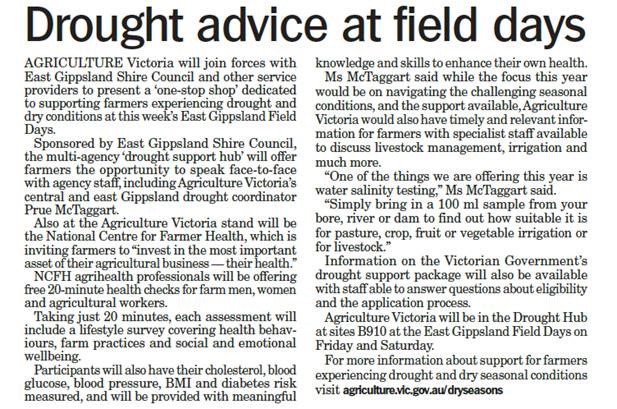
2019-04-23: Drought advice at field days – East Gippsland Field Days
Metalcorp Tick of Approval
Metalcorp and the National Centre for Farmer Health have continued their partnership in 2019, helping to make a difference to farmer’s lives.
Metalcorp’s corporate support of the NCFH provides vital funding to aid research and support ongoing activities to improve farmer health.
Recently, Metalcorp’s livestock handling equipment has received a safe farming tick of approval by the National Centre for Farmer Health.
A review by the National Centre For Farmer Health found that Metalcorp’s CLASSIC PLUS® Crush, CATTLEMASTER® Crush and the HOBBYMASTER® Vet Crush were considered to be a superior safety option for farmers.
The assessments were conducted by Livestock Veterinarian Dr David Rendell, Occupational Therapist Andrew Cross and NCFH Director Dr Susan Brumby to ensure Metalcorp’s Cattle Crushes enable cattle and humans to work together as safely and efficiently as possible.
Cattle Crushes play a vital role for farmers to carry out a variety of jobs on the animal, including vaccinating, dehorning, castrating, pregnancy testing, tagging, veterinarian treatment and much more.
With these important jobs to be carried out, the report revealed that Metalcorp’s Cattle Crushes meet manual handling demands and gates and locking mechanisms were considered reasonable, easy to use and well designed.
The report also revealed that because Metalcorp’s Cattle Crushes are designed with rectangular steel sections, this prevents the handler putting an arm in the cattle crush area and is viewed as a significant improvement from cattle crushes designed with round pipe sections.
Metalcorp’s Cattle Crushes effectively restrain the typical range of cattle in Australia, enabling important procedures to be carried out.