

A Pest to Mental Health? Exploring the Link between Exposure to Agrichemicals in Farmers and Mental Health
The current literature acknowledges that occupational exposures can adversely affect mental health. This review seeks to elucidate the current understanding of the effect of agrichemical exposure on mental health in the agricultural sector, including low-dose, chronic pesticide exposure. This scoping review adopted a snowballing and saturation approach. The review highlights inconsistencies in linking poor mental health and pesticide use. While some studies specifically showed that both high- and low-dose pesticide exposure were associated with poor mental health, consistent and rigorous research methods are lacking. The review also proposes terms to delineate exposure types described in the literature. The review outcomes direct efforts to protect the health, wellbeing and safety of farming communities across the globe.
Development and evaluation of e-mental health interventions to reduce stigmatization of suicidality – a study protocol
Worldwide, approximately 800,000 persons die by suicide every year; with rates of suicide attempts estimated to be much higher. Suicidal persons often suffer from a mental disorder but stigma, lack of available and suitable support, and insufficient information on mental health limit help seeking. The use of internet-based applications can help individuals inform themselves about mental disorders, assess the extent of their own concerns, find local treatment options, and prepare for contact with health care professionals. This project aims to develop and evaluate e-mental health interventions to improve knowledge about suicidality and to reduce stigmatization of those affected. In developing these interventions, a representative telephone survey was conducted to detect knowledge gaps and stigmatizing attitudes in the general population.
Suicide and Accidental Death for Australia’s Farming Families: How Context Influences Individual Response
This article presents qualitative data to explore the experience of farming family members faced with accidental or suicide death and understand how this is experienced within the farming context.
The epidemiology of emergency presentations for falls across Western Victoria, Australia
In order to develop and implement prevention strategies for falls, comprehensive epidemiological data are required. Therefore, this study mapped emergency presentations for falls across the western region of Victoria, Australia, encompassing urban, regional and rural areas.
‘It could have been a lot worse’: the psychological effects of farm-related serious injury in Victoria’
The psychological response to injury is an important factor in recovery, and the development of psychological problems can result in a delay or inability to return to pre-injury function, including return to work. Farming is widely acknowledged as a stressful occupation, with non-injured farmers already at an increased risk of developing significant psychological problems, including high levels of stress and depression, and increased rates of suicide. This study aimed to investigate the psychological effects of serious farm-related injury on farmers, and how this influences their recovery.
Revision joint replacement surgeries of the hip and knee across geographic region and socioeconomic status in the western region of Victoria: a cross-sectional multilevel analysis of registry data
Residents of rural and regional areas, compared to those in urban regions, are more likely to experience geographical difficulties in accessing healthcare, particularly specialist services. We investigated associations between region of residence, socioeconomic status (SES) and utilisation of all-cause revision hip replacement or revision knee replacement surgeries.
Mapping Cancer incidence across Western Victoria: the association with age, accessibility, and socioeconomic status among men and women
Cancer is a leading burden of disease in Australia and worldwide, with incidence rates varying with age, sex and geographic location. As part of the Ageing, Chronic Disease and Injury study, we aimed to map the incidence rates of primary cancer diagnoses across western Victoria and investigate the association of age, accessibility/remoteness index of Australia (ARIA) and area-level socioeconomic status (SES) with cancer incidence.
2019-08-12: Witness vox pop video – Royal Commission Mental Health – Victoria
Hear from some of the witnesses from our regional and rural hearing day in Maryborough in the Central Goldfields Shire.
Farmer Health eNews August 2019
Find out all the latest from the National Centre for Farmer Health
- Witness Statement for Royal Commission into Victoria’s Mental Health System
- Farmer Health Week Dowerin
- Gear Up—Strategies to change behaviours & improve health & safety practices
- Wellness Wednesday
Do you want to receive our eNews?
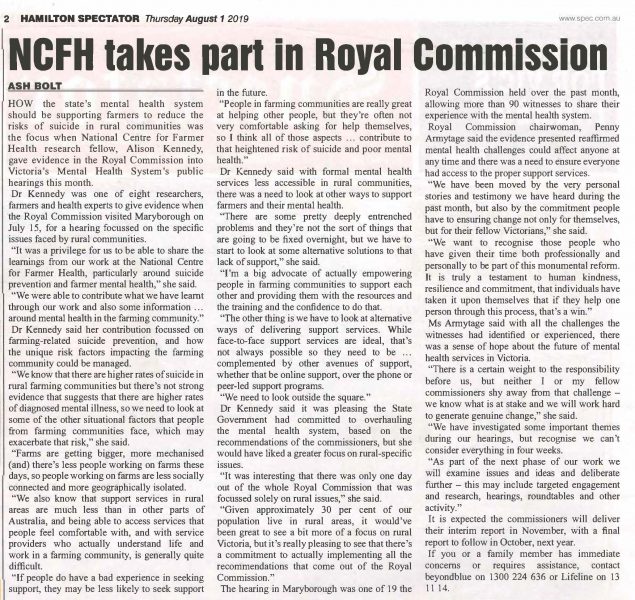
2019-08-01: NCFH takes part in Royal Commission – Hamilton Spectator
Royal Commission into Victoria’s Mental Health System – Witness Statement of Dr Alison Kennedy
Following the Commissions preliminary meetings, written submissions and attendances at hearings on July 15th, the National Centre for Farmer Health’s Dr Alison Kennedy was invited to give evidence before the Victorian Royal Commission into Mental Health Systems in Maryborough. This was the only day dedicated to hearing from witnesses in rural Victoria. Dr Kennedy was one of only eight witnesses called and gave evidence about the work of the Centre and the current evidence on farmer mental health and suicide prevention.
Read Dr Alison Kennedy’s Witness Statement
Visit the Royal Commission into Victoria’s Mental Health System website
2019-07-15: No psychiatric beds, but wife of suicidal man refused to give in – The Sydney Morning Herald
Image: Dr Alison Kennedy, National Centre for Farmer Health presenting at the Royal Commission
A woman had to consider locking her suicidal husband out of their family home in order to get him the help he desperately needed and that would only be given to him if he was deemed homeless.
In harrowing evidence to the mental health royal commission, Christine Thomas said her husband, Trevor, was in so much distress in September 2014 that he wanted to die.
Mrs Thomas was even scared for his safety if he went to the toilet alone.
However, when they arrived at a regional hospital’s emergency department, a psychiatric nurse said that although Mr Thomas was highly suicidal, there were no beds available.
The Numurkah couple were told to go home and come back the next day.
Mrs Thomas said she had been warned in advance by a family support worker that this may happen. She followed the worker’s advice by walking out and leaving her husband behind.
“I said, ‘You have admitted a duty of care to him. I’m leaving now’.”
Mrs Thomas told of her anguish in having to leave her husband of 20 years at the hospital: “Nobody should ever, ever have to do that to someone they love, and he shouldn’t have to have that done to him.”
She said that after leaving her husband at the hospital, she hid in bushes in the car park, in case he was sent home in a taxi when a staff member rang her to say they had found a psych ward bed.
“So I’m in this dilemma: Do I leave him here? Do I take him home? I’m struggling to keep him safe…
“When he got up during the night to go to the toilet [at home], I’m sneaking up behind him to make sure, yes he’s going to the toilet.”
She said when Mr Thomas was about to be released from PARC, his medication wasn’t established and “he wasn’t well – not that much better than when he went in”.
Again through the support worker – without whose counsel, she said, she believes Mr Thomas would be dead – she learned that, if he was homeless, he couldn’t be released.
“If you didn’t have somebody in the system, saying ‘Hey, this is what’s going to happen’, and sure enough these things happen, Trevor would be dead today. This person, I owe them his life.”
She hasn’t sought help from mental health services after her husband’s more recent breakdown in January because she was so disillusioned.
“I didn’t have the strength or the fight to fight with a broken system, this time it’s been different and worse, his breakdown, and I didn’t think the system would keep him safe.”
Mr Thomas told the commission that his father and two uncles died from suicide, and that he had suffered depression since his late teens, but didn’t get help until he was 58. He said he was “brought up in a family of blokes who were blokes and didn’t talk about that sort of stuff”.
Mr and Mrs Thomas were among seven people, including health professionals and community witnesses, who gave evidence to the Royal Commission into Victoria’s Mental Health System on Monday, its tenth day. The commission was sitting at the Community Hub in Maryborough, 167km north-west of Melbourne.
Another witness, farmer Al Gabb, told the commission that he became seriously depressed six or seven years ago after a relationship breakdown and his life “unravelled”.
Living alone, he became severely depressed and would speak to no one for weeks at a time while farming at his property at Skipton, 50 kilometres west of Ballarat.
He said the government-funded 10 week health plan sessions with a psychologist arranged by his GP proved inadequate, and he attempted suicide several times.
He was “very lucky” to be able to afford, with his family’s help, to see a private psychiatrist in Melbourne, however, it proved impractical to leave the farm to attend each session “for the best part of a day”.
Dr Alison Kennedy, a research fellow at Deakin University and the National Centre for Farmer Health, said researchers are working with the Coroner’s Court to gain a better understanding of farmer related suicide in Victoria.
Risk factors for included that fewer services were available from psychiatrists, psychologists, GPs and mental health nurses, and existing ones were not always experienced with issues farmers faced.
Stigma of admitting mental illness, of not being seen to be coping was stopping people getting help, and sometimes the only health professional was a local who they feared might gossip.
Maryborough District Health Services CEO Terry Welch told the Commission that complex psychiatric emergency cases had to be referred to a major town such as Bendigo.
There were no secure facilities at its urgent care centre and disruptive patients sometimes had to be transported by the police.
If you or anyone you know needs support you can contact Beyond Blue on 1300 224 636, or Lifeline on 13 11 14.
Read full article: CLICK HERE