

Learn where you live – Agricultural Health and Medicine goes online in 2021
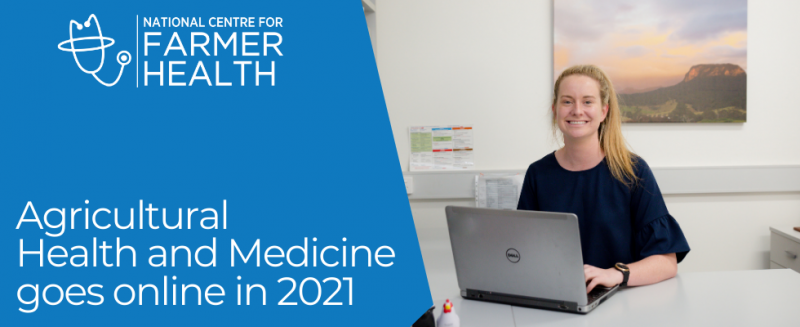
For the first time in twelve years Australia’s only postgraduate agricultural health and medicine unit is going online for 2021. This internationally recognised, multidisciplinary course better equips health providers, rural professionals and our rural communities with the knowledge and skills they need to live, work and prosper. To date, over 230 professionals working in agriculture, medicine, allied health, and nursing from across Australia, New Zealand, India, Indonesia, Africa and the UK have undertaken the unit which confronts the high rate of injuries, fatalities and non-communicable diseases experienced by farming families and their communities.
Unit chair Dr Jacquie Cotton says “The global pandemic event of 2020 has changed the way we teach and work. This means that you can now learn where you live, and by moving the course online enable our international and interstate students to study with us in 2021.”
The exciting 5-day intensive will be held online from February 22nd – 26th 2021 as a key part of the online unit. Agricultural Health and Medicine unit (HMF701) offered through Deakin University, School of Medicine. The presenters cover a broad range of health, safety and wellbeing issues ranging from mental illness and addiction through to emergency medicine, agrichemicals, zoonotic disease, non-communicable disease and agricultural trauma.
The course material shifts focus with the changing nature of adversity and health challenges faced by rural and remote agricultural communities, providing graduates with the necessary skills and knowledge to improve the social, physical and mental health of agricultural workforces and farming women, men and children across Australia.
NCFH Agrihealth professional, RN, and Agricultural Health and Medicine graduate, Amelia Cottrell from NSW is one of a team of rural nurses using their expert understanding of Agricultural Health to work with farmers and agricultural workers across the country. “The National Centre for Farmer Health has helped me fulfil my passion to improve the health and wellbeing of rural communities through conducting health assessments and educating farmers about the health risks associated with the agricultural industry and to make a positive change to farmers’ lives.” RN Amelia Cottrell said
Dr Cotton says “Registered nurses who successfully complete Agricultural Health and Medicine and meet requirements, are also ideally placed to join Australia’s only AgriSafe™ network.
To find out more about scholarships, AgriSafe™ career opportunities or apply for the Graduate Certificate of Agricultural Health and Medicine, visit www.farmerhealth.org.au/education, contact Dr Jacquie Cotton 03 5551 8533 or email j.cotton@deakin.edu.au.
*** ENDS ***
FOR MORE INFORMATION, PLEASE CONTACT:
National Centre for Farmer Health:
Dr Susan Brumby
Phone: 03 5551 8460
or
Dr Jacquie Cotton
Phone: 03 5551 8585, 0409 287 497
Email: j.cotton@deakin.edu.au
Farmer Health eNews November 2020
Find out all the latest from the National Centre for Farmer Health
- Ag Health and Medicine goes ONLINE in 2021!
- Gear Up for Ag Health and Safety Programs available free of charge in 2021 thanks to the Victorian Government’s Smarter, Safer Farms initiative
- SnapshotRuralVic Awards and Book Launch event
- Wellness Wednesday
Do you want to receive our eNews?
Women’s Health Week – catch up with Jodie Leske
Jodie Leske is a mum, business owner and farmer living in the Western District of Victoria, 259 kilometres west of Melbourne.
Like many women on the land, finding the time to look after her health is a constant challenge. Between juggling the usual daily demands of work and family, and on top of this, the distances needed to travel to some health services, Jodie’s health can take a back seat.
“It’s very easy to get caught up in being really busy getting the job done,” says Jodie. But Jodie acknowledges that her health and wellbeing are also really important, so she makes sure she finds time for herself. Whether it’s getting off the farm to see other people, doing some physical activity or finding down time. “It’s easy to get caught up, but it’s also important to stop.”
Jodie also knows her health is important not just to her, but her family and community. “With my health, I find if I’m not feeling right everyone feels it. It’s really important to look after yourself as well as everybody else around you.”
2020-10-06: Rural life in the spotlight – Sentinel Times
Greg Beal captured this photo of South Gippsland for the #SnapshotRuralVic campaign.
#SNAPSHOTRURALVIC, an initiative of the National Centre for Farmer Health, is bringing country Victorians together to tell a unique story of rural life during the second wave of COVID-19 lockdown.
Since launching over seven weeks ago, more than 1000 people have shared their photos and stories of everyday rural life over a number of social media platforms, including Facebook, Instagram, Twitter and the farmerhealth.org website.
During a time when people are more disconnected than ever, it proved to be a valuable outlet for people to connect and share aspects of how life goes on during lockdown.
One participant noted #SnapshotRuralVic “picked me up when feeling down and I enjoyed the positive and motivating pictures.”
Social media analytics show both rural and metropolitan areas are joining in with feedback received from the participants overwhelmingly positive.
Project officer Hilary McAllister said it had been encouraging to see the simple act of sharing a photo or story was keeping other people motivated during this lockdown.
Each week, there was a new theme, such as COVID cooking, masks on farms and stories from the shed.
“Some of the photos of the projects that people have been doing have been simply amazing,” Ms McAllister said.
A weekly shortlist of the entries also go in the running to win the People’s Choice award with the lucky winner receiving a $100 voucher to a local Victorian business of their choice.
With only a few weeks remaining, the National Centre for Farmer Health is hoping to see the community continue to grow. The campaign will culminate at the #SnapshotRuralVic Awards which will take place virtually in early November.
All submissions across the 10 weeks of the campaign will be considered for judging, with categories including ‘Celebrating the Next Generation’, ‘Lamb of the Year’ and ‘Best COVID-Kitchen Creation’. The campaign will conclude on Friday, November 6.
For further information, visit farmerhealth.org.au/snapshotruralvic or reach out to the Snapshot Online project officer, Hilary McAllister, directly at hmcallister@wdhs.net or on 0490 483 548 for more information.
Farmers, Suicide Literacy and Suicide Stigma – The Ripple Effect
Background: Globally many farming populations have been identified as having higher rates of suicide, in comparison to those living in metropolitan, rural and regional communities. The reasons for this are unclear although occupational risk and stigma are considered risk factors. This Australian study sought to understand the role of suicide literacy and suicide stigma in farming and rural populations and the relationship between these.
Methods: A mixed-methods online intervention was developed. This presentation reports on baseline quantitative data of suicide literacy, stigma and suicide effect collected from male and female rural Australian participants (N = 536) with an experience of suicide (attempted, considered, bereaved by, cared for, or any other experience).
Results: Our cohort demonstrated higher levels of stigma and significantly higher levels of suicide literacy when compared with previous Australian community samples. Males were also more likely to have considered suicide than females. Females were more likely than males to report a devastating and ongoing effect of suicide bereavement/s.
Conclusion: This study reiterates the clear need for much improved understanding of the risk factors for suicide and the experience of suicide that occurs within the life and work in farming communities. Importantly it identifies that increased literacy (intended to decrease risk) does not necessarily correspond with decreased rates or experience of suicide. How can we apply and adapt ‘best practice’ in farmer suicide prevention to reduce stigma and improve prevention efforts.
Farmer Health eNews October 2020
Find out all the latest from the National Centre for Farmer Health
- Are you our next Scholarship recipient? HMF701 Scholarships are now OPEN!
- National Centre for Farmer Health new website launch
- Mental Health 4 Ag – Your time can make a big difference!
- Wellness Wednesday
Do you want to receive our eNews?
Directors Blog – Hearten up! Heart health matters
by Dr Susan Brumby
Twitter: @brumby_susan
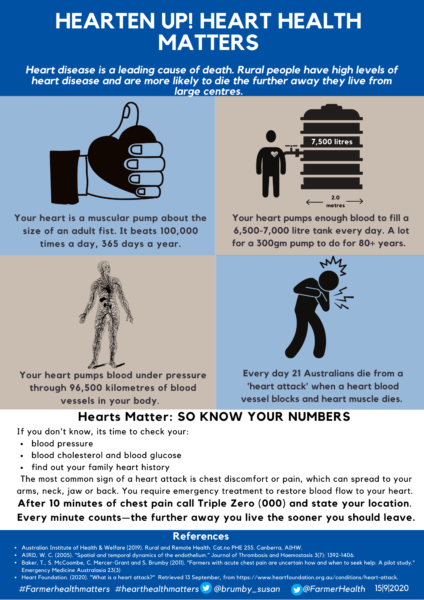
Your heart is an amazing pump. Weighing in at 300 grams it pumps 6500 – 7000 litres per day[1]. Every day you expect your heart to beat 100,000 times without stopping 365 days of the year. We hope our hearts will continue to beat consistently for 80 – 90 years. This is a big ask and perhaps unsurprising that cardiovascular disease is a leading cause of death with 21 people dying every day in Australia[2].
COVID-19 has not meant that heart attacks, strokes and other cardiovascular issues have stopped occurring, rather that people have put off getting treatment and seeking help. Many, many people have delayed or had to postpone cardiac specialist appointments because of COVID – 19. Whilst putting off appointments is understandable, a recent study undertaken during the COVID lockdown has shown the number of Victorian patients with severe chest pain attending hospital was reduced. Those that did attend were waiting much longer than usual to seek emergency medical treatment[3]. Time matters with heart attacks. In fact, every minute counts, because saving heart muscle depends on getting treatment quickly and early.
Unfortunately rural and remote people have higher levels of heart disease [4]. A study undertaken with Victorian farmers showed that even before COVID-19 farmers were likely to stay at home when they experienced chest pain, and paradoxically, the further they lived from an emergency department the longer they delayed seeking help [5]. Exactly the opposite of what you need to do. To save heart muscle you need to get assistance quickly.
People experiencing 10 minutes or more of chest pain should seek medical advice quickly. The further the distance from help the earlier you should seek assistance. That assistance /advice should be an emergency department with facilities to treat a heart attack – not a general practice clinic. Austin Health cardiologist Dr. Matias Yudi said during the COVID-19 lockdown, “We don’t yet know how many patients may have never presented at hospital or potentially died after having heart attacks,”. He noted that people who delayed treatment for heart attacks were at risk of other complications such as heart failure from the loss of heart muscle, fluid build-up in lungs and a decreased lifespan[6].
Rural and remote populations have shorter life expectancy than metropolitan populations. So make the time to research your family heart history, have a check-up with your GP and follow up on any appointments that you had.
Remember: If you have chest pain lasting more than 10 minutes and are delaying seeking help, think about your heart and the job it does for you every single day and call triple zero (000).
References
- Aird, W.C., Spatial and temporal dynamics of the endothelium. Journal of Thrombosis and Haemostasis, 2005. 3(7): p. 1392-1406.
- Heart Foundation. What is a heart attack? 2020 13 September]; Available from: https://www.heartfoundation.org.au/conditions/heart-attack.
- Toner, L., et al., Acute coronary syndromes undergoing percutaneous coronary intervention in the COVID-19 era: comparable case volumes but delayed symptom onset to hospital presentation. European Heart Journal – Quality of Care and Clinical Outcomes, 2020. 6(3): p. 225-226.
- Australian Institute of Health & Welfare, Rural and Remote Health. Cat.no PHE 255. 2019, AIHW: Canberra.
- Baker, T., et al., Farmers with acute chest pain are uncertain how and when to seek help: A pilot study. Emergency Medicine Australasia, 2011. 23(3).
- Melissa Cunningham and Aisha Dow, ‘Huge concern:’ Heart attack patients risk lives by delaying hospital treatment, in The Age. 2020, Nine: Melbourne.
Does 20-Minute Rounding Reduce Falls in an Aged-Care Setting? A Pilot Intervention Study.
Highlights
- The study investigated if 20-min rounding reduced falls in aged-care facilities.
- Overall, falls were reduced for residents of the aged-care facilities.
- No severe falls occurred during the intervention period.
- This is compared to three in the previous six months.
- There were no differences in falls for the intervention group.
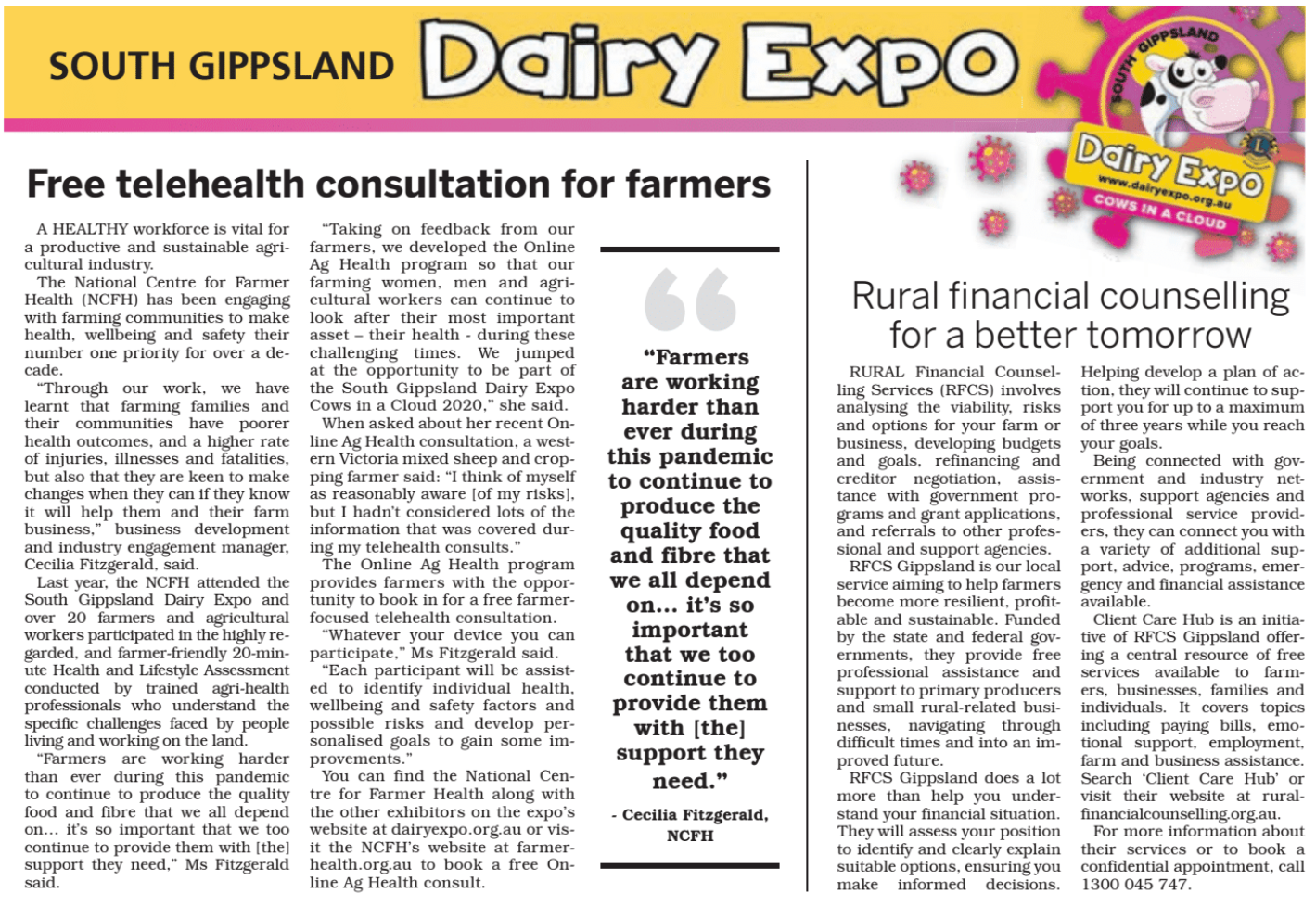
2020|09|08: Free telehealth consultation for farmers – The South Gippsland Sentinel-Times
Farmer Health eNews September 2020
Find out all the latest from the National Centre for Farmer Health
- Online Events in September
- Cuppa with the Women of the NCFH to celebrate Women’s Health Week
- South Gippsland Cows in a Cloud Dairy Expo – book your free online health check
- #SnapshotRuralVic Campaign is gaining momentum – check the latest entries
- Mental Health 4 Ag – new mental health project needs your involvement
- Wellness Wednesday
Do you want to receive our eNews?
Directors Blog – Farmer Health Matters: Heads up with mask wearing
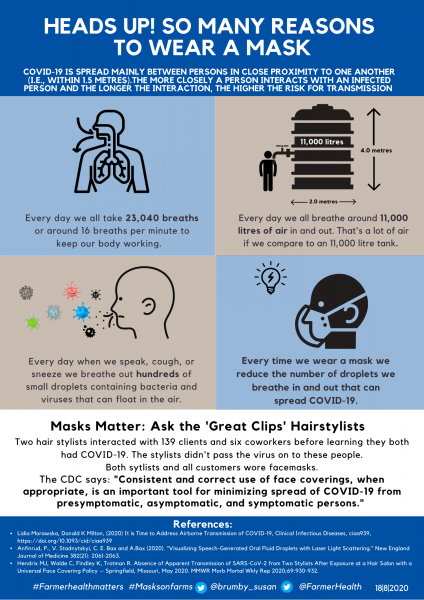
A recent paper indicated that whilst handwashing and social distancing are appropriate, they are insufficient to provide protection from virus-carrying respiratory micro droplets released into the air by infected people.(1)
From midnight on August 2, regional Victorians were required to wear face masks—including farmers. For many farmers, home is also their workplace and therefore must wear a mask if they have staff coming and going from the farm property. When you live and work in a family environment that is important because if you pick up COVID-19 from someone visiting the farm, you are very likely to take it into your home and infect your family. Even if visitors or staff feel well the viral load peaks in the day before symptoms of COVID-19 begin and just speaking is enough to expel virus-carrying droplets that can infect you, your family and staff.(2)
It’s pretty easy to understand why wearing a mask helps provide protection if you do the maths. An average person takes 23040 breaths per day, breathing in around 11000 litres of air. Think of an 11000 litre water tank. With each breath we inhale and exhale hundreds of biological particles, which include pollen, animal and human dander, plant debris, bacteria, and viruses. The smallest of these are viruses of up to 0.1 micron in size which is 200 times finer than your 20 micron wool. A recent experiment using high-speed video found hundreds of droplets were generated when saying a simple phrase, but that nearly all these droplets were blocked when the mouth was covered.(3)
This simple demonstration by Rich Davis, a Clinical Microbiology Lab Director(4) shows the effect of wearing a mask and not wearing a mask on bacterial spread (not viral spread) when sneezing, talking and coughing. He did this using bacterial culture plates.
Figure 1: Effect of wearing a mask and not wearing a mask on bacterial spread
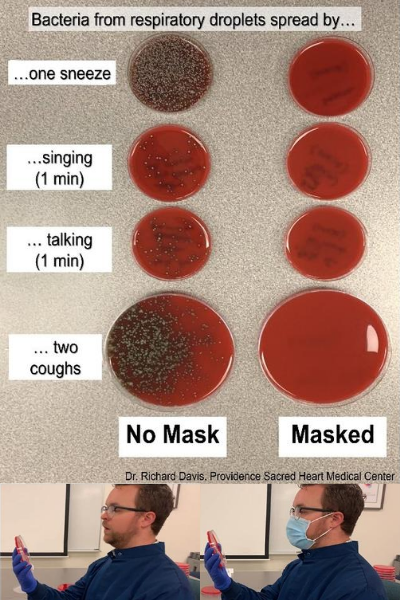
According to Mr Davis ‘It is likely that smaller aerosolized droplets ( that could carry viruses like COVID-19) are also produced during coughing and sneezing and that these would travel further and stay in the air longer than larger droplets’. Masks can help stop someone who has an infection -and doesn’t know it – from passing it on and can also help prevent you getting sick.
For those Australians (not in Victoria) the World Health Organisation is now recommending face masks to prevent the spread of COVID-19(5) and as outbreaks and second and third waves occur being prepared. Our experience in Victoria is that when you need them (masks) you need them and having ready made or stocks of disposable masks on hand is a good idea. Stores ran out of masks for sale and elastic for mask making had length limits in place. As farms are getting into their busy season- lamb marking, calving, silage making, shearing, harvesting, mango season and selling stock- it is important that we don’t see a rise in COVID- 19 resulting in further lockdowns.
Wearing a mask can do more than just filter air, it can also help with social distancing through how we perceive others and how willing we are to get to close to strangers.(6) It is also great to see the VFF promoting #Masksonfarms on twitter – do check it out.
Remember: Wearing a clean mask every time you leave your house makes good sense. There are lots of mask patterns available online but make sure they cover both your nose and mouth and have 3 layers.(7)
References:
- Lidia Morawska, Donald K Milton, (2020) It is Time to Address Airborne Transmission of COVID-19, Clinical Infectious Diseases, , ciaa939, https://doi.org/10.1093/cid/ciaa939
- Jayaweera, M., H. Perera, B. Gunawardana and J. Manatunge (2020). “Transmission of COVID-19 virus by droplets and aerosols: A critical review on the unresolved dichotomy.” Environmental research 188: 109819-109819.
- Anfinrud, P., V. Stadnytskyi, C. E. Bax and A. Bax (2020). “Visualizing Speech-Generated Oral Fluid Droplets with Laser Light Scattering.” New England Journal of Medicine 382(21): 2061-2063.
- Rich Davis, (2020) PhD https://twitter.com/richdavisphd/status/1276737371464060928
- WHO (2020, 5 June) Advice on the use of masks in the context of COVID-19: Interim guidance.
- Massimo Marchiori, (2020) COVID-19 and the Social Distancing Paradox: dangers and solutions. https://arxiv.org/pdf/2005.12446.pdf
- DHHS (2020) Key Points, Hygiene and physical distancing. DHHS Vic https://www.dhhs.vic.gov.au/staying-safe-covid-19
Farmer Health eNews August 2020
Find out all the latest from the National Centre for Farmer Health
- #SnapshotRuralVic – get involved!
- Farm Safety Week wrap up
- New Working Group expressions of interest; co-designing a peer-supported approach to improve mental health in rural farming communities
- Wellness Wednesday