

The dog school with a mental health difference
Written by Emma Foster for Westpac Wire.
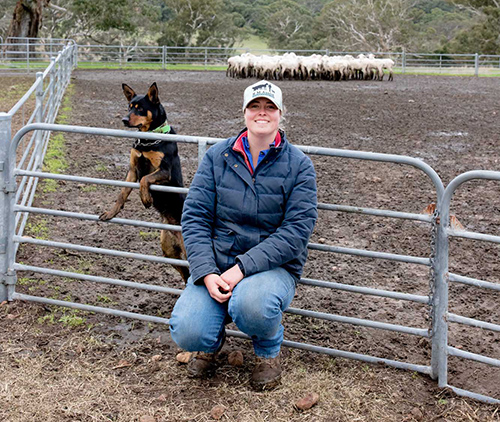
Kelly Barnes had always thought of Dugald, her 14-year-old farm working Kelpie, as a mate.
But she never guessed the old dog would end up sparking an idea to tackle the mental health struggles prevalent in farming communities across Australia.
“He’s just been everywhere with me, my constant companion and workmate,” says Barnes, who worked on farms as a livestock contractor across Australia after migrating from England in 2007.
Since he was a pup, Dugald went farm to farm with Barnes, on mustering, drenching, lamb marking and shearing jobs – his skills a valuable asset enabling the pair to get more work.
That was, until Barnes developed a chronic pain condition, diagnosed in 2015 as fibromyalgia. Dugald, too, slowed down after being hit by a car, leaving him “a bit hobbly and with a bandy leg”.
“It was quite funny. He and I just used to sit on the couch and have afternoon naps and hobble around together,” recalls Barnes, Victoria’s state winner in this year’s Agrifuture’s Rural Women’s Awards.
That’s when she conceived the idea for Mates Working Dog Training School, drawing on her realisation of just how much of a “rock” her dog had been – both as a physical workmate and a mental companion as she struggled with the transition into less labour intensive off-farm work.
Kicking off as a pilot in January in Dunkeld, around 280km west of Melbourne, participants of Barnes’ working dog training school attend six, day-long sessions over six months with a professional dog handling trainer, Ian O’Connell.
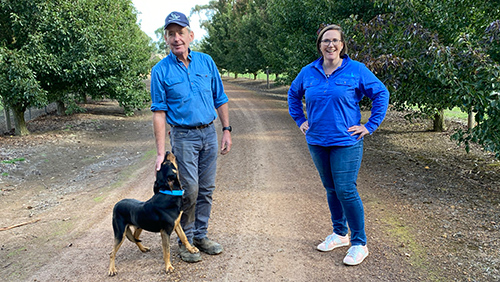
But, Barnes explains, the program aims to produce much more than just upskilled canines.
“Basically, the dog training is the hook to get people in,” she says.
“Then amongst the day full of training, I sneak in discussions about different resilience topics, like working with different personality types, or dealing with stressful situations, or the way nutrition affects how you feel – and sort of relate it all back to the dogs.
“It’s a nice way of introducing some of those topics, especially for people that are not really interested or find it uncomfortable.”
She says the program’s true value is in getting people off farm and into a like-minded group to create new social connections.
“It’s creating those little pockets of people that they can call on if they need to. And for some of them, just getting off farm and into a group, while learning to use their dogs better, is enough to benefit them without them even realising,” she says.
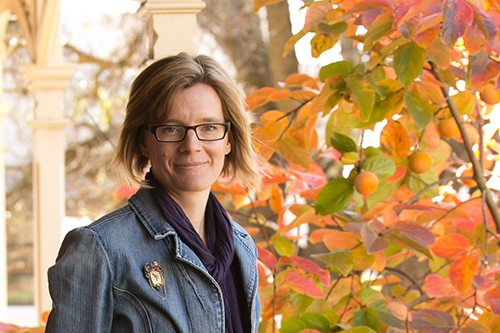
Dr Alison Kennedy, a behavioural scientist and acting director for the National Centre for Farmer Health, says the program is “incredibly insightful” and has great potential to benefit many people in farming communities.
“Kelly’s created this very practically focused program that ties in with farming culture … so it takes a lot of the stigma away that’s often associated with mental health programs and presents it in a really approachable way,” Dr Kennedy says.
Having spent more than a decade focused on farmer mental health and suicide prevention in Victoria’s rural farming community, Dr Kennedy says despite the inroads made, situational factors such as social and geographic isolation, drought, fires and floods and a lack of mental health professionals (and anonymity) in small towns – put farming communities at higher risk of poor mental health. In some areas, suicide rates are up to twice that of the general population.
“We are getting better at understanding and talking about the risks to mental health in our farming communities, but there are some very strongly entrenched cultures…which means it does take a lot of effort over a sustained period of time to really make significant changes,” Dr Kennedy says.
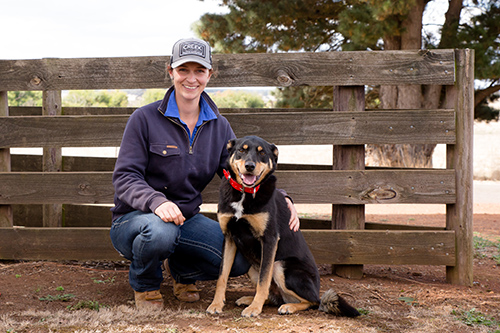
One of the first 15 participants, Rachael Morris, says the program was “amazing” for both her and her two-year-old “eager” Kelpie, Max.
Morris had always worked on farms in her home of King Island in the Bass Strait but had no experience with working dogs until she moved to regional Victoria around three years ago as a farm labour contractor working mainly with sheep.
“I’m still a bit new to it, so I’ve got a lot to learn, but I’ve learnt a lot,” says Morris, who has three other dogs working with her and Max every day – Ammo, Digger and Barry.
Morris says she “can’t wait” to have a reunion with the other participants, who she’s stayed in regular contact with since starting the program.
“It was a really good bunch of people, really diverse, with different dogs at different training levels and abilities, and we all really looked forward to the training days,” Morris says.
An independent evaluation of the program by the National Centre for Farmer Health found while some participants were surprised that mental resilience topics were tied in with the dog training, they recognised how beneficial it was for their wellbeing and had already started to apply what they learnt in other areas of their life.
Another participant Dr Jo Ward, a livestock vet based in Coojar, agreed the program opened doors to wellbeing conversations that some participants may not otherwise have had, while bonding over their dogs.
“Because we were meeting over the six months, we were able to build a rapport with each other,” says Ward, who took her 5-month-old Border Collie pup Maggie and 7-year-old Kelpie, Ralph.
“It’s been nice from a social aspect to stay in touch, but it also keeps us motivated to keep training our dogs.”
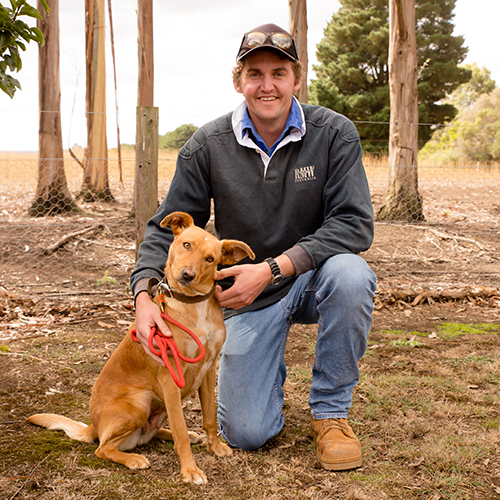
Likewise, Tom Higgins, who attended with his two-year-old Kelpie Dot, says breaking up the training day to “have a cup of tea and a talk” meant he would now “definitely have a chat” with the people he attended the training with when he runs into them in town.
While Higgins, who works on his family’s sheep property, had worked with dogs his whole life, he’d never been formally trained and was attracted to the opportunity of learning from such a well-renowned dog handler as Ian O’Connell.
“The training was probably more for me, I guess,” he chuckles. “I could then show Dot what to do and where to go and we’ve definitely both improved.”
Based on the success of the pilot, Barnes has a waitlist for future school intakes and is working towards rolling-out a refined program from next year. Over time, she hopes it will be replicated in other rural communities around the country.
“Every famer has a dog, often they have a team of dogs, and if they can learn to use them as a resource to help with their mental health, I think it can be valuable.”
As one of seven state winners of this year’s Agrifuture’s Rural Women’s Awards, Kelly Barnes received a $10,000 bursary from Westpac to support her project as part of the bank’s Platinum Sponsorship. The national winner will be announced virtually on October 20.
If you or anyone you know needs help, call Lifeline on 13 11 14 or Beyond Blue on 1300 224 636.
Farmer Health eNews October 2021
Find out the latest from the National Centre for Farmer Health
- Think Safe. Work Safe. Be Safe. Check out our resources to promote a safe workplace during National Safe Work Month 2021.
- Be AgriSafe this Work Safe Month. Find out more about our AgriSafe program and how it can help you and your family.
- The Agricultural Health and Medicine (HMF701) Scholarships are now open!
- Wellness Wednesday
Do you want to receive our eNews?
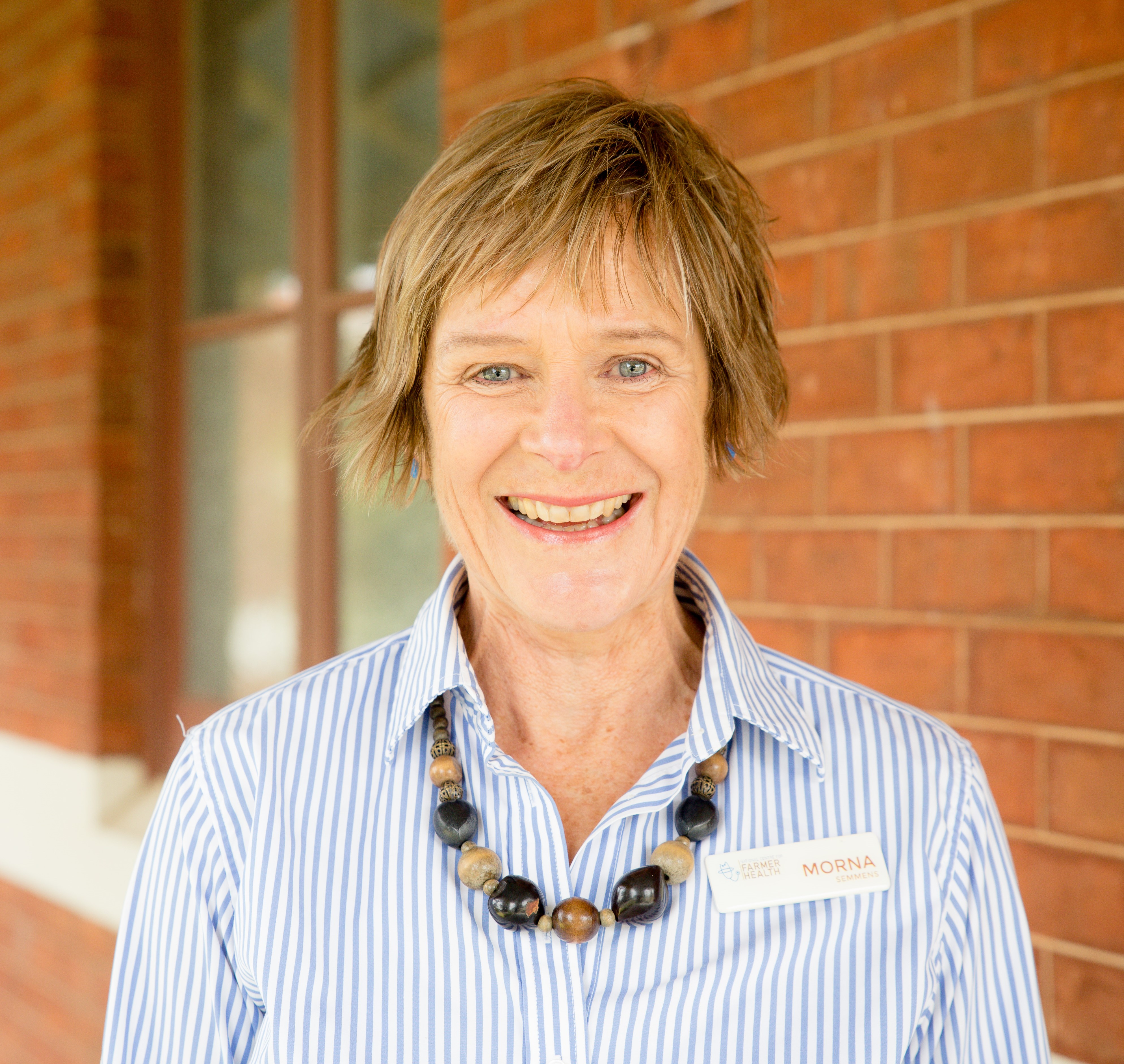
Meet the Team! Morna Semmens
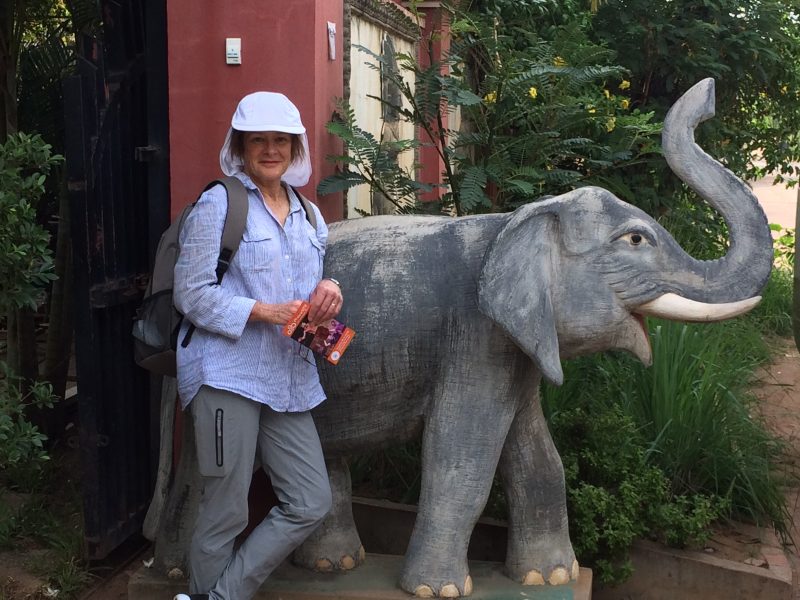
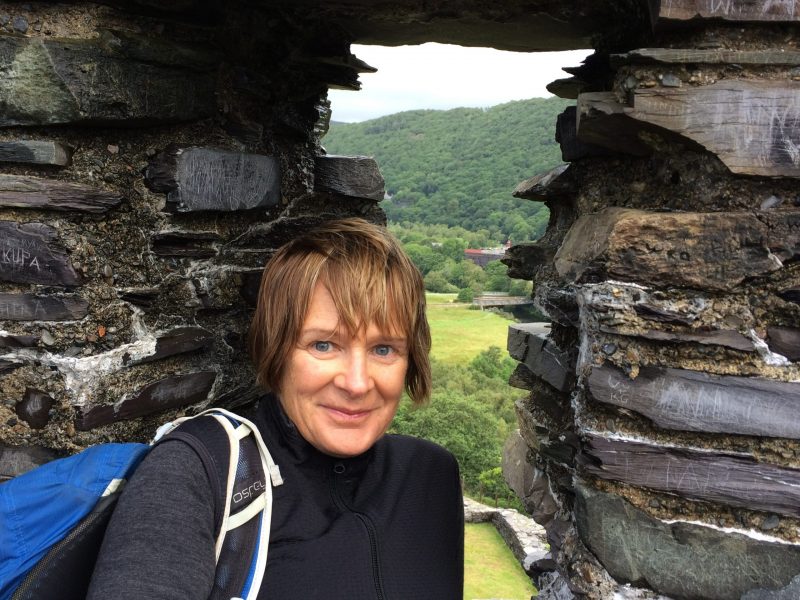
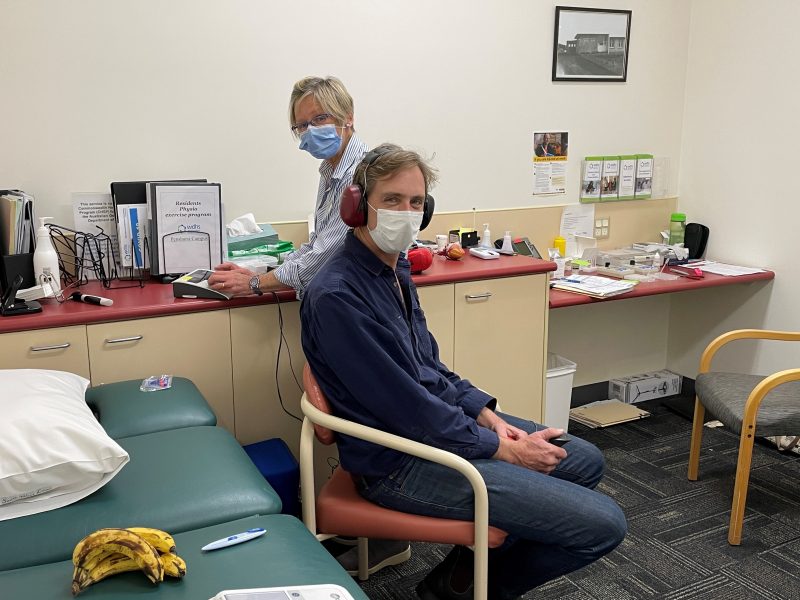
Meet Morna Semmens – our wonderful Agrisafe Clinician and Registered Nurse. When she is not looking after our local farmers through her work at the AgriSafe clinics, or educating students on farm safety through our Gear Up program, she is working with husband on their sheep and cattle grazing farm in Gazette, Western Victoria.
We found some time in Morna’s busy schedule to learn a little bit more about her…
Favourite Quote:
I’m an optimist, but an optimist who carries a raincoat.
Harold Wilson
What is something that Australian farmers have to deal with that you would like to fix?
The pressure they feel to address their animal, crop, and soil health before they prioritize their own health.
What do you like about working with NCFH?
Everyone’s skills and input are valued- the mix of skills brings creativity and new ways of approaching challenges to agricultural health and medicine.
What are you currently working on at NCFH?
AgriSafe Clinics for farmers and agricultural workers, and Gear UP sessions for students to ensure the next generation of agricultural workers manage their risks and survive/thrive in agriculture.
What is your background?
Speech Pathology-Vocational Rehabilitation-Sheep/Beef Farming.
What are the values that drive you?
1. Play your part and work hard to contribute to family – community and the world.
2. Look at the world from other’s perspectives first.
3. Listen with intent.
What are your three favourite podcasts/books?
1. A kestrel for a knave, by Barry HINES. It is a story about a young boy in a tough environment surviving emotionally by befriending a kestrel. If you prefer the movie version look up KES.
2. Seeing Voices by Oliver Sacks. It is a neurologist’s view into deaf culture and their visual language systems.
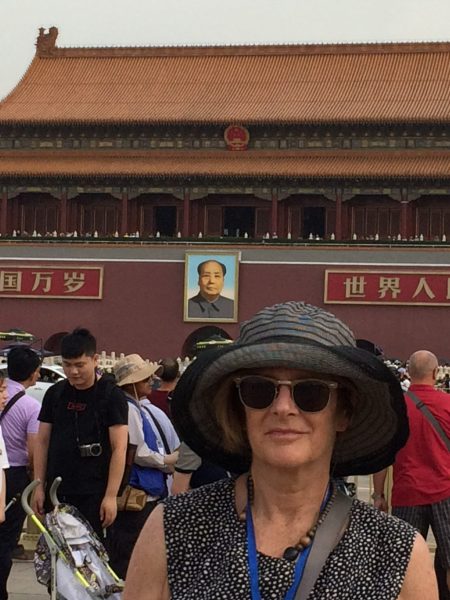
3. The Sixteen Trees of the Somme by Lars Mytting. It is a great family epic based in Norway – a country I visited a few years ago and loved.
Basically I love stories where people overcome adversity or where the story is about how earlier generations of a family influence the next generation….
What do you enjoy doing when you are not working?
Swimming, bike riding and growing food…. In that order.
To book in to see Morna for a Health and Lifestyle Assessment through the AgriSafe clinics, or to find out more about the Gear Up for Ag Health and Safety program for schools and educational institutions, please follow the links below.
It’s possible to reduce the stress of harvest… even during the Covid-19 labour shortages
This topic will be discussed as part of our online bonfire on October 06 at 7:30pm, “Seasonal and Contract Labour: It Works Both Ways” with Aimee McCutcheon, Statewide Seasonal Workforce Coordinator, Ag Vic.
A bumper avocado harvest is underway for growers in the Riverland and Sunraysia districts. But while the climatic conditions have been just right, a lack of pickers on the ground is causing other kinds of stress.
“There’s been a lot of excitement in the lead up to harvest,” Richard*, an avocado grower near Mildura, said.
“The quality level of the fruit is high and there’s just a lot around,” he said.
There’s expected to be a glut of avocados this season, which will mean the price growers receive is likely to drop. But that’s not the biggest concern for Richard.
COVID-19 has meant the usual backpacker workforce that the horticulture and other agricultural industries rely on, just isn’t available.
“We struggled last year when we didn’t have the usual flow of backpackers looking for work,” Richard said.
Last season, Richard and his family often worked from sunup to sundown picking fruit along his small team of harvest employees.
“It was chaotic. We were so busy picking ourselves that didn’t have time to really organise our workforce,” Richard said.
This has been a common story for growers since the pandemic, with some farmers unable to harvest their crops in time. In February this year, The National Farmers’ Federation’s lost crop register topped more than $45 million, due to the seasonal worker shortage.
But the cost has been more than just financial, for both growers and their employees. There are several work-related mental health risk factors identified by WorkSafe, including high job demands, poor support, organisational change and remote work.
“Our harvest lasts for months and from a mental health perspective, you just can’t operate on such high stress levels for that period of time. We were also constantly worried about losing our crop,” Richard said.
This time around, Richard is more prepared. He arranged for workers from the Pacific Islands to come in through the Commonwealth’s Seasonal Worker Program. While this was an extra expense, due to the costs of travel and quarantine, he says it’s worth it.
“There are extra demands on us as employers, in terms of all the rules and regulations and organising accommodation. We also need to be mindful of cultural differences, training and making sure there is good communication. This prevents excess stress on our workers and relieves both their, and our, anxiety regarding expectations at work.”
But Richard said pre-planning allowed him enough time to overcome these challenges. He even enlisted the help of one his harvest workers from last season, Shelley*, a British backpacker who decided to stay in Australia throughout the pandemic.
“I’ve been able to help in the training process and give staff directions if they’re unsure what to do”, Shelley said.
20-year-old Shelley said last season there was a lot of confusion on the ground, with the sheer workload there was often no one to go to for support.
“I was expecting to be travelling the country right now, but on the plus side I’ve been able to further my career in the Sunraysia disctrict, taking on added responsibility, which I’m really enjoying.”
For Richard, having an organisational plan has made harvest a lot easier.
“We still wish we had more staff, but we’re using their skills in the best way we can and I’m confident we’ll be able to get the fruit off the trees in time.”
Whether you have been able to bring on a seasonal workforce prior to this harvest or not, below are some ways to mental health risk factors during harvest:
For farm owners/managers:
- Have an organisational work plan (who is doing what, when) with an efficient onboarding process for new staff.
- Encourage a feeling of connection to the local community for seasonal workers, especially if they are migrants.
- Manage the workload of staff to allow enough time for relaxation and recreation.
- Ensure good communication (do staff know who to call and what to do? Is there a process for employees to raise questions or complaints?)
- Recognise staff for their hard work and achievements.
When it comes to running the family farm, investing in mental health initiatives is not only good for your family and staff, but it’s good for business too. The NCFH is supporting farmers just like you to manage and respond to work-related risks that impact on workplace mental health – these are factors in your work that can affect an employee’s mental health and include high job demands, low job control, low role clarity and more. Managing these factors, means decreasing the risk of work-related stress, which can prevent physical injury, mental injury or even both at the same time. Find out more about being mentally safe on the farm at www.farmerhealth.org.au/campfire.
This blog is part of the Primary Producer Knowledge Network led by the National Centre for Farmer Health to promote mentally healthy workplaces. Campfire, part of The Primary Producer Knowledge Network, is funded by the Victorian State Governments WorkSafe WorkWell Mental Health Improvement Fund.
Join the team for the online bonfire session, “Seasonal and Contract Labour: It Works Both Ways” on October 06 at 7:30pm to hear more from Aimee McCutcheon about her recommendations and strategies for a mentally healthy workplace, both during harvest and the entire year.
*Primary producers featuring in this blog are fictional, but based on research interviews with farmers, and developed with the assistance of the National Centre for Farmer Health
Farmers, it is time for your to join us around the Campfire
Designed by farmers for farmers as part of the National Centre for Farmer Health’s Primary Producer Knowledge Network, the innovative online FREE Campfire platform supports farmers to network, find practical solutions, and proactively prevent risks to mental health in their workplaces. Up and running for 3 months now, the Campfire is lit every Wednesday at 7:30pm; with facilitated Bonfire events every alternate Wednesday. Bonfire events are Q&A sessions with guest experts and farmers from across Victoria – working in industries from cattle to cropping to financial planning and beyond.
Topics for Q&A Bonfire events address key risks to mental health in Victorian agriculture—such as workplace relationships, periods of high demand, role clarity and change management—in practical and relatable ways. As Sally Cunningham—Campfire Project Manager for the National Centre for Farmer Health—explains, “In recent months around the Bonfire, we have yarned about real world farming challenges and solutions on topics like succession planning, farm safety, family business, communication and resilience to environmental extremes.”
Alternate Wednesdays are Campfire nights where farmers engage in more informal text-based chat with other Victorian producers on topics of their choice that can be tailored to their industry. Hugh Macdonald, sheep farmer and regular Campfire contributor, believes “the Campfire project is a brilliant way to engage farmers regarding their mental health”. Preventing risks to mental health, rather than waiting till things reach crisis point, is what Campfire is all about.
“Not comfortable with online chat?” asks Sally Cunningham, “You can access information on all our topics through complementary podcast episodes, blog posts and other resources addressing various work-related risks to mental health. These incorporate commentary from experts and farmers as well as helpful resources and scenarios we can all learn from.”
Mike Krause, an expert in farm business decision making, believes “the Campfire Chat format is special, as you can ask difficult questions to people you can trust, while remaining anonymous. It’s simple and easy to participate, and you can be anywhere in Australia.” Andrew Edgar, a family farmer from the Western District can also see the benefits of the platform. As he explains, “The Campfire platform puts everyone on an even plane and allows everyone to have input and ask questions.”
If you are a primary producer who finds your workplace generates undue levels of stress for you, your family or your workers, maybe it’s time you joined the Campfire discussions. You’ll soon be able to identify factors in your work systems that can be changed to create a fairer, happier, and healthier workplace, which ultimately will have positive benefits for your business profitability and your mental health. As a participant, you can propose topics for discussion with experts or other farmers, or just drop a few questions into the fortnightly Q&A.
“We have some great topics coming up for discussion over the next few months,” explain Sally Cunningham. “These include supporting the next generation of primary producers, seasonal and contract labour, working dogs, bushfire preparedness, strategies for decision making, staying socially connected and managing fatigue. Something to suit every farmer and every farming business.”
Which one will you join?
More information about the Primary Producer Knowledge Network can be found here: https://farmerhealth.org.au/primary-producer-knowledge-network
The Campfire digital platform can be accessed here: https://farmerhealth.org.au/campfire
The Primary Producer Knowledge Network and the Campfire platform is being funded by the Victorian Government’s WorkSafe WorkWell Mental Health Improvement Fund . WorkWell Toolkit – WorkWell | WorkSafe Victoria
*** ENDS ***
FOR MORE INFORMATION ABOUT THIS PROJECT, PLEASE CONTACT:
National Centre for Farmer Health:
Sally Cunningham
Phone: 03 5551 8533
Email: sally.cunningham@wdhs.net
Media Contact
Annabelle Macgugan
amacgugan@wdhs.net
0458517699
Is your farm “mentally healthy”? The answer is probably in your workplace design
This topic will be discussed as part of our online bonfire on September 22 at 7:30pm, “Practical Tips to Prevent Stress on the Farm” with Dr Kate Gunn.
The overall mental health of your farm often depends on how the workplace is designed. Sandra and Paul hadn’t required staff on their Gippsland beef farm until recently and realised the hard way that they needed to provide structure and feedback to employees to keep them engaged and motivated.
Ask a farmer what they love about their job and the word “freedom” usually comes up.
For farmers it’s as much about the outdoors as it is avoiding the corporate trappings of seemingly endless meetings, red tape and layers of bureaucracy.
Sandra* runs Angus cattle in Gippsland, Victoria and says she just likes to wake up every day and get on with it.
She and her husband Paul were used to farming by themselves, with help from contractors, as well as their son and daughter.
“But the kids are in their mid 20s now and off studying and working in the city, so we’ve had to take on some employees,” Sandra said.
There are now five people (including Sandra and Paul) working on the farm. And running a team – both in terms of work design, and looking after the workload and mental health of their workers – has been a steep learning curve for them both.
“I didn’t realise how much of the stuff Sandra and I do all the time, lives in our heads. It’s not written down, or on a board. And it takes more time than you think for people to learn the ropes. Plus, we had to learn that how we communicate expectations to our workers matters.” Paul said.
The flip side to the great freedoms of farming, can be a lack of organisational structure. This can lead to employees having a lack of clarity about their role, increased feelings of stress, and conflict. When this is combined with the high job demands of farming, it can ultimately lead to poor mental health outcomes. (See: Preventing and managing work related stress: a guide for employers).
Sandra and Paul felt frustrated with their new employees at first, who didn’t seem to show enough initiative or understand when there might be an issue with the cows.
“We realise now we expected too much of them too soon and didn’t really know how to provide feedback or positive support,” Sandra said.
The feedback they were getting from their own staff, wasn’t good. Sandra and Paul were told by their employees that the workload was unrealistic. One person even quit, mainly because of the pressure and poor communication about what was needed.
This caused Sandra and Paul to realise their farm was not just ‘theirs’ but a workplace, which needed to be a positive environment for everyone. They accessed Worksafe’s WorkWell tool kit, which helped them implement a good work design, where staff roles were defined, tasks were set out clearly and a regular feedback system was established.
“There’s so much more to creating job satisfaction and a good workplace, than just telling people ‘Here’s something that needs to be done,’ now go do it,” Paul said.
“I think some farmers worry that if they start implementing too many processes, you’ll end up with a bunch of meetings and pointless tasks. But you really don’t need to change too much and, it has actually lifted our overall productivity as a team.”
Sandra and Paul found their staff became much more engaged and motivated by including the team in the decision making, listening to their ideas and making sure each team member had a variety of tasks.
A mentally healthy workplace requires leaders who:
- demonstrate commitment to mental health in the workplace
- manage workplace relationships respectfully
- treat employees with fairness and respect at all times
- demonstrate a zero-tolerance for bullying and discrimination
- are accessible and willing to listen
- communicate clearly and openly in a timely manner
- provide feedback in a constructive way
- ensure employees have safe workloads
- clarify role expectations and reporting structures
- provide reward and recognition for good work
(From Worksafe’s Mental Health: Safety Basics)
A mentally healthy workplace also requires leaders who are mentally fit themselves.
Dr Kate Gunn is a clinical psychologist who has created a free, online tool, ifarmwell, to help farmers cope with challenging circumstances on the farm.
Kate grew up on a rural property herself, near Streaky Bay, in South Australia and understands how difficult accessing mental health services can be. She says sometimes all a farmer needs are some practical tips on improving their wellbeing.
“A lot of us spend time worrying about things that never actually happen and waste a lot of energy doing that, so what this tool does is help people work out where their mind tends to go… whether or not that’s helpful to focus on and then how to shift their attention away from unhelpful stuff,” Dr Gunn told the Wellington Times.
For farmers, this may mean focusing on things like the weather, drought or commodity prices, rather than channelling that energy into what can be controlled (i.e. planting at a different time of year, finding government grants or looking for new markets).
“Farmers are very good problem solvers who are good at fixing things in their everyday life, but it’s when they feel like they can’t solve an issue that it becomes challenging for them. So, it’s about moving on from what can’t be fixed, and focusing on what can be,” she said
When it comes to running the farm, investing in mental health initiatives is not only good for your family and staff, but it’s good for business too. The NCFH is supporting farmers just like you to manage and respond to work-related risks that impact on workplace mental health – these are factors in your work that can affect an employee’s mental health and include high job demands, low job control, low role clarity and more. Managing these factors, means decreasing the risk of work-related stress, which can prevent physical injury, mental injury or even both at the same time.
Find out more about being mentally safe on the farm at www.farmerhealth.org.au/campfire.
This blog is part of the Primary Producer Knowledge Network led by the National Centre for Farmer Health to promote mentally healthy workplaces. Campfire, part of The Primary Producer Knowledge Network, is funded by the Victorian State Governments WorkSafe WorkWell Mental Health Improvement Fund.
Join the team for the online bonfire session, “Strengthening Your Support Team: Rural Financial Counselling Service” on September 22 at 7:30 to hear more from Dr Kate Gunn about her recommendations and strategies for a mentally healthy workplace.
*Primary producers featuring in this blog are fictional, but based on research interviews with farmers, and developed with the assistance of the National Centre for Farmer Health
Reach out to a mate this R U Ok? Day
It can be a difficult question, but asking “R U Ok?” can be the first step in helping someone in emotional distress. Today is R U Ok? Day, an opportunity for us to check in with the people in our lives, and to put a spotlight on the conversation around mental health and suicide prevention.
Now more than ever it is important to check in with our mates and loved ones. In the wake of several lockdowns, stay-at-home orders, travel restrictions and no foreseeable end to the COVID-19 saga, the effects of social isolation are reaching everyone.
While Australians in rural communities enjoy higher life satisfaction than those in metropolitan areas*, within our communities the people facing mental health challenges can really suffer. Australian suicide rates are 67 per cent higher in rural and regional communities than in capital cities**. While the causes of suicide are complex, in rural areas limited access to mental health services and stigma can be contributing factors.
People who are struggling may feel ashamed of the headspace they are in, and shy away from avenues of support. Taking the first step for them by asking them how they are doing can let them know they are supported, and help them feel safe and seen.
It is important to remember that it is fine to ask “are you ok?” and not know what to say after that. You’re not expected to have all the answers, or to find a solution to the problems they’re facing. Just being there to listen and to help someone feel supported can make a huge difference to their state of mind. If someone is at risk of harming themselves, be prepared to stay with them until you can access crisis support (see links below).
After having a conversation, it may be helpful for you to suggest options for improving mental health. This can be as simple as planning a walk together, suggesting they speak to their GP, or helping them access an online resource to understand and address their situation (there are two free resources available at the end of this blog). It’s also important to follow up on any commitments you make when offering support.
A word from RUOK? Day…
Life’s ups and downs happen to all of us. Chances are someone you know might be struggling. Your genuine support can make a difference to whatever they are facing, big or small. So, don’t wait until someone’s visibly distressed or in crisis. Make a moment meaningful – ask them how they’re really going and be prepared to listen.
Managing Stress on the Farm
Managing Stress on the Farm is a free downloadable book that aims to help farmers, farming families, and agricultural workers to better understand the stress they may be feeling and take actionable steps to alleviate it. The book can be found here: Managing Stress on the Farm Book | National Centre for Farmer Health
Steering Straight
Steering Straight aims to help farmers look beyond the endless cycle of tasks and provides guidance on reflection, planning for upcoming challenges, and preparing for action, with a strong focus on wellbeing. Steering Straight will help you to:
- Identify what activities are helpful and keep you feeling positive during tough times
- Achieve future goals, and break them down into manageable steps
- Know who you can call on for support when tackling a goal or a challenge
Steering Straight can be downloaded here: Mental Health 4 Ag | National Centre for Farmer Health
Lines to call if you or your loved one is in crisis:
Emergency: 000
Lifeline: 13 11 14
MensLine: 1300 78 99 78
Kids Help Line: 1800 55 1800
Beyond Blue: 1300 22 4636
Written by the National Centre of Farmer Health for Rural Bank in celebration of RUOK? Day.
References
* https://www.ruralhealth.org.au/book/determinants-health
**https://www.crrmh.com.au/content/uploads/Addendum_Suicide-Prevention-Position-Paper_4-Feb-2021-1.pdf
The next generation of farmers needs your support… for their mental wellbeing.
This topic was discussed as part of our online bonfire on September 8 at 7:30pm, “Supporting the Next Generation of Primary Producers.”
As a child, Sam Marwood dreamed of running his parents’ dairy farm in Central Victoria. But things didn’t turn out the way he planned.
“In grade one I would give up my recess time to draw trucks and tractors, that my mate and I were going to have on our farm”, he told the Beyond the Farmgate podcast.
But one day, as he walked back from the dairy, at the age of 8, he had a conversation with his dad, that has stuck with him for life.
“I looked up and said ‘Dad, when am I going to own the farm?’
“And immediately he laughed at me and said ‘you’re not having the farm… Mum and I are selling. How else are we going to retire and get the money?”
Young Sam threw out those drawings.
“And I knew I would never be a farmer”, he said.
There’s a prevailing notion that to be a farmer you need to have a farm (or at least one waiting for you). And this can put a lot of mental stress and uncertainty on young people wanting to pursue a career in agriculture, especially if succession planning hasn’t been worked out or they know they won’t be inheriting any land.
For young people in general, those early years of study or work can be very stressful. Leaving the known environment of school is often exciting, but it can also be very daunting.
Research from 2019 found mental health concerns among young people are becoming increasingly common, with a 5.5 percent increase over the previous seven years.
And early research on the impact of lockdowns during the Covid-19 pandemic suggests the problem has worsened for young people, especially in Victoria.
For those carving out a future in agriculture, they might have to deal with the social isolation of working on a farming property, that’s hours away from their friends. It’s therefore especially important for employers to be mindful of creating a positive and respectful workplace culture for them to be a part of.
According to Worksafe’s guide on preventing and managing work related stress, young people regularly experience low job control and low role clarity (even when working on their own family farm), as well as the psychological stress of remote work.
Acknowledging the difficulties, however, shouldn’t take away from the promising opportunities in agriculture. The industry remains strong, with solid export and local markets and there’s been an increase in young people wanting to study agriculture.
Bill Hamill is the Chief Executive of Hamilton’s Rural Industries Skill Training (RIST) which currently has 200 students involved in school-based training right up to university level courses (run in partnership with CQUniveristy).
Bill says RIST was established to combine education, training and research to encourage innovation and attract more young people to the industry.
“Where I see education, where it is going in the future is completely different. If we don’t keep up with how the younger people want to learn, we are going to be left behind,” Bill told the Weekly Times.
From a mental health perspective, formalised training can have many benefits for young people. These include having the confidence to do the job well, receiving up-to-date training, as well as the opportunity to build networks in agriculture with fellow peers and industry leaders.
Also, the reality of learning from your parents, isn’t always rosy. Working relationships with family can mean your Mum or Dad may not always be the best teacher for you. Formal training away from the farm can provide the opportunity to take new skills back to the farm. This includes opportunities to acquire skills and knowledge relating to agricultural production, as well as skills that can contribute to preventing work-related risks to mental health—such as human resource management, decision making and planning.
That’s of course, if you have a farm to go back to.
So, what happened to 8-year-old Sam Marwood?
Well, his parents sold the dairy when he was 17 and Sam went on to work in environmental policy.
For fifteen years, he accepted that he would never be in farming. That was, until he had an idea that’s now breaking down pre-conceptions about farm ownership.
Sam founded Cultivate Farms, a social enterprise which matches the next generation of aspiring farmers with retiring farmers and investors to own and operate a farm together.
“That idea that there are thousands of young people out there who would love to be farmers, but they have this barrier … is what drives me now”, Sam said.
Cultivate Farms has made 17 successful matches in the past three years, helping people who never thought they could own a farm, realise their dream.
“Work on a farm, build your skills, learn how to become the best farmer and while you’re doing that, keep your antenna up to farmers who don’t have kids to hand their farm onto… and also investors,” Sam said.
“So, our pitch to the next generation is that there is hope.”
When it comes to running the farm, investing in mental health initiatives is not only good for your family and staff, but it’s good for business too. The NCFH is supporting farmers just like you to manage and respond to work-related risks that impact on workplace mental health – these are factors in your work that can affect an employee’s mental health and include high job demands, low job control, low role clarity and more. Managing these factors, means decreasing the risk of work-related stress, which can prevent physical injury, mental injury or even both at the same time.
Find out more about being mentally safe on the farm at www.farmerhealth.org.au/campfire.
This blog is part of the Primary Producer Knowledge Network led by the National Centre for Farmer Health to promote mentally healthy workplaces. Campfire, part of The Primary Producer Knowledge Network, is funded by the Victorian State Governments WorkSafe WorkWell Mental Health Improvement Fund.
Review the online bonfire session, “Strengthening Your Support Team: Rural Financial Counselling Service” from September 8 to hear more from Sam Marwood (Cultivate Farms) and Bill Hamill (RIST) about their recommendations and strategies for a mentally healthy workplace, and how to best support the next generation of farmers.
*Primary producers featuring in this blog are fictional, but based on research interviews with farmers, and developed with the assistance of the National Centre for Farmer Health
Farmer Health eNews September 2021
Find out the latest from the National Centre for Farmer Health
- Announcing the launch of our Farmer Health Assessment Tool (Farmer HAT)!
- Women’s Health. Powerful Stuff. Find out about our digital storytelling program and how it is empowering rural women this Women’s Heath Week.
- Directors Blog: The most important aspect of a healthy farm is still a healthy farming family. Follow the link to read Sue Brumbys reflection on her time as Founding Director for NCFH.
- Wellness Wednesday
Do you want to receive our eNews?
The most important aspect of a healthy farm is still a healthy farming family
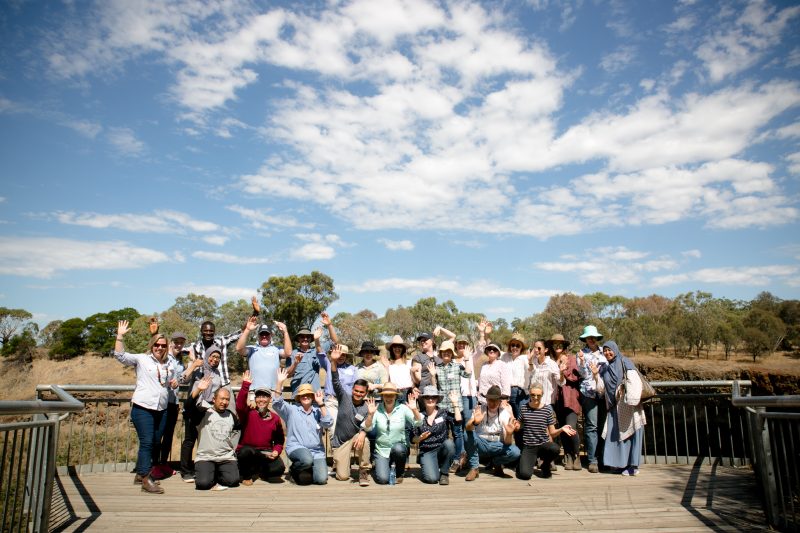
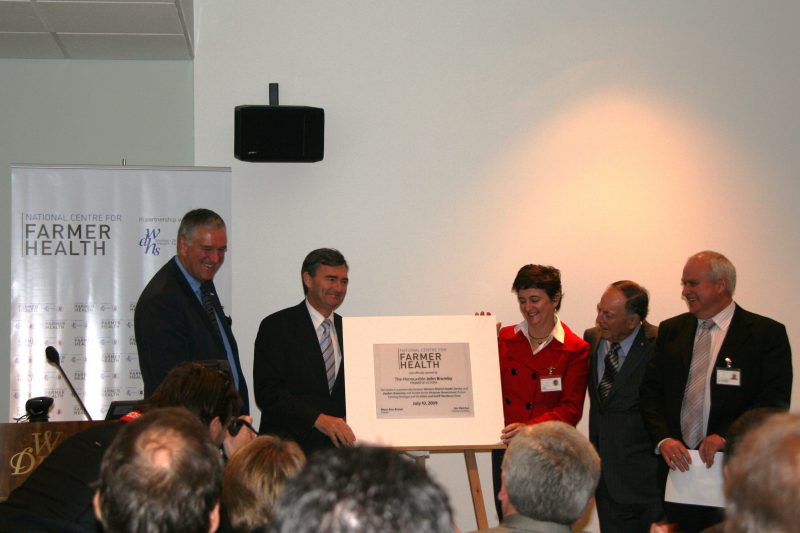
It has been 13 years since the National Centre for Farmer Health (NCFH) first opened its doors in 2008. Based in the agricultural hub of Hamilton, Victoria, the NCFH brought together two organisations focussed on service to rural and regional communities –Western District Health Service and Deakin University, with funding from the Victorian Government and the Helen and Geoff Handbury Trust.

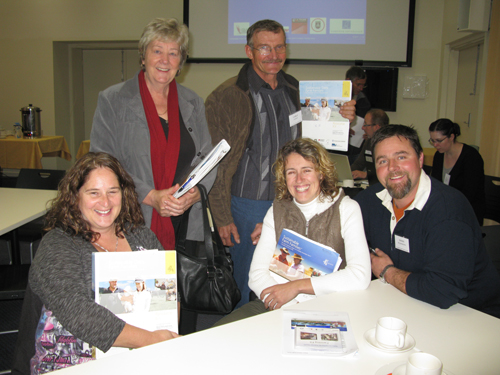
Farm women and men have long been key contributors to our rural and regional communities –their land and livestock producing the food and fibre that sustains and clothes us. Surprisingly, the number of farmers supporting this vision has remained surprisingly few with around 335,000 people directly employed in agriculture, forestry or fishing representing less than 3% of Australia’s workforce.[i] When the NCFH opened we were well into what became known as the millennium drought, with all of regional Victoria and parts of the nation declared in Exceptional Circumstances[ii].
Apart from challenging climatic conditions, agriculture, forestry and fishing had the unenviable record of a high risk workforce with high numbers of workplace deaths, including bystanders and children[iii]. My own personal experience of both working on farm and in rural health had highlighted to me the disparity of rural people (farming and agricultural workers in particular) to have voice in relation to their health, wellbeing and safety. It also became abundantly clear that to make any difference to farmer health, wellbeing and safety we could not rely solely on health services, and health professionals. To make a difference required a multipronged, cross sectoral and policy driven approach.
Over the 13 years the NCFH has helped and worked with many individual farm men, women and agricultural workers. We have provided thousands of health, wellbeing and safety assessments, detected early cancers, cardiac arrhythmias, mental health problems, respiratory illness, kidney disease and diabetes to name a few. We have undertaken significant research on cardiovascular disease, wellbeing, mental health, suicide, hearing loss, obesity and pesticides in farming communities and supported higher degree by research students. We have published widely[iv] and worked to translate these findings into new and better ways of working with farming communities. For 13 consecutive years we have taught Australia’s only Graduate Certificate in Agricultural Health and Medicine providing well over 200 health professionals with new skills and knowledge to assist with working in agricultural communities[v]. Our partnerships have been extensive collaborating across sectors of industry and agribusiness and across the nation. We have contributed to policy by participating in numerous reviews, parliamentary inquiries, quad bike standards, advertising standards and Royal Commissions.
Have we made a difference?
I believe so. There are many individual stories outlining the difference NCFH has made to individual and families lives. Stories telling of farm families getting off farm, making healthier food choices, increasing physical activity, improving safety, following up with medical appointments, changing pesticide use, utilising PPE, purchasing safer equipment and reducing their stress.[vi] Past students report improvements in their engagement with farmers and the insights and deeper understanding of health, wellbeing and safety issues that affect farmers. Pleasingly in 2020, a 39% decrease in fatality rates in agriculture, forestry and fishing since the peak in 2007 was reported by Safework.[vii] However, there is still much to do.
Whilst droughts, bushfire and floods will continue, the COVID-19 pandemic has further reminded us of the importance and vulnerability of our food supplies as never before has the world relied on so few to produce food and fibre for so many. Addressing and adapting to the impacts of environmental change with sustainable agricultural practices and food systems will require new and improved ways of doing things. Good health, wellbeing and safety of farmers and their families are fundamental to having successful and sustainable farm businesses and to build resilience to address the challenges of climatic, environmental and global change.
[i] Australian Bureau of Statistics (2011). Labour Force Survey. Canberra, ABS.
[ii] Department of Agriculture Fisheries and Forestry. (2007). The Year in Review 2006-2007. Retrieved December 28, 2010, from http://www.daff.gov.au/agriculture-food/drought/ec/nrac/nrac_2006-07_annual_report/the_year_in_review
[iii] Safe Work Australia. (2012). Work-related traumatic injury fatalities, Australia 2010-2011. Canberra: Safe
Work Australia.
[iv] https://farmerhealth.org.au/category/publications
[v] https://farmerhealth.org.au/education
[vi] https://farmerhealth.org.au/sustainable-farm-families-3/1618-2
[vii] Safe Work Australia (2020). Work-related Traumatic Injury Fatalities, Australia 2019, Safe Work Australia
Episode 5: “Strengthening your support team: Rural Financial Counselling Service”
In this episode, Malcolm Rowe from the Rural Financial Counselling Service in Western Victoria, and Peter, a primary producer client of RFCS from the Wimmera district discuss how engaging with an RFCS counsellor can help you to reduce financial stress and be more in control of your farm business through timely, evidence-based decision making.
Now streaming on Spotify, Apple Podcasts and here.
This podcast is part of the Primary Producer Knowledge Network led by the National Centre for Farmer Health to promote mentally healthy workplaces. Campfire, part of the Primary Producer Knowledge Network, was funded by the Victorian State Government’s WorkSafe WorkWell Mental Health Improvement Fund.
Farmers: you can get financial help, before the situation becomes dire
This topic will be discussed as part of our online bonfire on August 25 at 7:30pm, “Strengthening Your Support Team: Rural Financial Counselling Service.”
Fruit growers have been hit by labour shortages under Covid-19 as well as a rise in several input costs. After a stressful and mentally challenging 2020 citrus harvest, Michael listened to the advice of a friend, who convinced him to talk to a rural financial counsellor. Now, the current harvest season is looking very different and their mental health is back on track.
Agriculture is booming in Australia; cattle prices have skyrocketed, the drought has broken and even the price of wool has picked up. But for citrus growers like Michael, who is based near Mildura, the past two years have been incredibly tough.
While the impact of COVID-19 on agriculture has been relatively minimal for other farming industries, fruit growers have been struck with severe labour shortages as well as a rise in the cost of diesel, fertiliser and packing materials.
Michael would normally have a stream of backpackers to pick oranges at harvest time, and despite the Federal Government’s efforts to bring in Pacific Island workers to help, there’s still not enough pickers to go around.
“Last year, we did our best with the staff we had, but we couldn’t get all the fruit off the trees quick enough, which meant oranges was simply left to rot,” Michael said.
“We ended up making a substantial loss. I’ve been growing fruit for 15 years and while I have broken even a few times before, that’s the first time I’ve ever made a loss. Seeing the piles of wasted fruit, was just heartbreaking. We were anxious for what the next season would bring, and wondering if we would be able to pull through. Managing the farm and dealing with labour shortages, let alone during a pandemic, took a serious toll on our mental health.” he said.
So, at the start of 2021, when it was becoming clear that Covid-19 was not going away, Michael decided he would take action to prevent some of the stress of the previous year.
“My mate, who is also a grower, said he had spoken to a rural financial counsellor, who helped him with forward budgeting,” he said.
“My initial thought was, no, I don’t need that, I’ve been running a successful business for years before COVID, it’s not for me. But I got over my pride and it’s been the best thing I could have done.”
A local counsellor from the Rural Financial Counselling Service Victoria helped Michael and his family to plan ahead, factoring in the increase in input costs, as well as the high likelihood of another harvest labour shortage. They also helped him to apply for government grants.
Ultimately this alleviated much of the stress Michael had been feeling about having a lack of control over his business during the pandemic, as well as the uncertainty over how to make organisational changes in the workplace, to deal with yet another difficult season. Worksafe Victoria has identified these as workplace factors which can contribute to poor mental health – and has more information on ways to improve stress in the workplace here.
Michael says speaking with a rural financial counsellor completely changed his mindset.
“Instead of going into harvest and just hoping for the best, I had a plan. Then I could brief the staff about how we were going to tackle this season with fewer people and how I had structured the daily tasks differently to cope.”
Michael said this also helped reduce the stress his staff were feeling, who were concerned about the impact labour shortages would have on their workload.
“We’re in full harvest swing now. And it’s always a busy time…but I have been able to set achievable targets for the staff and the business as a whole, which has actually helped to increase productivity.”
While Michael says this season certainly won’t be his best year, the business will be able to get through this difficult time, with a small profit.
The Rural Financial Counselling Service is a free, independent and confidential service operating across Victoria (with similar services in other states).
“When you call the RFCS, you’ll get a counsellor who lives and works locally and is a specialist in local conditions,” Wayne Stephen, Senior Business Financial Counsellor at the RFCS said.
Wayne Stephen said the aim is to get the farmer to a better place.
“A better place could be a better asset to liability ratio, a better production system, a better succession plan, a better relationship with banks and creditors, a better relationship with family members, and a better relationship with yourself,” he said.
Michael says he is certainly a lot happier, less stressed and feeling optimistic about the future.
“I can’t control what happens with Covid-19, but I now have control over my business again.”
When it comes to running the family farm, investing in ways of working that support goodmental health is not only good for your family and staff, but it’s good for business too.
The NCFH is supporting farmers just like you to manage and respond to work-related risks that impact on workplace mental health – these are factors in your work that can affect an employee’s mental health and include high job demands, low job control, low role clarity and more. Managing these factors, means decreasing the risk of work-related stress, which can prevent physical injury, mental injury or even both at the same time.
Find out more about being mentally safe on the farm at www.farmerhealth.org.au/campfire.
This blog is part of the Primary Producer Knowledge Network led by the National Centre for Farmer Health to promote mentally healthy workplaces. Campfire, part of The Primary Producer Knowledge Network, is funded by the Victorian State Governments WorkSafe WorkWell Mental Health Improvement Fund.
Join the online bonfire session, “Strengthening Your Support Team: Rural Financial Counselling Service” on August 25 to hear more from Financial Counsellor Malcolm Rowe about his recommendations and strategies for a mentally healthy workplace, and how the RFCS can work with you to prevent work-related stress.
*Primary producers featuring in this blog are fictional, but based on research interviews with farmers, and developed with the assistance of the National Centre for Farmer Health